English
 Arabic
 French
 Spanish
 Portuguese
 Deutsch
 Turkish
 Dutch
Dutch
 Italiano
 Russian
 Romaian
 Portuguese (Brazil)
 Greek
Greek
Why Integrated Safe Systems of Work Are Transforming Industrial Safety
Other |
2026-07-07 12:56:41
 Advertise With Us
 About Us
 Terms And Conditions
 Privacy Policy
Ver Todo
Privacy Policy
Ver Todo

Upgrade to Pro
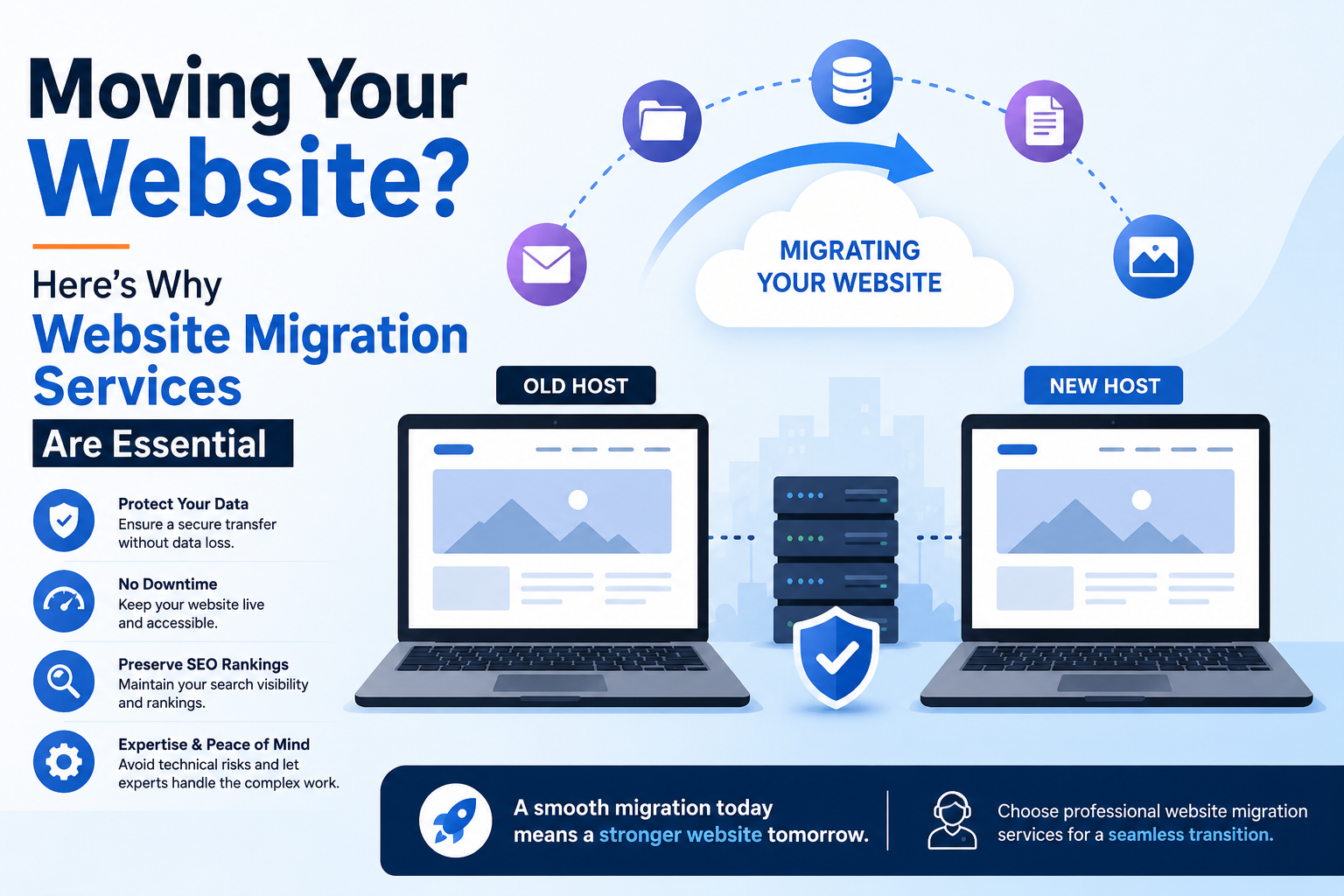
Changing your website is one of the most significant technical events an online business can go through. Whether you are moving to a new domain, switching platforms, redesigning your site structure, or shifting from HTTP to HTTPS, every change carries real risk. Rankings that took months or years to build can disappear within days of a poorly executed migration. Traffic can collapse. Revenue can drop. And in many cases, the damage is not immediately visible. It appears gradually over weeks as search engines process the changes and realize something has gone wrong.
This is not a reason to avoid website migrations. Redesigns, platform upgrades, and domain changes are often necessary and strategically correct. The reason to take them seriously is that the outcome of a migration is almost entirely determined by how it is planned and executed, not by the migration itself. Businesses that treat website migration as a purely technical project managed by a developer alone consistently see worse outcomes than those who bring qualified SEO expertise into the process from the beginning.
Search engines index your website as a specific set of URLs. Each URL that earns a ranking position has accumulated a history of signals: backlinks pointing to it, user behavior data associated with it, internal link authority flowing through it, and crawl patterns built around it. When a migration changes URLs, restructures the site, or moves the domain entirely, all of that accumulated history has to be transferred correctly or it is lost.
The most common point of failure is redirect implementation. A 301 redirect tells search engines that a page has permanently moved and instructs them to transfer the ranking signals associated with the old URL to the new one. When redirects are missing, incorrect, or implemented as temporary 302 redirects instead of permanent 301s, those signals do not transfer. Pages that were ranking for valuable queries simply stop ranking because search engines cannot find or connect them to the new version of the site.
Other frequent migration failures include broken internal links that orphan important pages from the rest of the site, canonical tag errors that cause the wrong version of a page to be indexed, XML sitemap updates that are delayed or incomplete, and page title or meta description changes that happen without any assessment of their ranking impact. Each of these issues compounds the others. A migration that has multiple simultaneous errors can produce dramatic and fast traffic losses that are difficult to diagnose and slow to recover from.
A qualified website migration service is not a single action. It is a structured process that runs from pre-migration planning through post-migration monitoring. Each stage has specific deliverables that protect the organic search performance of the site throughout the transition.
The pre-migration audit is where most of the protective work happens. This involves crawling the existing site to capture a complete inventory of all indexed URLs, current rankings, inbound links, page performance data, and technical configurations. This snapshot becomes the benchmark against which the post-migration site is compared. Without it, there is no way to know what was lost or changed during the migration.
Redirect mapping is the most labor-intensive part of a professional migration. Every URL that will change or be removed needs a correctly configured redirect pointing to the most relevant equivalent page on the new site. For large sites with thousands of URLs, this is a significant undertaking. For sites with complex parameter-based URLs, faceted navigation, or multilingual content, it requires both technical knowledge and SEO judgment to implement correctly.
Platform-specific configuration covers everything from robots.txt files and sitemap generation to server response codes and canonicalization settings. Different CMS platforms handle these differently. A website migration service that has worked across multiple platforms brings this knowledge directly to the implementation, reducing the risk of configuration errors that a platform-unfamiliar developer would not anticipate.
Post-migration monitoring is what distinguishes a thorough migration from a completed one. The first four to six weeks after a migration launch are critical. Search engines recrawl and reindex the new site during this period. Ranking fluctuations are normal. Errors that were not caught in testing often surface at this stage. Active monitoring of crawl errors, ranking movements, organic traffic patterns, and redirect performance allows problems to be identified and resolved quickly before they produce lasting damage.
A website migration done well is also an opportunity, not just a risk to be managed. The process of auditing an existing site before migration frequently uncovers long-standing technical issues, underperforming pages, content gaps, and structural problems that have been quietly suppressing rankings for years. A migration handled by a best seo agency treats these discoveries as opportunities for improvement rather than simply replicating the old structure in a new environment.
This is also the moment when businesses can reconsider their digital presence more broadly. If your current domain does not reflect your brand clearly, a migration to a better domain is the right time to make that change. If your site architecture has grown organically over years into something confusing for both users and search engines, a migration provides the structural reset needed to fix it properly.
For individuals and smaller operators, the concept of being discoverable across Google's full suite of surfaces, including the ability to add me in search through Google's People Cards feature, is part of the same broader principle: your digital presence must be intentionally managed across every platform and property where your audience looks for you. A digital marketing agency that understands both technical SEO and broader discoverability brings this perspective to migration projects and uses them to strengthen overall visibility, not just preserve it.
SEO Discovery has managed hundreds of website migrations for businesses across industries ranging from ecommerce and SaaS to healthcare and legal services. Our migration process covers every stage from pre-launch audit to post-migration recovery monitoring, ensuring that your rankings and traffic are protected throughout the transition. Contact us today to speak with our technical SEO team and get a free migration readiness assessment before you make any changes to your site.
A website migration is not something to approach with confidence alone. It requires a systematic, documented process managed by people who understand both the technical requirements and the SEO consequences of every decision made during the transition. The businesses that come through migrations without ranking losses are the ones that planned every step in advance. The ones that suffer are usually the ones that did not know what they did not know.