English
 Arabic
 French
 Spanish
 Portuguese
 Deutsch
 Turkish
 Dutch
Dutch
 Italiano
 Russian
 Romaian
 Portuguese (Brazil)
 Greek
Greek
Washing Tablet Market Growth Driven by Convenient Cleaning Formats
Other |
2026-08-08 07:24:49
 Advertise With Us
 About Us
 Terms And Conditions
 Datenschutzbestimmungen
Alle anzeigen
Datenschutzbestimmungen
Alle anzeigen

Upgrade auf Pro
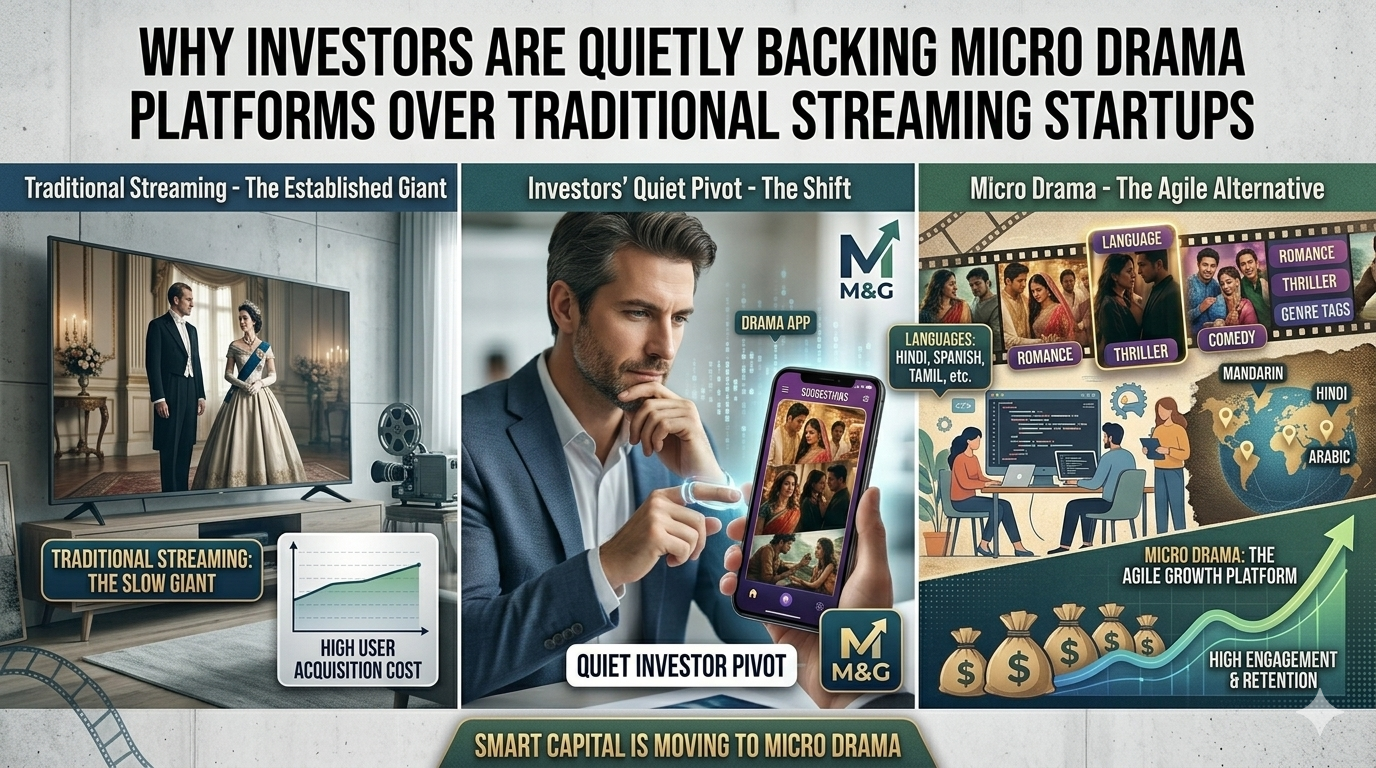
For years, streaming was considered one of the most capital-intensive and risky bets in digital media. The numbers told a brutal story — billions spent on content, years of losses, and a race to scale that only the largest players could sustain. Netflix, Disney, and Amazon could absorb those costs. Everyone else struggled.
That calculus is changing. A new category of streaming business is attracting serious investor attention — and it operates on economics that look nothing like traditional streaming. Micro drama platforms are pulling capital away from conventional streaming startups, and the investors making these moves are not doing it quietly out of speculation. They are following the data.
This article breaks down exactly why micro drama platforms have become the preferred bet for investors who understand digital media — and what it means for businesses considering entering this space.
To understand why micro drama is winning investor interest, it helps to understand what made traditional streaming such a difficult investment in the first place.
The core problem is the content cost structure. A single season of a premium drama series on a traditional streaming platform can cost anywhere from ten million to over a hundred million dollars to produce. Before a single subscriber signs up, the platform has already committed to enormous fixed costs with no guarantee of audience uptake. The content either works or it does not — and if it does not, that capital is gone.
Distribution compounds the problem. Building an audience on a traditional streaming platform requires competing against Netflix, Disney Plus, Apple TV Plus, and Amazon — all of whom are spending at a scale that independent platforms cannot match. Customer acquisition costs are high, churn is persistent, and the path to profitability requires a library so large that most independent platforms never get there.
Investors learned this lesson the hard way through a long list of streaming casualties. Quibi raised nearly two billion dollars and shut down in under a year. Numerous regional streaming platforms have come and gone without ever finding a sustainable business model. The space became known for burning capital rather than generating returns.
Micro drama platforms operate on a fundamentally different economic model — and that difference is what is attracting investor attention.
Content production costs are dramatically lower. A micro drama episode runs between one and five minutes and can be produced for a fraction of the cost of traditional television. Entire series — twenty to thirty episodes — can be produced on budgets that would not cover a single day of shooting on a premium streaming drama. This changes the risk profile of content investment entirely. Instead of betting tens of millions on a single title, a micro drama platform can spread that same budget across dozens of series, significantly reducing the downside of any individual piece of content underperforming.
The monetization model is equally compelling. The coin and credit system used by leading micro drama platforms generates revenue that is directly tied to engagement rather than passive subscription retention. When a viewer is invested in a storyline, they will unlock the next episode without hesitation — and that impulse purchase behavior drives per-user revenue that consistently outperforms subscription-only models. Platforms that combine coin systems with subscription tiers create multiple revenue streams that are resilient across different user segments.
The result is a business model with lower upfront capital requirements, faster paths to revenue, and unit economics that make sense at smaller scale. For investors, this is a genuinely different risk-reward profile compared to traditional streaming.
Investors follow performance, and the performance data coming out of micro drama platforms is hard to ignore.
ReelShort broke into the top entertainment apps in the United States within two years of launch — in a market dominated by platforms with decades of head start and billions in content budgets. DramaBox reported revenues in the hundreds of millions of dollars annually, driven almost entirely by in-app purchases from a user base that was acquired at relatively low cost compared to traditional streaming.
Engagement metrics are equally strong. Session lengths on micro drama platforms consistently exceed those of traditional short-form video apps. Users who are mid-series will open the app multiple times per day. Retention curves — the percentage of users still active after 30, 60, and 90 days — outperform most mobile entertainment categories.
These numbers are not projections. They are documented results from platforms that have already reached scale. For investors evaluating where to allocate capital in digital media, micro drama has moved from an interesting experiment to a proven model.
Beyond the unit economics, investors are paying close attention to market timing — and the current window is unusually attractive.
The micro drama format has been validated in the United States and East Asian markets. The audience behavior is proven, the monetization mechanics work, and the content production ecosystem is developing rapidly. But the vast majority of the global market remains unaddressed.
Regional language markets across South Asia, Southeast Asia, the Middle East, and Latin America represent billions of potential users who have no dedicated micro drama platform serving them in their language and cultural context. These markets have high mobile penetration, strong appetite for drama content, and almost no competition in the micro drama format.
Investors who back regional micro drama platforms today are getting in at the equivalent of backing a streaming platform before the market consolidates — with the added advantage of a proven business model reducing the format risk that early streaming investors had to absorb.
The businesses building in this space right now — whether through custom vertical micro drama app development or through white-label frameworks — are establishing content libraries, creator relationships, and user bases that will be extremely difficult for later entrants to displace.
Understanding why investors are backing micro drama is one thing. Understanding what specifically makes a micro drama platform investable is another.
The platforms attracting the most serious capital share several characteristics. They have a clear regional or demographic focus rather than trying to compete globally from day one. They have a content strategy built around original series rather than licensed or aggregated content. They have monetization built into the product architecture from launch, not added later. And they have a technology foundation that can scale without requiring proportional increases in engineering cost.
That last point matters more than most founders realize. A platform built on the right technical foundation can handle ten times the users at a fraction of the incremental cost of a poorly architected system. Investors who have seen streaming platforms fail understand this — and they scrutinize the technology decisions as carefully as the content strategy.
Platforms that launch with a proven DramaBox clone framework as their technical foundation are often better positioned in investor conversations than those that built from scratch without streaming-specific expertise. The white-label approach signals capital efficiency — a team that made a smart build-versus-buy decision rather than spending months reinventing infrastructure that already exists.
There is a comparison that serious investors in this space keep returning to — micro drama in 2026 looks a lot like short-form video in 2018.
In 2018, TikTok was still a relatively unknown platform outside of China. Investors who recognized what vertical short-form video would become and backed the infrastructure, tools, and adjacent businesses around it generated extraordinary returns. Those who waited for the format to fully mature paid multiples they could not justify.
Micro drama is not identical to short-form video — the business models are different, the content is more structured, and the monetization is more direct. But the pattern of a new mobile-first content format proving itself in one market before expanding globally, with a window of opportunity before consolidation, is strikingly similar.
The investors making quiet bets on micro drama platforms right now are not doing so blindly. They are making a calculated decision that the format is proven, the market is large, and the window for capturing significant market share at reasonable valuations will not stay open much longer.
If you are a business considering entering the micro drama market, the investor interest in this space is a signal worth paying attention to — not because raising capital should be your primary motivation, but because sophisticated investors moving into a category is one of the strongest validations that the underlying business model is sound.
The economics that make micro drama attractive to investors are the same economics that make it an attractive business to operate. Lower content costs, stronger monetization, proven audience behavior, and large unaddressed markets are advantages that benefit operators and investors equally.
The businesses that move now — building on the right technology foundation, with a focused content strategy and a clear regional or demographic target — are the ones that will be in the strongest position whether they are building to scale independently or building toward an acquisition or investment event.
Exploring vertical micro drama app development with a partner who understands the specific technical and business requirements of the format is the right starting point. The market is open. The model is proven. The investor interest confirms what the user data already showed — micro drama is not a passing trend. It is where streaming is going.