English
 Arabic
 French
 Spanish
 Portuguese
 Deutsch
 Turkish
 Dutch
Dutch
 Italiano
 Russian
 Romaian
 Portuguese (Brazil)
 Greek
Greek
The Perfect Blend of Style Comfor and Everyday
Other |
2026-07-11 12:09:08
 Advertise With Us
 About Us
 Terms And Conditions
 Datenschutzbestimmungen
Alle anzeigen
Datenschutzbestimmungen
Alle anzeigen

Upgrade auf Pro
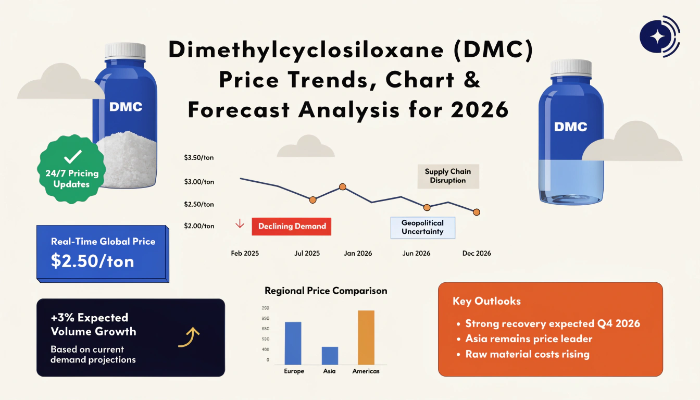
Dimethylcyclosiloxane (DMC) Prices in Q2 2026 showed a wide regional spread, ranging from USD 2,151/MT in China to USD 3,424/MT in Germany. The available Q2 dataset indicates substantial differences in regional production economics, downstream silicone demand, feedstock costs, and logistics. The Dimethylcyclosiloxane (DMC) price trend cannot be classified with a verified percentage increase or decrease because the supplied data contains Q2 values but no Q1 benchmark. A quarter-on-quarter percentage would therefore require unsupported assumptions. Procurement teams can use DMC Price History to compare historical benchmarks. The Q2 figures presented here are based on IMARC Group's Q2 2026 price-tracking database and methodology, providing a consistent reference for buyers and analysts.
Dimethylcyclosiloxane (DMC) Prices Q2 2026: Regional Price Snapshot
The Q2 spread indicates notable regional cost differences. Germany recorded the highest assessed price at USD 3424/MT, while China was lowest at USD 2151/MT, creating a USD 1273/MT gap. Canada and the United States occupied the higher-middle range, while India remained closer to the lower end. The spread may reflect differences in silicone-chain demand, feedstock economics, production availability, freight, energy costs, and regional trade exposure.
Q2 2026 Price Analysis: How Do Regional DMC Prices Compare?
North America: USA And Canada Price Outlook
The United States recorded USD 2815/MT, while Canada stood at USD 3118/MT in Q2 2026. No Q1 values were supplied, so a verified quarterly direction cannot be assigned. Both markets are supported by demand from silicone polymers, sealants, personal care, automotive, electronics, and industrial applications. Regional production costs, energy prices, and cross-border logistics can influence procurement differences.
Asia-Pacific: China And India Price Comparison
China recorded USD 2151/MT, the lowest benchmark in the supplied dataset, while India was assessed at USD 2345/MT. The lower Chinese benchmark may indicate comparatively competitive production economics and strong regional manufacturing capacity. India's pricing reflects domestic demand, import requirements, freight, and availability. Japan was listed in the requested regional grouping, but no verified Q2 2026 value was provided, so no price or trend direction is assigned.
Germany Price Benchmark
Germany recorded USD 3424/MT, the highest reported Q2 value. The premium relative to China may reflect differences in production and energy costs, regional operating expenses, logistics, and downstream demand. Although Germany was not included in the requested country-grouping structure, its verified Q2 value is included because it forms part of the supplied dataset. No unsupported Europe-wide assessment is made.
Supply And Demand Overview – Q2 2026
Supply conditions for DMC were influenced by production availability, feedstock economics, plant operating rates, and logistics. On the demand side, consumption is closely linked to the broader silicone value chain, including elastomers, sealants, adhesives, coatings, personal care ingredients, and industrial products. The large gap between China and Germany highlights how regional manufacturing costs and supply-chain structures can affect procurement prices. Buyers should monitor plant maintenance, raw-material availability, inventory levels, and downstream silicone demand when evaluating supplier quotations.
Dimethylcyclosiloxane (DMC) Price Index & Historical Analysis: What Does Q2 Show?
The Dimethylcyclosiloxane (DMC) Price Index for Q2 2026 can be evaluated through the five reported regional benchmarks, which ranged from USD 2151/MT in China to USD 3424/MT in Germany. However, the supplied dataset does not provide a Q1 index value or percentage movement. Consequently, a precise quarter-on-quarter index change cannot be calculated reliably. For historical benchmarking, buyers should compare identical product specifications, delivery terms, locations, and assessment periods. This approach provides a more meaningful view of price movement than comparing isolated regional quotations.
Dimethylcyclosiloxane (DMC) Price Forecast 2026: What Could Happen Over The Next 12 Months?
The next 12 months will likely depend on silicone-sector demand, feedstock costs, energy prices, plant utilization, freight, and regional inventory levels. Strong demand from construction, automotive, electronics, healthcare, personal care, and industrial silicone applications could support pricing. Conversely, improved production availability or weaker downstream consumption could limit upward pressure. The Dimethylcyclosiloxane (DMC) Prices outlook should therefore be assessed alongside supplier availability and regional cost conditions. Buyers should also monitor upstream chlorosilane and silicon-related economics when preparing forward procurement plans.
Key Factors Affecting DMC Prices Quarterly: What Should Buyers Monitor?
What Is Dimethylcyclosiloxane (DMC) And Where Is It Used?
Dimethylcyclosiloxane, commonly abbreviated as DMC, is a cyclic silicone intermediate used in the production of silicone-based materials. It serves as an important feedstock for silicone polymers and related products used in sealants, adhesives, elastomers, coatings, personal care, electrical applications, and industrial formulations. Its commercial value is influenced by upstream feedstock availability, manufacturing capacity, energy costs, product specifications, and demand from downstream silicone industries.
Recent Developments in Q2 2026: What Changed for Buyers?
The strongest Q2 observation was the substantial regional pricing gap. Germany recorded USD 3424/MT, compared with USD 2151/MT in China, producing a USD 1273/MT difference. Canada and the United States were assessed at USD 3118/MT and USD 2815/MT, respectively, while India stood at USD 2345/MT. No verified capacity expansion, major supplier announcement, plant shutdown, or specific trade-policy development was included in the supplied Q2 dataset. Procurement teams should therefore focus on monitoring capacity utilization, feedstock costs, freight, inventories, and downstream silicone demand.
FAQs About Dimethylcyclosiloxane (DMC) Price Index 2026:
What Is the Dimethylcyclosiloxane (DMC) Price Index In Q2 2026?
The Q2 regional benchmarks ranged from USD 2151/MT in China to USD 3424/MT in Germany. The supplied data does not include a single global index value or Q1 percentage change, so these five regional assessments provide the verified Q2 reference points.
Where Can I Find A Dimethylcyclosiloxane (DMC) Price Chart for Q2 2026?
A Dimethylcyclosiloxane (DMC) Price Chart can be prepared using the verified Q2 values for the United States, China, Germany, India, and Canada. The comparison highlights a USD 1273/MT difference between the lowest and highest reported benchmarks.
What Is the Dimethylcyclosiloxane (DMC) Price Forecast 2026?
The outlook will depend mainly on silicone demand, feedstock and energy costs, plant utilization, freight, inventories, and trade flows. Strong downstream consumption may support prices, while improved availability or weaker demand could reduce upward pressure.
How IMARC Helps Buyers Track DMC Prices
IMARC Group provides structured pricing intelligence covering regional benchmarks, historical analysis, and forward-looking assessments. Q2 2026 data shows a significant geographic spread, led by Germany and followed by Canada, while China recorded the lowest benchmark. These differences can help procurement teams evaluate supplier quotations and sourcing options more effectively. Over the next year, silicone demand, feedstock economics, production availability, and logistics will remain key indicators for future price direction.
Explore pricing intelligence across 500+ commodities: https://www.imarcgroup.com/pricing-intelligence
Contact Us:
IMARC Group
134 N 4th St., Brooklyn, NY 11249, USA
Email: sales[@]imarcgroup.com
Tel No:(D) +91 120 433 0800
United States: +1-201971-6302