English
 Arabic
 French
 Spanish
 Portuguese
 Deutsch
 Turkish
 Dutch
Dutch
 Italiano
 Russian
 Romaian
 Portuguese (Brazil)
 Greek
Greek
Trapstar in Italia: Felpa, Tuta e lo Stile Streetwear che Conquista il Paese
Shopping |
2026-06-20 10:52:02
 Advertise With Us
 About Us
 Terms And Conditions
 Política de Privacidade
Ver Todos
Política de Privacidade
Ver Todos

Atualize para o Pro
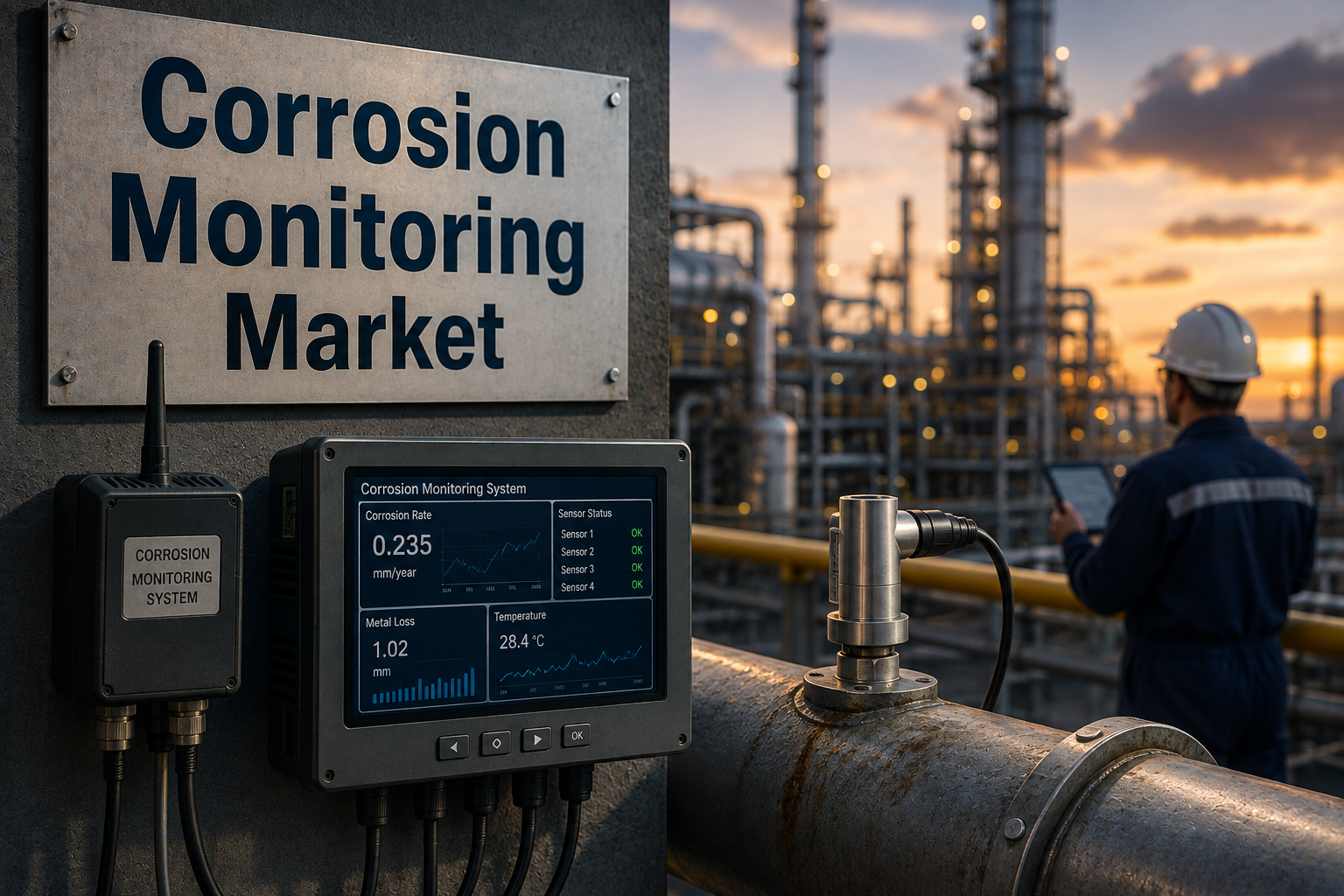
Corrosion monitoring technologies help industrial operators track material degradation and assess the condition of critical assets such as pipelines, vessels, storage tanks, boilers, and process equipment. These solutions provide information about corrosion rates, wall thickness, temperature, and related process conditions, supporting asset integrity, maintenance planning, safety, and operational continuity across demanding industrial environments.
The Corrosion Monitoring Market was valued at US$ 5.33 billion in 2025 and is estimated to reach US$ 13.78 billion by 2034. The market is expected to register a CAGR of 11.13% during 2026-2034. Demand is being influenced by the growing importance of asset integrity, prevention of unexpected outages, and material degradation management across oil & gas, chemicals, manufacturing, power generation, and pulp and paper industries.
The Corrosion Monitoring Market is transitioning from conventional inspection practices toward more frequent, repeatable, and digitally connected monitoring. Fixed probes, ultrasonic transmitters, corrosion coupons, electrical resistance probes, and digital platforms are increasingly supporting operators seeking more timely information about asset conditions. These developments can help organizations identify corrosion-related risks and prioritize maintenance activities.
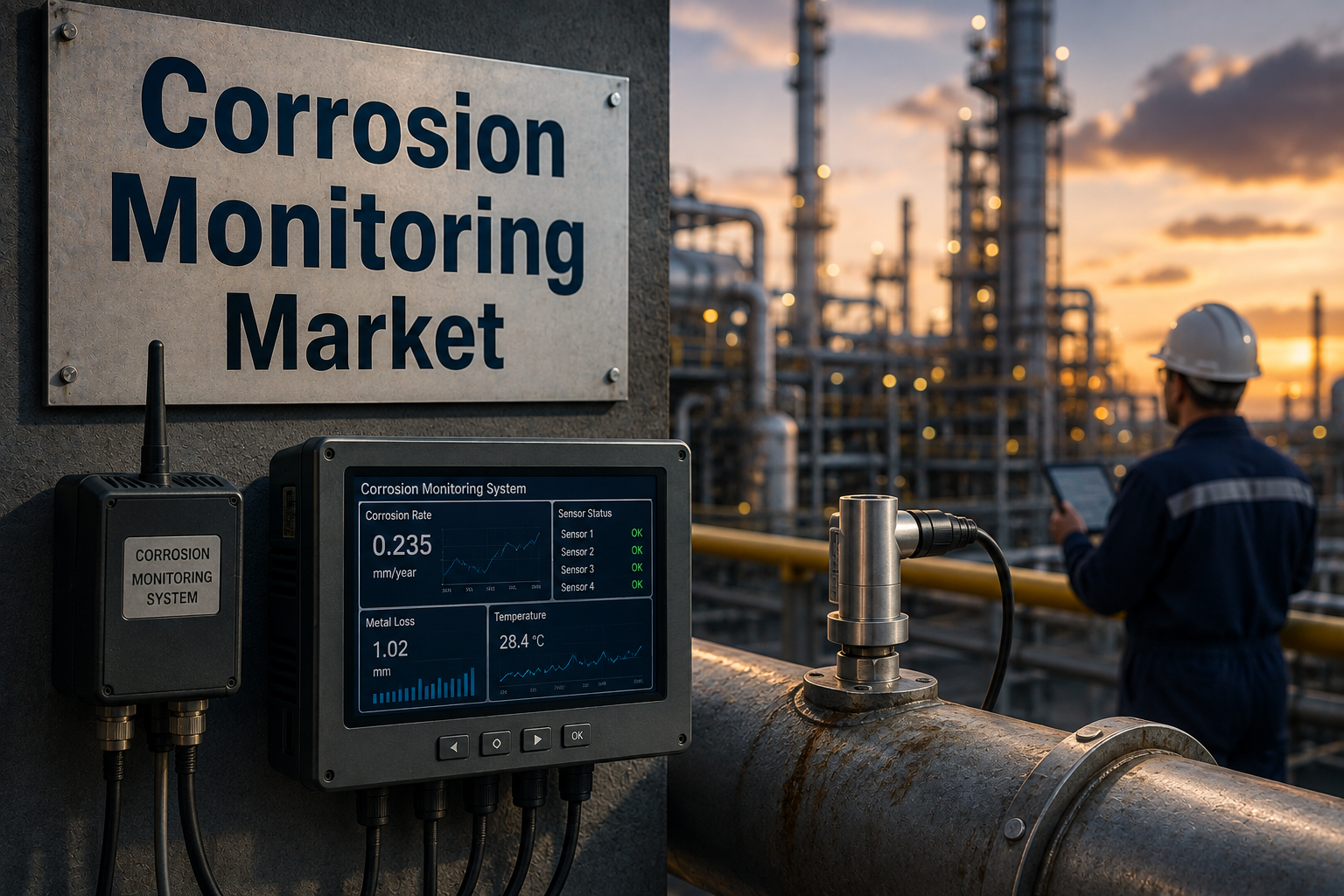
Aging pipelines and infrastructure are important factors supporting the Corrosion Monitoring Market. Oil & gas operators, refineries, chemical facilities, and power generation companies need to maintain equipment integrity while extending the operational life of existing assets. Monitoring systems can provide information needed to identify degradation and support maintenance planning before failures result in unexpected outages.
Regulatory requirements are another important growth factor. Operators increasingly need formal monitoring programs to address risks associated with leaks, emissions, personnel safety, and water contamination. Compliance requirements can encourage the adoption of technologies capable of providing reliable and repeatable corrosion information across critical equipment.
The increasing adoption of predictive maintenance and digital integrity management creates additional opportunities. Cloud-based platforms and integration of corrosion information with plant control and data systems can enable operators to combine corrosion measurements with other process variables. Hybrid approaches using intrusive and non-intrusive techniques can further support maintenance prioritization across pipelines, vessels, tanks, boilers, and process equipment.
Get a Sample PDF Report: https://www.theinsightpartners.com/sample/TIPRE00018374
The Corrosion Monitoring Market includes intrusive and non-intrusive techniques. Non-intrusive techniques accounted for approximately 56-60% of the market share in 2025 and are projected to register a CAGR of 11.4-12.0% during 2026-2034. Their ability to support monitoring without extensive plant downtime is contributing to growing interest among industrial operators.
Ultrasonic thickness measurement represented approximately 18-22% of the market in 2025 and is projected to grow at a CAGR of 13.0-13.8% through 2034. Increasing adoption of wireless ultrasonic sensors is contributing to the segment's growth by providing operators with additional options for monitoring wall thickness and identifying material degradation.
Applications span oil & gas, chemicals, manufacturing, power generation, pulp and paper, and other industries. These industries depend on reliable asset integrity programs because corrosion can affect pipelines, processing equipment, storage systems, vessels, and other infrastructure.
North America accounted for approximately 31-34% of the Corrosion Monitoring Market in 2025 and is projected to register a CAGR of 9.2-9.8% between 2026 and 2034. Growth is supported by pipeline integrity requirements, refinery upgrades, aging infrastructure, and increasing use of remote monitoring technologies.
The region is experiencing increased demand for wireless ultrasonic transmitters, corrosion coupons, and electrical resistance probes. Operators are adopting monitoring technologies to obtain more consistent asset-condition information while reducing dependence on manual inspection processes and minimizing disruption to operations.
North America's mature energy infrastructure also creates replacement and modernization opportunities. Refinery upgrades and life-extension initiatives require reliable monitoring programs that can help identify corrosion risks and support maintenance decisions.
The US represented approximately 72-76% of North American revenue in 2025 and is projected to grow at a CAGR of 9.4-10.0% during 2026-2034. Refineries, shale assets, utilities, pipelines, and other industrial infrastructure represent important application areas.
The US market is benefiting from increasing attention to pipeline integrity, aging infrastructure, refinery modernization, and remote asset monitoring. Wireless monitoring solutions can support operators seeking continuous or more frequent corrosion information while limiting the need for intrusive inspections and operational interruptions.
Industrial operators are also increasingly connecting monitoring information with broader maintenance and integrity-management programs. This trend supports demand for solutions capable of providing actionable information that can contribute to predictive maintenance and asset life-extension strategies.
Europe accounted for approximately 22-25% of the market in 2025 and is projected to grow at a CAGR of 8.4-9.1% through 2034. Germany, the UK, France, Italy, and Spain are important markets, with compliance requirements and replacement demand supporting adoption.
Asia Pacific captured approximately 27-30% share in 2025 and is projected to register a CAGR of 12.5-13.4% during 2026-2034. China, India, Japan, South Korea, and Australia are key contributors. Energy security requirements, petrochemical development, industrial expansion, and grid reliability initiatives are creating opportunities for corrosion monitoring technologies across the region.
Technology migration is transforming corrosion monitoring through the increasing use of fixed probes, wireless ultrasonic transmitters, digital platforms, and sensor-based systems. These technologies provide operators with more frequent information than conventional visual inspections and can support monitoring of high-consequence assets.
Electrical resistance and ultrasonic sensors can complement corrosion coupons by providing additional information for corrosion-rate assessment and response. Digital platforms can consolidate corrosion measurements with process information, supporting more informed maintenance decisions. Cloud-based integrity management and predictive maintenance are also emerging as important areas of technology development.
The competitive environment includes automation companies, inspection providers, corrosion specialists, testing organizations, and technology suppliers. Companies are differentiating through monitoring reliability, wireless capabilities, inspection expertise, data management, field services, and integrated asset integrity solutions.
The Corrosion Monitoring Market is projected to expand from US$ 5.33 billion in 2025 to US$ 13.78 billion by 2034, representing an increase of US$ 8.45 billion. The projected CAGR of 11.13% demonstrates the growing importance of corrosion management across asset-intensive industries.
North America held approximately 31-34% share in 2025, while Asia Pacific is expected to record the fastest regional growth. Non-intrusive techniques represented approximately 56-60% of the market, while ultrasonic thickness measurement is positioned as a high-growth segment due to increasing wireless sensor adoption.
The future of the Corrosion Monitoring Market is expected to be shaped by increasing investment in asset integrity, aging infrastructure management, regulatory compliance, and predictive maintenance. Operators are expected to continue moving toward monitoring solutions that provide frequent and actionable information while reducing operational disruption.
Wireless sensors, ultrasonic technologies, cloud-based platforms, and hybrid monitoring systems can create additional opportunities. Growing investment in energy infrastructure, petrochemicals, utilities, manufacturing, and industrial facilities across emerging regions is also expected to support demand. Integration of corrosion data with broader digital maintenance and control systems can further strengthen the role of monitoring technologies in long-term asset management.
Particle Counter Market Growth, Trends & Forecast by 2034
Grow Light Market Trends, Size & Forecast by 2034
The Insight Partners is a Insight global leader in market research, delivering comprehensive analysis and actionable insights across diverse industries. The company empowers decision-makers with data-driven intelligence to navigate evolving markets and accelerate growth.
Contact Us: