Most Oversized Gym Tops Look the Same Until You Train in Them
A relaxed gym tee can look convincing in a product photograph while behaving badly under a barbell. Studio lighting shows the silhouette, but it rarely tells you how the fabric moves when you hinge at the hips, whether the sleeve catches your upper arm during a press, or where the shoulder seam actually lands.
That distinction matters because "oversized" describes a fit, not a construction standard. A casual cotton shirt made two sizes larger is still technically oversized, but it may not work particularly well for training. A purpose-built relaxed top considers the relationship between shoulder width, sleeve length, body length, hem shape, and fabric weight.
Deadlifts expose poor construction surprisingly quickly. As you hinge forward, excess fabric moves toward the chest and stomach. A stiff straight hem can fold into a thick horizontal ridge, while a lighter fabric with a shaped hem tends to move with the torso. Bench pressing creates a different test: fabric gathers beneath the upper back and shoulders, making seam placement and material recovery much easier to notice.
The Drop Shoulder Placement — Why It's More Important Than Fit Alone
A drop shoulder works by moving the shoulder seam beyond the body's natural shoulder point. That extra room changes how the sleeve follows the upper arm. During an overhead press, the arm can travel upward without forcing a conventional shoulder seam to pull across the deltoid. During rows and pulldowns, the sleeve has more space to move backward with the arm.
But there is a limit. If the seam drops excessively toward the elbow, the sleeve can become heavy and floppy. It may also bunch underneath the arm during lateral raises. A good relaxed cut usually keeps the shoulder visibly dropped while maintaining enough sleeve control to avoid turning the shirt into a blanket.
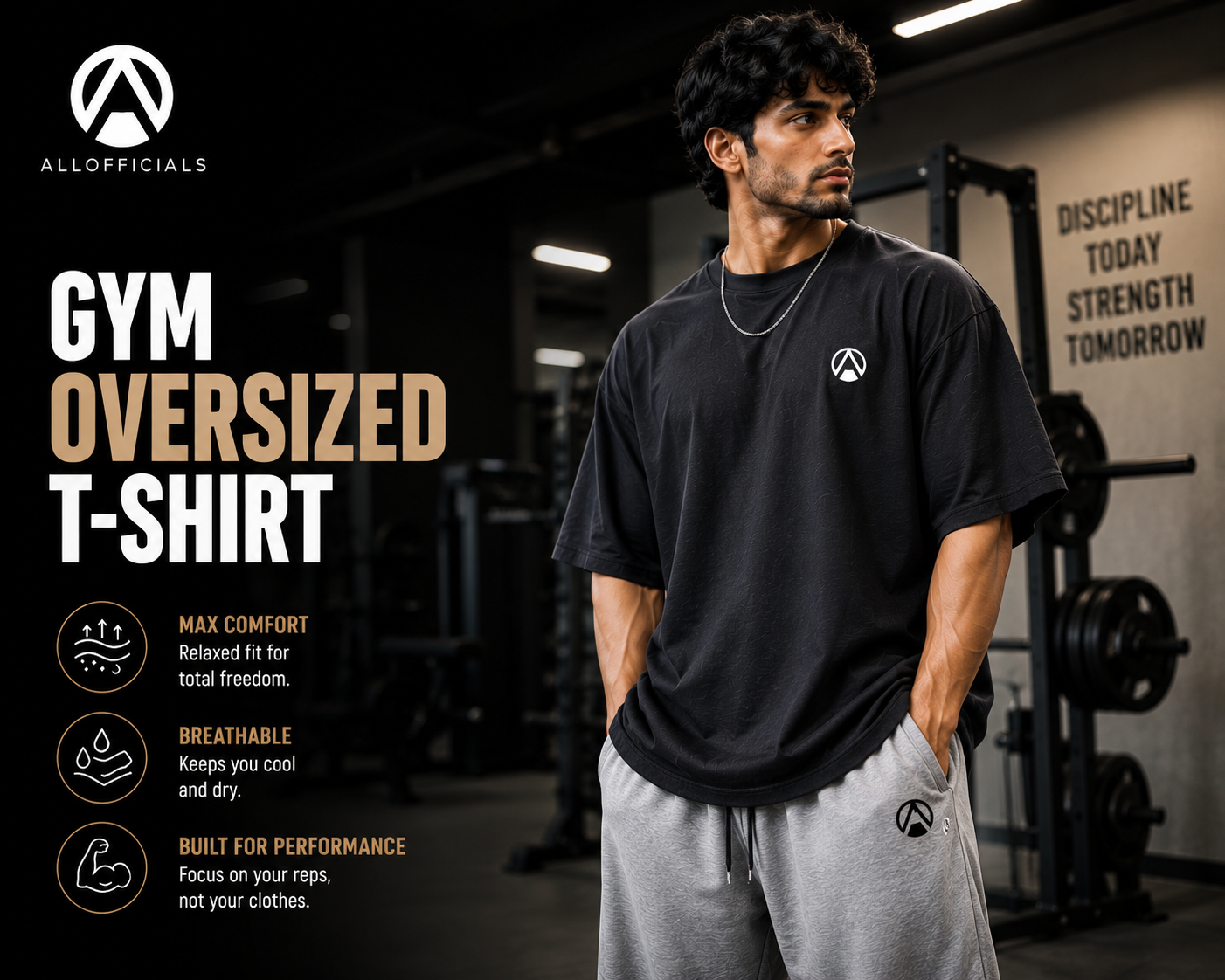
The gym oversized t-shirt range from AllOfficials is worth examining alongside other relaxed training cuts if shoulder construction is a priority.
One useful fitting test costs nothing. Stand naturally with your arms at your sides, then raise both arms overhead. Watch the shoulder seam rather than the chest. If the seam pulls sharply inward or the sleeve twists around the upper arm, the cut may be working against the movement it was supposed to accommodate.
Construction Feature Reference
| Construction Detail |
What Good Looks Like |
What's a Red Flag |
| Drop shoulder placement |
Falls naturally off shoulder point |
Pulls inward or sits on shoulder |
| Hem design |
Curved or split hem for movement |
Straight hem that bunches during squats |
| Side seam type |
Flatlock — lies flat against fabric |
Raised seam that irritates during training |
| Fabric weight |
180–220 GSM for drape + breathability |
Under 150 GSM (see-through) or over 260 GSM (heavy) |
| Fabric composition |
Poly-cotton blend or performance poly |
100% heavy cotton |
| Sleeve length |
Drops past the shoulder without restricting |
Too long (bunches) or too short (defeats purpose) |
These figures are useful reference points, not rigid rules. A 175 GSM fabric can work well if its construction and fibre blend suit the intended use, while a 220 GSM shirt can feel surprisingly warm in a poorly ventilated gym in Ahmedabad. Price also does not guarantee better construction. A ₹450 tee with sensible proportions may serve an occasional lifter better than a ₹1,200 shirt designed mainly for visual appeal.
For regular training, though, these details become more valuable because the same small problems repeat several times a week. A slightly irritating seam is easy to ignore once. After twelve sessions, it becomes the thing you notice every time you move your arm.
Fabric Weight and Drape — Why 100% Cotton Often Disappoints
Heavy cotton has an appealing feel when you first pick up the shirt. It feels substantial, hangs neatly, and often gives an oversized silhouette a strong streetwear appearance. That experience changes once sweat enters the fabric.
Cotton absorbs moisture and holds onto it. During a hard back session in a warm Mumbai gym, the area between the shoulder blades can become saturated while the rest of the shirt still feels relatively dry. The garment then gets heavier and clings to the body in places where you wanted loose movement. Once the workout ends, the damp fabric can remain uncomfortable during the ride home.
A polyester-cotton blend usually offers a more practical compromise. Cotton contributes softness and a familiar hand feel, while polyester tends to move moisture away more effectively and recover its shape after repeated wear. Performance polyester can go further, although some people dislike the smoother synthetic feel compared with cotton.
Fabric weight also changes the way a shirt drapes. Very light material can look oversized but collapse against the torso instead of holding the intended silhouette. Under strong gym lighting, thin fabric may also become more transparent when stretched across the shoulders. At the other end, very heavy material can create excellent drape while becoming unpleasant in India's hotter months.
For someone training in a well-air-conditioned Bengaluru gym for 45 minutes, a heavier fabric may not cause much trouble. A person training outdoors or in a basic non-AC facility in Lucknow during June has a different requirement. Construction should always be judged against the environment in which the garment will actually work.
One small detail deserves more attention than it gets: the inside of the side seam. Run a finger along it before buying if you can. A raised seam that feels harmless against dry skin can become surprisingly irritating once sweat and repeated arm movement add friction.
Final Thoughts
A gym oversized t-shirt works because several construction decisions cooperate. The shoulder needs to drop without becoming excessive, the sleeve needs room without turning floppy, and the hem needs enough freedom to move with the torso. Fabric weight then determines whether that shape remains comfortable once training starts.
Indian buyers also need to think beyond the first five minutes of wear. A ₹500 cotton tee may be perfectly sensible for occasional sessions or casual use. Someone training five days a week in Chennai, Mumbai, or Delhi may value moisture management and wash durability enough to justify spending more.
The best test remains movement. Raise your arms, hinge forward, rotate your shoulders, and sit into a squat. Notice where the fabric gathers. If you stop thinking about the shirt after a few minutes of training, its construction is probably doing its job. If you keep pulling at the hem or adjusting the sleeves, the oversized proportions may look better than they perform.
Frequently Asked Questions
Q: What fabric weight works best for a gym oversized tee?
A: Around 180 to 220 GSM can provide a useful balance between drape and breathability, particularly in a polyester-cotton blend or performance polyester. Very lightweight fabric may lose structure or become transparent when stretched, while very heavy fabric can retain too much heat in warm Indian gyms.
Q: Why does the drop shoulder placement matter so much in oversized gym tees?
A: The shoulder seam determines how the sleeve follows the upper arm. A seam that sits naturally beyond the shoulder point can give the arm more room during pressing and pulling movements. If it sits too close to the natural shoulder or drops excessively, it can create different movement problems.
Q: Is a curved hem actually necessary in an oversized training top?
A: Not always, but it can be useful. A curved or split hem allows the front and back panels to move more independently during squats, lunges, hinges, and other movements involving the torso. A straight hem may work perfectly well for upper-body sessions but bunch more noticeably during lower-body movements.
Q: Is a heavy cotton oversized tee bad for gym training?
A: Not automatically. Heavy cotton can work for short sessions, cooler gyms, or low-intensity workouts. The main limitation is moisture retention. In a hot Indian gym, it tends to become heavier and clingier as sweat accumulates.
Q: Does a more expensive oversized gym tee always have better construction?
A: No. Price can reflect fabric, branding, manufacturing, or design rather than better training performance. Check shoulder placement, seams, fabric composition, hem construction, and washing instructions instead of relying on price alone.
Final Thoughts
Construction matters more than the oversized label itself. A well-designed gym oversized t-shirt should give you additional room without creating unnecessary fabric, heat, or movement problems.
For Indian training conditions in 2026, the sensible choice is the one that matches your gym, workout style, climate, and washing habits. The best-looking silhouette is useful only if it still feels right halfway through the session.
 English
 Arabic
 French
 Spanish
 Portuguese
 Deutsch
 Turkish
 Dutch
Dutch
 Italiano
 Russian
 Romaian
 Portuguese (Brazil)
 Greek
Greek
 Advertise With Us
 About Us
 Terms And Conditions
 Privacy Policy
See All
Privacy Policy
See All