English
 Arabic
 French
 Spanish
 Portuguese
 Deutsch
 Turkish
 Dutch
Dutch
 Italiano
 Russian
 Romaian
 Portuguese (Brazil)
 Greek
Greek
FYP Book The Subtle Art of Not Giving a F*ck: A Counterintuitive Approach to Living a Good Life by Mark Manson
Sports |
2026-06-22 06:22:05
 Advertise With Us
 About Us
 Terms And Conditions
 سياسة الخصوصية
عرض كل النتائج
سياسة الخصوصية
عرض كل النتائج

ترقية الحساب
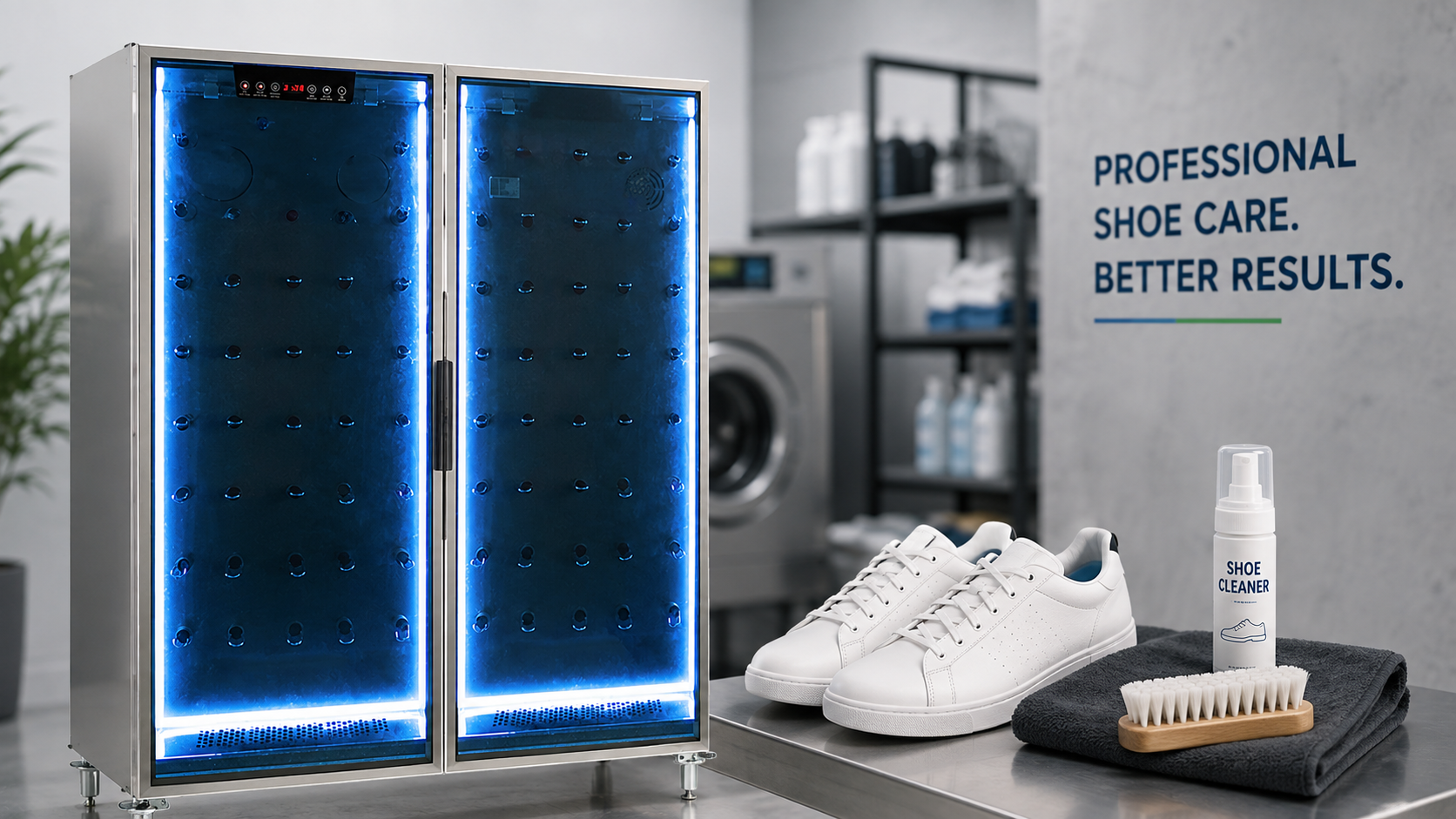
Footwear has become an important part of personal style, and customers are increasingly willing to pay to maintain premium sneakers, sports shoes, formal footwear, and other valuable pairs. For entrepreneurs and existing laundry owners, this creates an opportunity to add professional shoe care as a specialized service.
A shoe cleaning machine can help standardize parts of the cleaning process, improve productivity, and reduce dependence on completely manual washing. But buying a machine only makes business sense when there is sufficient demand, appropriate pricing, and a clear operating model.
Before investing, you should understand the machine cost, target customers, processing capacity, supporting equipment, and potential return. This guide explains the key factors you should evaluate before starting or expanding a shoe cleaning business.
A commercial shoe cleaning machine is equipment designed to support professional cleaning of footwear at a higher and more consistent volume than purely manual processing.
Depending on the machine and application, a professional shoe-care setup may involve equipment for washing, sole cleaning, stain treatment, controlled drying, sanitization, or finishing.
Unlike basic household cleaning methods, commercial equipment is selected around repeatable processing, productivity, and the types of footwear the business plans to accept.
For entrepreneurs, the objective is not simply to buy a machine. It is to create a complete shoe cleaning setup capable of delivering consistent results customers are willing to pay for.
The exact process varies according to the type of shoe washing machine and footwear being processed.
A typical professional workflow may start with shoe inspection, lace removal, dry brushing, and stain identification. Suitable footwear then goes through the appropriate cleaning process using compatible chemicals and controlled mechanical action.
After cleaning, shoes may require careful drying, reshaping, deodorizing, finishing, and final quality inspection.
Not every shoe should automatically receive the same process. Material, construction, color fastness, adhesives, decoration, and care requirements should be assessed before cleaning.
It can be, provided the business has enough demand to keep the equipment productively utilized.
The investment becomes more attractive when the machine helps the business:
Process more pairs within available working hours
Reduce repetitive manual work
Maintain a more standardized workflow
Offer shoe care alongside existing laundry services
Serve customers with premium or specialist footwear
Build repeat business from regular shoe-care requirements
The real question is therefore not simply, “Is a shoe cleaning machine worth buying?” It is whether your expected customer volume and service pricing can justify the investment.
Understanding the customer base is critical before calculating shoe cleaning business ROI.
Potential customers can include sneaker enthusiasts, office professionals, students, athletes, gym members, families, premium footwear owners and customers already using laundry or dry-cleaning services.
A business can also explore institutional opportunities such as sports academies, hostels, educational institutions and other organizations where footwear cleaning is required at greater volume.
Location matters. Areas with colleges, offices, premium residential communities, gyms and strong sneaker culture may offer different demand than purely price-sensitive markets.
Machine compatibility depends on the specific equipment and manufacturer recommendations.
Common customer categories may include sneakers, sports shoes and certain washable casual footwear. Leather, suede, embellished footwear and shoes with sensitive adhesives or construction may require specialized processes or more manual treatment.
This is why a professional shoe laundry business should classify footwear before processing rather than promise machine washing for every pair.
Material identification and operator training are just as important as the equipment itself.
There is no single shoe cleaning machine price in India because equipment can range from relatively simple cleaning systems to more specialized professional machines.
Price can vary according to processing capacity, automation level, construction quality, cleaning technology, drying capability, machine configuration, brand, installation and after-sales support.
When comparing quotations, do not evaluate only the purchase price. Ask what is included: installation, training, warranty, accessories, service and required supporting equipment.
A cheaper machine can become expensive if downtime, poor support or unsuitable capacity restricts your operation.
Your shoe cleaning business investment extends beyond the main machine.
A startup budget may need to account for premises, cleaning equipment, drying equipment, spotting tools, brushes, chemicals, racks, worktables, packaging, electrical and plumbing work, branding and initial working capital.
A small pickup-and-delivery model will have different costs from a premium retail studio.
Therefore, calculate your complete setup cost rather than treating the shoe cleaning machine price as the total investment.
A professional operation may require pre-treatment tools, stain-removal products, brushes, drying equipment, shoe forms, worktables, storage racks and finishing accessories.
The exact combination depends on the services you plan to provide.
For example, a business focused mainly on everyday sneakers may have a different equipment requirement from one handling premium leather, suede and restoration work.
Build your equipment list around your service menu rather than buying every available machine at the beginning.
Daily processing capacity cannot be determined by machine capacity alone.
You need to consider cleaning cycle time, number of pairs per cycle, inspection, pre-treatment, drying time, finishing, operator availability and working hours.
For example, if washing is fast but drying becomes a bottleneck, increasing washing capacity will not proportionally increase daily output.
Calculate capacity across the entire shoe-care workflow before deciding which machine size your business needs.
Pricing depends on the local market, footwear category, service complexity and level of finishing.
Instead of setting one price for every pair, businesses can create service categories such as basic cleaning, deep cleaning, premium sneaker care, stain treatment or specialized material care.
Your price must cover more than labour and chemicals. Include rent, utilities, packaging, marketing, equipment depreciation, maintenance, rejected or reprocessed work and delivery costs where applicable.
The objective should be sustainable contribution per order—not simply the lowest local price.
A shoe cleaning business in India can be profitable when there is adequate order volume, sensible pricing and controlled operating costs.
Consider this simplified example:
If your average contribution after variable costs is ₹250 per pair and you process 20 pairs per day for 26 days:
20 × 26 = 520 pairs per month
520 × ₹250 = ₹1,30,000 monthly contribution
This is an illustration, not a profit guarantee. Fixed expenses such as rent, salaries, marketing, equipment finance and maintenance must still be deducted.
Your actual shoe cleaning business profit depends on local pricing and utilization.
A simple starting calculation is:
Payback Period = Total Investment ÷ Monthly Net Cash Contribution
Suppose the complete incremental setup costs ₹6 lakh and generates ₹50,000 in additional monthly cash contribution after relevant operating expenses.
₹6,00,000 ÷ ₹50,000 = 12 months
Real-world results will vary, so calculate ROI using conservative order volumes rather than assuming full machine utilization from day one.
Test different scenarios—low, expected and high demand—before investing.
For many established laundries, this can be an attractive route.
An existing business may already have customers, premises, staff, garment-care experience, billing systems and pickup-and-delivery infrastructure. Shoe cleaning can then become an additional service sold to the same customer base.
For example, someone already sending garments for laundry or dry cleaning can also be offered sneaker or footwear care.
This can increase revenue per customer without requiring the business to acquire every shoe-care customer from scratch.
A standalone shoe-care business can develop a specialized identity and focus heavily on sneakers, premium footwear and restoration services. However, it must independently generate enough customer traffic to support its fixed costs.
Adding shoe cleaning to an existing laundry can lower the customer-acquisition challenge because the business already has an operating base.
The better model depends on your location, existing infrastructure, investment capacity and target market.
For a new entrepreneur, demand validation should happen before committing to a larger standalone setup.
Evaluate the machine according to the footwear you expect to process, realistic daily order volume and complete workflow.
Check usable capacity, cycle time, material compatibility, utility requirements, space requirements, operator training, cleaning process, maintenance needs, spare-parts availability, warranty and after-sales service.
Most importantly, ask the supplier to explain what the machine can and cannot safely process.
Buying more capacity than your market needs can lock capital into an underutilized asset.
One common mistake is purchasing equipment before validating local demand. Others include accepting every footwear material without inspection, underpricing difficult jobs, ignoring drying capacity and assuming that the machine eliminates the need for skilled handling.
Businesses should also avoid calculating profitability from selling price alone.
Revenue is not profit. Chemical consumption, labor, utilities, rent, packaging, pickup and delivery, marketing, maintenance, and rework all affect the final margin.
Orgaearth provides professional shoe cleaning equipment and solutions for entrepreneurs, commercial laundries and businesses looking to expand into footwear care.
Instead of selecting a shoe cleaning machine for business based only on price, OrgaEarth can help evaluate expected processing volume, service requirements, machine capacity and supporting equipment. This helps businesses plan a shoe-care setup around actual operational requirements and future growth.
For an existing laundry, the same approach can help determine whether shoe cleaning should be introduced as an additional revenue stream and what equipment is appropriate for the expected demand.
Orgaearth Laundry Solutions
Plot no. 714, Udyog Vihar, Phase 5, Gurugram, Haryana, India-122016
Email: marketing@orgaearth.com
Contact No.: +91 7042912777
The cost varies according to machine capacity, cleaning technology, automation, configuration, brand, and included support. Compare complete quotations rather than the machine price alone.
It can be profitable when order volume, pricing and operating costs support sufficient contribution per pair. Calculate profitability using realistic demand, not maximum machine capacity.
Daily capacity depends on pairs processed per cycle, cycle time, operating hours and supporting processes such as pre-treatment, drying and finishing. Evaluate the complete workflow rather than washing capacity alone.
Investment can include the shoe laundry machine, drying and supporting equipment, premises, utilities, chemicals, tools, packaging, marketing and working capital. The total varies significantly by business model and scale.
It may be worth buying when you have sufficient customer demand and the machine improves processing capacity or consistency enough to justify its cost. Estimate realistic monthly orders and payback before investing.