English
 Arabic
 French
 Spanish
 Portuguese
 Deutsch
 Turkish
 Dutch
Dutch
 Italiano
 Russian
 Romaian
 Portuguese (Brazil)
 Greek
Greek
Myasthenia Gravis Disease Market: Precision Medicine & Treatment Advancements
Other |
2026-08-18 09:29:01
 Advertise With Us
 About Us
 Terms And Conditions
 Política de privacidade
Ver todos
Política de privacidade
Ver todos

Atualizar para Plus
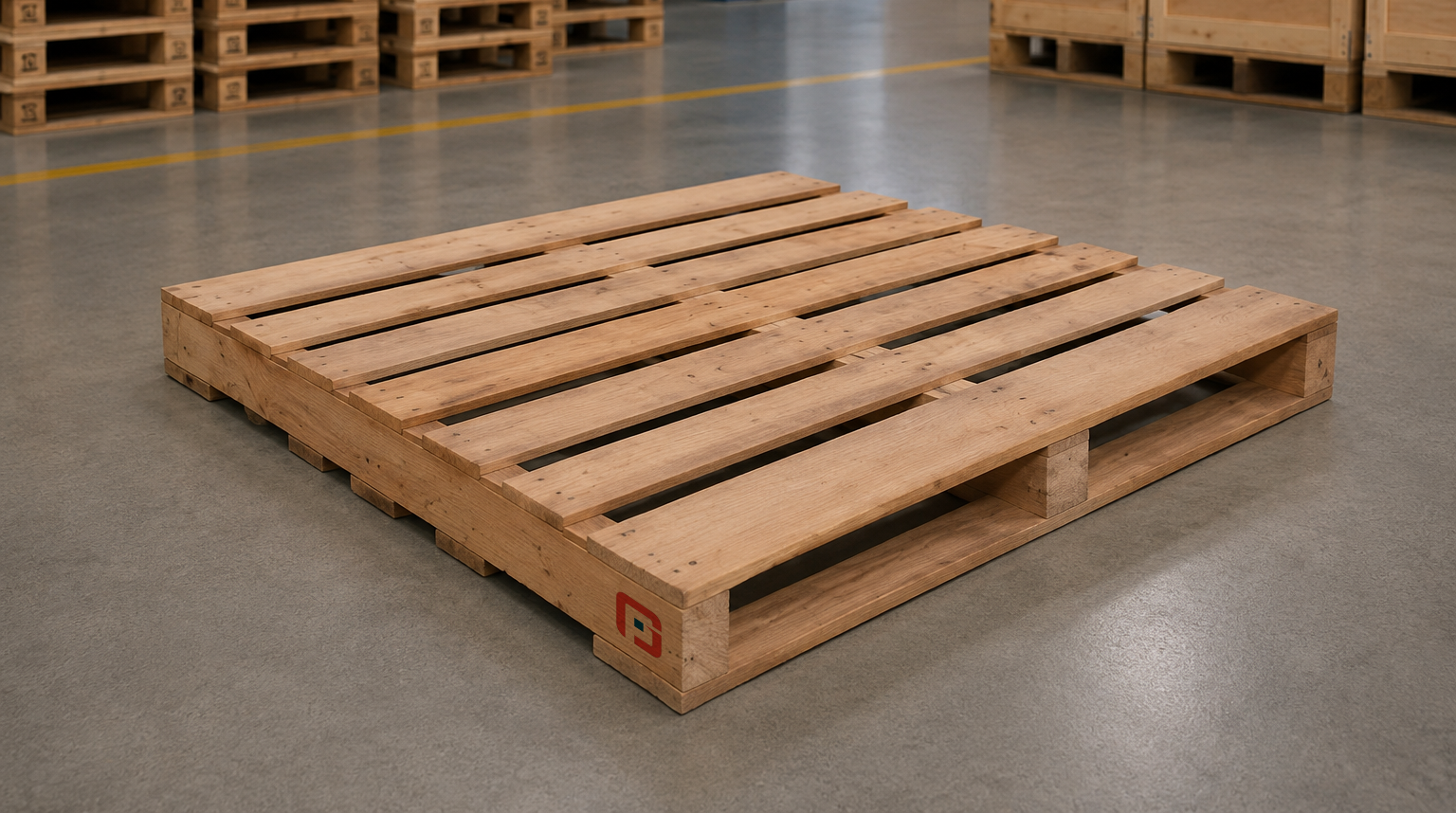
Walk into almost any warehouse, distribution centre, or manufacturing plant, and you'll find the same humble object holding the entire operation together: the wooden pallet. It rarely comes up in supply chain strategy meetings, yet it quietly determines how fast goods move, how safely they arrive, and how much money a business loses to damaged inventory every year.
This guide breaks down how industrial wooden pallets influence warehouse throughput and logistics performance, and what separates a good pallet from a poorly built one.
What Are Industrial Wooden Pallets?
An industrial wooden pallet is a flat structural platform, usually built from seasoned softwood or hardwood, designed to support unit loads during storage, handling, and transportation. Deck boards sit on top, stringers or blocks run underneath, creating a gap that lets forklifts, pallet jacks, and conveyors lift and move the load without touching the goods directly.
A well-engineered pallet comes down to three things: load-bearing capacity, dimensional consistency so it fits racking, trucks, and containers predictably, and durability under repeated handling, since one pallet might be loaded and unloaded dozens of times before it's retired.
Wood remains the dominant material for industrial pallets worldwide because it combines a high strength-to-weight ratio, low material cost, easy repairability, and compatibility with almost every handling system already in use.
Why Pallet Choice Is a Bigger Efficiency Lever Than Most Warehouses Realise
Warehouse efficiency usually gets discussed in terms of layout, WMS software, or labour scheduling. Pallets rarely get the same attention, but they touch nearly every physical process in the facility. Pallet dimensions determine how quickly goods get unloaded and staged at receiving. Pallet strength determines whether you can safely rack stack or block stack in storage. Pallet stability determines how safely pickers access SKUs. And pallet compliance determines whether a load clears customs or a retailer's dock without getting rejected.
A weak or inconsistent pallet fleet creates friction at every one of these stages. A well specified one removes that friction almost invisibly, which is probably why it goes unnoticed until something goes wrong.
Key Ways Wooden Pallets Improve Efficiency
Higher load capacity for safer stacking. Block style and heavy duty stringer pallets carry substantial static and dynamic loads, often 1,000 to 2,000 kg dynamically depending on wood grade. That lets warehouses stack higher and use vertical racking space more aggressively, reducing floor footprint per unit of inventory.
Standardized dimensions. Most operations run on standard footprints like 1200 x 1000 mm (ISO), 1200 x 800 mm (Euro pallet), or 48 x 40 inch (North American). Because wooden pallets are built to these sizes, they slot straight into existing forklifts, racking, and container configurations without retooling.
Durability that reduces transit damage. A poorly constructed pallet, with loose boards or weak stringers, is one of the most common causes of in-transit product damage. Well-seasoned timber with proper nailing patterns holds up through repeated handling and stacking pressure, meaning fewer returns and insurance claims.
Reusability that lowers total cost. A well-built wooden pallet gets reused across dozens of shipping cycles, and a cracked board or split stringer can usually be repaired on site rather than replaced, unlike moulded plastic. Over a few years, that repairability lowers cost per shipping cycle by a meaningful margin.
Compliance with international shipping standards. For exporters, pallet compliance is a customs requirement, not a preference. Under ISPM 15, wood packaging used in international trade must be heat treated so the core reaches a minimum of 56°C for at least 30 minutes, neutralising pests that could spread across borders. Compliant pallets carry the official "HT" stamp. Shipments on non-compliant pallets are routinely rejected or re-exported at the border.
Better space utilisation. Precise, uniform dimensions let warehouses calculate rack slots, loading patterns, and container fill rates accurately, reducing wasted cubic space and lowering cost per unit shipped.
Compatibility with automation. AGVs, conveyor sortation, and AS/RS systems depend on consistent pallet dimensions and predictable weight distribution. Pallets built to tight tolerances integrate far more reliably than inconsistent packaging.
Sustainability advantages. Wood is renewable, and industrial pallets are among the most recycled packaging products in the supply chain, commonly repaired, dismantled for parts, or chipped for biomass rather than landfilled.
Types of Wooden Pallets
How to Choose the Right Pallet
Start by confirming your load weight and type, since static, dynamic, and racking loads each place different stress on a pallet. Match dimensions to your racking and transport system before ordering, and check whether the shipment is domestic or international, since only international loads require ISPM 15 treatment. Decide between two-way and four-way entry based on how your team picks and moves stock, and ask suppliers about wood seasoning, since poorly seasoned timber warps and loses strength faster. If your product doesn't fit standard sizes, ask for a custom footprint instead of forcing an awkward fit.
Best Practices for Maximizing Pallet Efficiency
Inspect pallets on receiving and before dispatch to catch damage before it causes a failure mid-transit. Standardize on one or two sizes across your facility to keep racking and slotting simple, and rotate stock on a first-in, first-out basis so older units get retired before they degrade. Track repair versus replace costs to spot underperforming suppliers early, and train forklift operators on proper pallet engagement, since improper fork insertion is a leading cause of avoidable damage.
Final Thoughts
Industrial wooden pallets don't get much attention in supply chain conversations, but their impact on warehouse throughput, shipment safety, and total logistics cost is real and measurable. Businesses that treat pallet specification as a deliberate decision, matching load capacity, dimensions, and compliance requirements to their actual needs, consistently see fewer damaged goods, faster handling, and lower long-term packaging costs than those that treat pallets as an afterthought. Working with a manufacturer who understands load engineering, timber seasoning, and international compliance standards is often the simplest, highest-impact upgrade a warehouse operation can make.