English
 Arabic
 French
 Spanish
 Portuguese
 Deutsch
 Turkish
 Dutch
Dutch
 Italiano
 Russian
 Romaian
 Portuguese (Brazil)
 Greek
Greek
Microneedling vs PRP Facial in Winnipeg: Which Treats Acne Scars Better?
Health |
2026-08-17 12:23:48
 Advertise With Us
 About Us
 Terms And Conditions
 Politique de confidentialité
Tout voir
Politique de confidentialité
Tout voir

Mise à niveau vers Pro
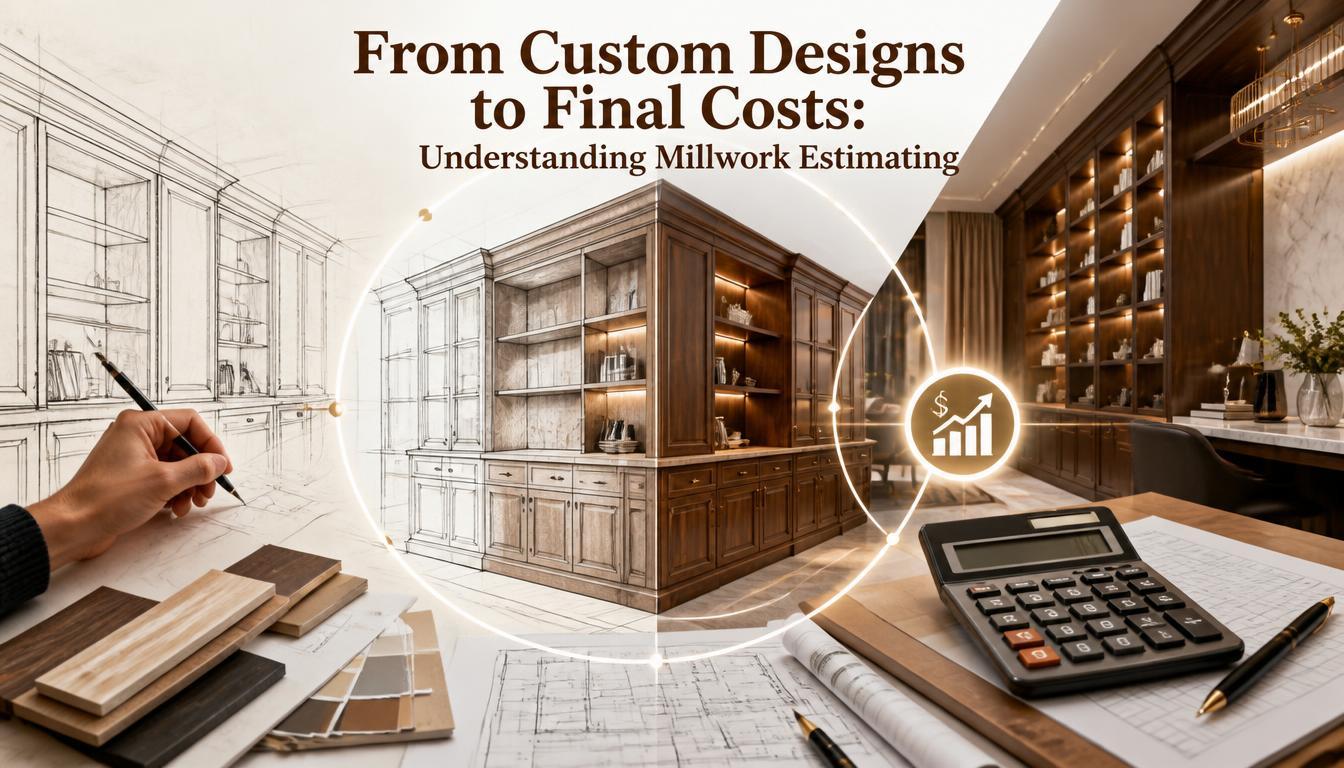
Ever fallen in love with a custom walnut reception desk in a rendering, only to watch the number attached to it double by the time it hits the shop floor? That gap between "beautiful drawing" and "final invoice" is exactly what millwork estimating exists to close.
If you've ever wondered how a stack of architectural drawings turns into a real dollar figure, this guide walks through it — no jargon, no fluff, just how the numbers actually get built.
Millwork estimating is the process of translating architectural drawings into a real cost for custom woodwork — cabinetry, trim, paneling, doors, and built-ins. It covers materials, labor, hardware, finishing, and installation.
Think of it as a translator. Architects speak in elevations and details; estimators convert that language into board feet, labor hours, and purchase orders. Miss a step in translation, and the budget breaks.
This isn't guesswork with a calculator. It's a structured process that pulls from drawings, specifications, material pricing, and shop capacity all at once.
Because millwork is one of the easiest line items to underprice — and one of the most expensive to fix after the fact. A missed detail in a drawing can turn into thousands in rework.
Custom woodwork isn't drywall. Every run of cabinetry, every radius panel, every book-matched veneer face is its own small manufacturing job. That complexity is exactly where bad estimates hide.
A solid estimate protects three things at once: the contractor's margin, the client's budget, and the shop's production schedule. Get it wrong, and all three take a hit together.
The U.S. millwork industry is a genuinely large, active market — not a small niche trade. That scale is part of why precise estimating has become a competitive advantage rather than a nice-to-have.
A few numbers put this in perspective:
The U.S. millwork industry was valued at roughly $38.5 billion in 2026, according to IBISWorld's market-size data for the sector.
Millwork manufacturing sits under NAICS code 32191, which also covers wood windows, doors, cut stock, and flooring sold mainly to housing and building construction firms.
IBISWorld notes the industry is expected to return to growth over the next five years after a softer stretch tied to broader construction slowdowns.
When an industry moves tens of billions of dollars a year through thousands of small and mid-size shops, even a 3–5% estimating error becomes a serious sum of money, fast.
A complete millwork estimate covers five core pieces: material takeoffs, labor hours, hardware and finish costs, shop drawings and engineering time, and installation. Leave one out, and the number is fiction.
Material takeoffs come first. The estimator measures every cabinet, panel, and trim run from the drawings and converts it into board feet, sheet goods, veneer, and hardware counts.
Labor follows close behind. Custom work is priced in hours per unit — cutting, assembly, sanding, finishing — and those hours shift depending on complexity and shop equipment.
Shop drawings and engineering are often the quiet budget-killer. Complex casework needs detailed submittals before a single board gets cut, and that design time costs real money.
The grade specified — Premium, Custom, or Economy — changes the price of a millwork estimate more than almost any other single factor. It's worth checking before pricing anything.
These three grade tiers trace back to the Architectural Woodwork Institute's original Quality Standards, first published in 1961 and still the reference point used in specifications today. Premium Grade demands the tightest tolerances and best-matched materials; Economy Grade is built for function over finesse.
A cabinet run specified "Custom" grade and mistakenly priced as "Economy" can blow a budget before installation even starts. Estimators check the spec section — not just the drawing — for exactly this reason.
Millwork estimating is usually handled by specialized estimators working alongside carpenters, shop foremen, and project managers — professionals who understand both the trade and the math behind it.
The people building what gets estimated are a sizable workforce. U.S. Bureau of Labor Statistics data shows carpenters held about 959,000 jobs in 2024, with a median annual wage of $59,310, and the field is projected to grow 4% from 2024 to 2034 — roughly average for all U.S. occupations.
That's a lot of skilled labor whose hours need to be priced correctly. An estimator who underestimates labor time isn't just wrong on paper — they're setting up a real crew for a real loss.
Material selection, design complexity, and finish specification drive the majority of cost swings in a millwork estimate. Everything else tends to be smaller adjustments around these three.
Material choice: solid hardwood, veneer, laminate, and engineered substrates all carry very different price points and waste factors.
Design complexity: curves, inset doors, book-matched veneers, and tight reveals all add labor hours that flat panel work never needs.
Finish specification: a hand-rubbed lacquer finish costs meaningfully more in labor than a sprayed catalyzed finish, even on identical cabinet boxes.
Freight and lead times matter too, especially for imported veneers or specialty hardware — a detail that's easy to forget until a shipment is delayed six weeks.
Green building requirements now directly shape millwork estimating, because certified wood and low-emission materials often carry a cost premium worth planning for upfront.
The U.S. Green Building Council released LEED v5 in April 2025, and in January 2026 aligned it with the FSC, SFI, and PEFC wood certification standards. Under LEED v5, certified wood can contribute up to 22 points on Building Design and Construction projects and up to 30 points on Interior Design and Construction projects.
That's not a small detail buried in a spec book — it's a real driver of which materials get sourced, at what price, and from whom. Estimators working on LEED-targeted projects need to price certified stock separately from standard material.
The most common millwork estimating mistakes are incomplete takeoffs, outdated material pricing, and skipping labor contingency for design changes. All three are avoidable with a consistent process.
Skipping a full takeoff — eyeballing quantities from a floor plan instead of measuring every run.
Using stale pricing — lumber and hardware costs shift often enough that last quarter's numbers can be dangerously wrong.
Ignoring change-order risk — design revisions are common on custom work, and estimates that don't build in a buffer get squeezed hard later.
Confusing grade requirements — as noted above, mixing up Premium, Custom, and Economy specs is a classic and costly error.
None of these mistakes are exotic. They're the same handful of slip-ups repeated across the industry — which is exactly why they're worth guarding against deliberately.
Contractors turn to dedicated millwork estimating services when projects get too complex, too time-sensitive, or too numerous for an in-house team to price accurately and quickly. It's a capacity decision as much as an expertise one.
A specialized millwork estimating service typically brings software-driven takeoffs, current material pricing databases, and estimators who work exclusively in woodwork — not general construction. That focus tends to catch details a generalist estimator might miss.
For smaller shops bidding several jobs a month, outsourcing estimating can also simply be a time-management call. Every hour spent measuring drawings is an hour not spent running the shop floor.
A typical millwork estimating process moves through five stages: drawing review, takeoff, pricing, markup and contingency, and final proposal. Each stage builds directly on the one before it.
Drawing and spec review — confirming grade, finish, hardware, and installation requirements before any numbers get pulled.
Quantity takeoff — measuring every cabinet run, panel, and trim piece from the drawings.
Material and labor pricing — applying current costs to the takeoff quantities.
Markup and contingency — adding overhead, profit, and a buffer for likely change orders.
Final proposal — packaging it all into a clear, itemized bid the client and shop can both work from.
Skipping stage one is where most bad estimates start — everything downstream inherits that early mistake.
Millwork estimating isn't just arithmetic bolted onto a drawing set — it's the discipline that keeps custom woodwork projects financially honest from the first sketch to the final install. Get the grade right, price labor realistically, and build in room for change, and the number you quote will actually survive contact with the job site.
Whether that estimate comes from an in-house specialist or a dedicated millwork estimating service, the goal is the same: a number the shop can build to, and a budget the client can trust.