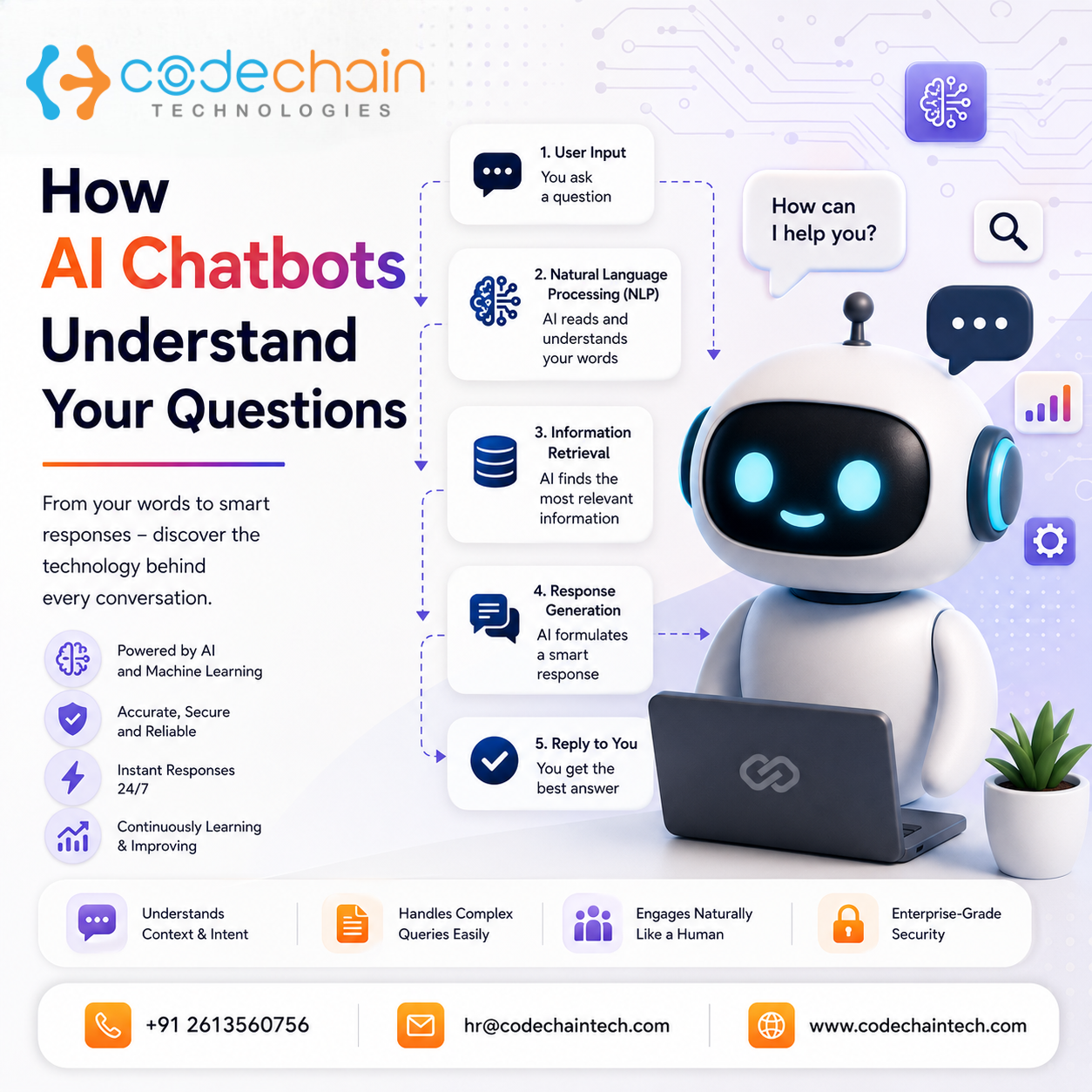
AI doesn’t just read your question—it understands it. Modern artificial intelligence systems can analyze the words a person uses, identify context, recognize intent, and generate responses that are relevant to the conversation. This is one of the biggest differences between traditional software and modern AI-powered systems.
Instead of simply matching a question with a predefined answer, advanced AI can process natural language and use the surrounding context to determine what a user is actually asking.
How Does AI Understand a Question?
When a person asks an AI system a question, the system does more than look for individual keywords. Modern AI models analyze relationships between words and the broader context of the request.
For example, consider these two questions:
- "How can I improve my website?"
- "Why is my website loading slowly?"
Both questions are related to websites, but they have different intentions. An AI system needs to understand the context and intent behind each question to provide a useful response.
This ability comes from technologies such as natural language processing, machine learning, and large language models.
AI Understands Context
Context plays an important role in how AI responds.
Imagine someone asks:
"What is Python?"
Then follows up with:
"Is it good for web development?"
A modern AI system can understand that "it" refers to Python. It does not need the user to repeat the complete question.
This contextual understanding makes AI conversations feel more natural and useful.
AI Can Identify User Intent
Understanding intent is different from simply recognizing words.
For example, a customer might ask:
"Can I get this delivered tomorrow?"
The important information is not only the words "delivered" and "tomorrow." The AI needs to understand that the customer is asking about delivery availability for a specific product or order.
AI-powered systems can combine language, conversation history, and available business information to identify what the customer is trying to accomplish.
The Role of Natural Language Processing
Natural Language Processing, commonly called NLP, is a major technology behind AI's ability to work with human language.
NLP helps computers process and analyze language in ways that can support:
- Question answering
- Text classification
- Translation
- Sentiment analysis
- Summarization
- Information extraction
- Conversational AI
Modern AI systems combine NLP techniques with large-scale machine learning models to handle increasingly complex language tasks.
Large Language Models Make Conversations More Natural
Large Language Models, or LLMs, are trained using large collections of text and learn statistical relationships between language patterns.
When an LLM receives a question, it processes the input and generates a response based on patterns learned during training and the context provided in the conversation.
This is why modern AI can handle questions that are phrased in different ways.
For example:
- "How do I build a mobile app?"
- "What are the steps to create a mobile application?"
- "I want to develop an app. Where should I start?"
Although the wording is different, the underlying intent can be similar.
AI Can Understand More Than Simple Keywords
Traditional search systems often rely heavily on keywords. If a user searches for a specific phrase, the system looks for relevant matches.
AI-powered search can go further by considering the meaning and intent behind a query.
For example, a customer searching for:
"comfortable shoes for walking all day"
may receive recommendations based on concepts such as comfort, walking, and usage rather than only pages containing the exact phrase.
This can make search and product discovery more useful.
AI Understanding in Business Applications
Businesses are increasingly using AI to understand customer requests and automate interactions.
AI can be integrated into:
- Customer support
- E-commerce platforms
- CRM systems
- Mobile applications
- Enterprise software
- Search systems
- Recommendation engines
- Business analytics
For example, an AI chatbot can understand a customer's question, identify the purpose of the request, retrieve relevant information, and provide an appropriate response.
AI Does Not Understand Exactly Like Humans
Although the phrase "AI understands" is commonly used, AI understanding is different from human understanding.
AI systems do not necessarily possess human experiences, emotions, consciousness, or personal understanding. They process information using computational models trained to recognize patterns and generate outputs.
This distinction is important because AI can sometimes produce responses that sound confident but are incorrect.
For important business decisions, human review and reliable source data remain important.
Why Context Matters for AI
The quality of an AI response often depends on the quality of the information provided.
A vague request may produce a general answer, while a detailed prompt can provide the model with more useful context.
For example:
Less specific:
"Create a marketing strategy."
More specific:
"Create a digital marketing strategy for a small B2B software company targeting manufacturing businesses in India."
The second request gives AI more information about the objective, audience, and market, allowing it to generate a more relevant response.
AI and the Future of Conversational Technology
As AI systems continue to improve, conversations with software are becoming more natural. Users can interact with applications using everyday language instead of learning complicated commands or interfaces.
This can make technology more accessible to people who may not have technical knowledge.
AI-powered interfaces can potentially allow users to:
- Search using natural language
- Ask questions about business data
- Generate reports
- Find products
- Automate workflows
- Get personalized recommendations
- Receive real-time assistance
The future of software may increasingly involve conversational interactions alongside traditional interfaces.
How Businesses Can Use AI Understanding
Businesses can start by identifying areas where customers or employees frequently ask questions or perform repetitive tasks.
For example, an organization could use AI to:
- Understand customer questions.
- Classify requests by intent.
- Retrieve relevant information.
- Generate an appropriate response.
- Escalate complex cases to a human employee.
This approach can improve efficiency while keeping human involvement where it is most valuable.
CodeChainTech provides AI, web, mobile, and custom software development solutions that can help businesses explore AI-powered applications based on their specific requirements.
Conclusion
AI doesn’t just read your question—it understands it by analyzing language patterns, context, relationships between words, and the likely intent behind a request. Technologies such as NLP, machine learning, and large language models make this possible.
However, AI understanding is not the same as human understanding. AI can process language remarkably well, but it can still make mistakes and requires appropriate data, testing, and human oversight.
As conversational AI continues to evolve, the way people interact with websites, applications, and business software is likely to become increasingly natural, personalized, and intelligent.
 English
 Arabic
 French
 Spanish
 Portuguese
 Deutsch
 Turkish
 Dutch
Dutch
 Italiano
 Russian
 Romaian
 Portuguese (Brazil)
 Greek
Greek
 Advertise With Us
 About Us
 Terms And Conditions
 Политика конфиденциальности
Смотреть все
Политика конфиденциальности
Смотреть все