English
 Arabic
 French
 Spanish
 Portuguese
 Deutsch
 Turkish
 Dutch
Dutch
 Italiano
 Russian
 Romaian
 Portuguese (Brazil)
 Greek
Greek
Smart Power Tools Market Connected Jobsite Equipment Innovations Forecast 2025 - 2035
Other |
2026-07-27 10:05:52
 Advertise With Us
 About Us
 Terms And Conditions
 Privacy Policy
Afiseaza-i pe toti
Privacy Policy
Afiseaza-i pe toti

Upgrade to Pro
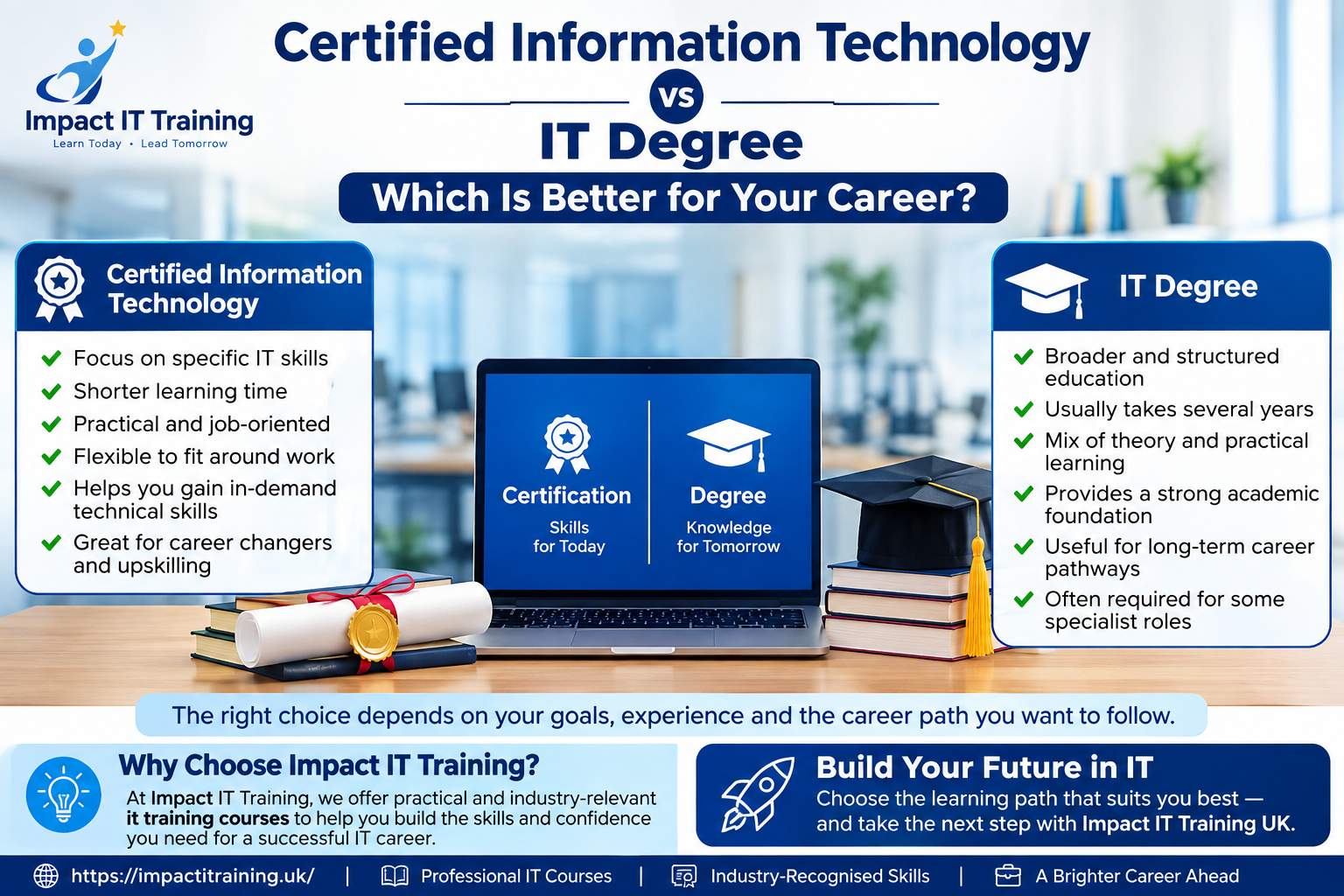
Choosing the right path for an IT career can be difficult. Some people prefer a university degree, while others choose professional certifications and focused training. Both options can help you build valuable technology skills, but they serve different purposes.
If you are considering certified information technology training or an IT degree, understanding the differences can help you make a smarter career decision.
Certified information technology generally refers to professional certification or training that demonstrates knowledge and skills in a specific area of IT. Unlike a traditional degree, certification programmes are usually more focused and can be completed in a shorter period.
Depending on the programme, you may develop skills in areas such as IT support, networking, cybersecurity, cloud computing, systems administration, or IT service management.
Professional certifications can be particularly useful when you want to develop a specific skill or improve your CV. Many IT professionals also add certifications to their existing degrees to demonstrate specialised knowledge.
An IT degree is a university qualification that provides broader and more structured education in information technology and related subjects. A degree can cover areas such as programming, databases, networking, systems analysis, software development, cybersecurity, and information management.
A degree normally requires a larger time commitment than a certification. However, it can provide a strong academic foundation and may be useful for career paths where employers specifically request a university qualification.
IT graduates can pursue roles such as software developer, systems analyst, data analyst, cybersecurity professional, IT consultant, and IT support specialist.
The biggest difference is focus and flexibility.
| Factor | IT Certification | IT Degree |
|---|---|---|
| Duration | Usually shorter | Usually several years |
| Learning style | Focused on specific skills | Broader academic education |
| Career goal | Skill development and specialisation | Broad IT career foundation |
| Flexibility | Often easier to fit around work | Usually requires a larger time commitment |
| Practical focus | Often focused on job-related skills | Mix of theory and practical learning |
| Best for | Upskilling, career changes and specialisation | Students seeking a comprehensive IT education |
Professional certifications can help learners target specific technical skills, while degrees provide broader academic knowledge. The best option depends on your career goals, existing experience, available time, and the roles you want to pursue.
There is no single answer because your career goals matter.
If you are new to technology and want a broad understanding of IT, a degree may be a suitable choice. It can provide a structured education and help prepare you for different technology careers.
On the other hand, if you already have work experience or want to develop a particular IT skill, certification can be a more focused option. Shorter professional training can help you update your knowledge as technology changes. Industry guidance also highlights the value of professional certifications and additional training alongside formal education.
For people changing careers, certification can also provide a practical way to start developing IT skills without immediately committing to a multi-year degree.
Quality it training courses can help learners build practical knowledge and understand how technology is used in real workplace environments. Training can be especially valuable when it combines structured learning with practical exercises and career-focused skills.
At Impact IT Training, learners can explore IT training opportunities designed to help them develop relevant knowledge and improve their professional capabilities.
The UK technology sector is also expected to continue creating demand for skilled professionals. Skills England projects significant growth in priority digital and technology occupations between 2025 and 2035, highlighting the importance of developing strong technical and problem-solving skills.
Yes. In fact, combining formal education with professional certification can be a strong approach.
A degree can give you broad knowledge and an academic foundation, while certifications can help you develop specialised skills. Continuing professional development is common in technology because IT tools, systems, and practices continue to evolve.
For example, someone with an IT degree could later pursue certifications in cybersecurity, networking, cloud technologies, or IT service management to strengthen their professional profile.
So, certified information technology vs IT degree: which is better for your career? The answer depends on where you are now and where you want to go.
An IT degree may be the better choice if you want comprehensive academic education and are starting your long-term technology career. Certification may be more suitable if you want focused skills, career development, or a faster route to specialised IT knowledge.
For many professionals, the best approach is not choosing one over the other. Combining a degree with relevant certifications and practical it training courses can help create a stronger and more adaptable IT career.
Neither is automatically better. An IT degree provides broader education, while certification focuses on specific skills. Your career goals and experience should guide your choice.
Yes. Some IT roles can be entered through certifications, practical experience, and relevant technical skills. However, specific employers and roles may have different qualification requirements.
The duration varies depending on the certification and subject. Some focused programmes can take considerably less time than a university degree, making them useful for targeted skill development.
You can. Combining a degree with professional certifications can help demonstrate both broad IT knowledge and specialised technical skills.
Yes. The right IT training courses can help beginners develop foundational knowledge and understand which technology career path may suit their interests and goals.