English
 Arabic
 French
 Spanish
 Portuguese
 Deutsch
 Turkish
 Dutch
Dutch
 Italiano
 Russian
 Romaian
 Portuguese (Brazil)
 Greek
Greek
Synthetic Quartz Market Thrives on Growing Need for Reliable Crystal Oscillators at 5.60% CAGR
Other |
2026-06-25 10:00:41
 Advertise With Us
 About Us
 Terms And Conditions
 Πολιτική Ιδιωτικότητας
δες τα όλα
Πολιτική Ιδιωτικότητας
δες τα όλα

Upgrade to Pro
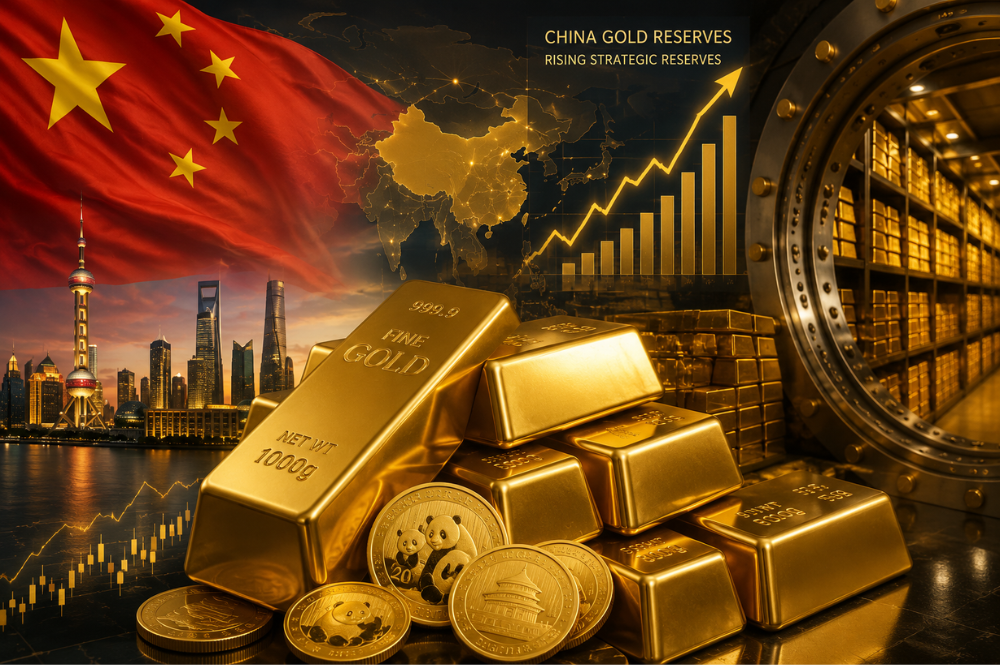
While Western investors were selling gold in June 2026, China's central bank was quietly buying more of it than at any point in the past two and a half years. That is not a typo. Gold fell 16% in Q2 2026, its worst quarterly performance since 2013. It briefly touched $4,002 per ounce, its weakest level since November 2025. Institutional investors across Wall Street and London were reducing positions, citing Federal Reserve hawkishness, a strengthening US dollar, and elevated real yields. The narrative was clear: gold was under pressure, and the smart money was stepping back.
The People’s Bank of China has made a move. In June 2026, China's central bank increased its gold reserves by 14.93 tonnes, marking the largest monthly increase since October 2023. This marked China's 20th month of continuous purchases of the precious metal, its longest streak in almost 11 years, and came during a time when the price of gold had sunk to its lowest level in several months. There is no accident here. It is a deliberate, decades-long strategy on behalf of the Chinese sovereign, and learning about it is arguably the most important thing you can do as a US gold investor right now. Here’s how.
The numbers behind China's June 2026 gold purchase tell a story that goes far beyond a single monthly data point. According to data published by China's State Administration of Foreign Exchange (SAFE) on July 7, 2026, the People's Bank of China added 480,000 troy ounces (14.93 tonnes) of gold to its official reserves in June. Total PBOC gold holdings now stand at 75.44 million troy ounces (2,346 tonnes), the highest level on record.
What makes this purchase particularly significant is the acceleration pattern leading up to it. PBOC monthly purchase volumes have increased every single month since March 2026:
|
Month |
Purchase Volume |
Tonnes |
|
March 2026 |
160,000 oz |
4.97 tonnes |
|
April 2026 |
260,000 oz |
8.09 tonnes |
|
May 2026 |
320,000 oz |
9.95 tonnes |
|
June 2026 |
480,000 oz |
14.93 tonnes |
This represents a 50% increase in one month, coinciding with gold trading at its cheapest level since November 2025. This uptick was not accidental; rather, it was a considered, counter-cyclical strategy that aligns with how the world's most advanced reserve managers work.
So far in 2026, China has purchased an additional 40 tonnes of gold. The total holdings are now up to 2,346 tonnes from around 2,280 tonnes at the beginning of the year. The trend of purchases has occurred across each communications cycle of the Federal Reserve, each interest rate decision, and each geopolitical event from November 2024 through to June. No matter what happens, no event has been able to derail or even slow this process. Indeed, June was the month it got faster.
Krishan Gopaul, Senior Analyst for the World Gold Council in EMEA, confirmed these numbers and observed that gold has established a decent technical floor at $4,000 an ounce thanks largely to this sort of structural central bank demand.
This is the question most US investors ask when they first see the data, and the answer reveals something fundamental about how central banks think versus how retail investors think.
Central banks do not trade gold. They allocate it. A futures trader in Chicago looks at the same screen every minute, responds to Fed statements, tracks real yields, and adjusts positions based on what gold will do this quarter. A reserve manager at the People's Bank of China is asking a completely different question: can this asset protect China's purchasing power over the next 30 years? Those two questions produce completely different behavior at a price near $4,000.
With gold declining by 16% in Q2 2026, western institutional players perceived the decline of a non-yielding asset amid the environment of persistently high interest rates and trimmed positions accordingly. With the price of a strategic reserve asset declining meaningfully below its previous levels even months earlier, the PBOC capitalized on the opportunity to accumulate additional ounces of gold at a discount. An increase in monthly purchases of the asset by 50% at multi-month lows is not panic but precision.
The sell-off of gold was fueled by three major factors. First, the Federal Reserve announced a higher-for-longer rate policy, which made the non-yielding asset less attractive than US treasuries. Second, the US Dollar Index rose by almost 2.3% just in June, which increased the cost of dollar-denominated gold and decreased its price further. And third, positive results in Iran peace negotiations diminished the risk of geopolitics, thus removing another support layer of gold prices.
Nothing here affects the long-term picture of gold as a reserve asset. This is known by the PBOC well enough. Thus, its buying spree continues uninterrupted through all communications cycles of the Fed since November 2024.
Here is the critical context that puts this behavior in perspective: China's gold currently represents just 8.8% of its total foreign exchange reserves, significantly below the global average of 27% and far below the approximately 70% weighting maintained by the United States. That gap does not close in one year or even one decade. It represents a structural rebalancing project operating on a multi-decade horizon, and June's purchase is simply the latest step in a journey that has a very long way still to run.
China's gold buying program cannot be understood in isolation. It is one component of a broader, coordinated strategy to reduce the vulnerability of China's $3.4 trillion reserve portfolio to US-controlled financial infrastructure. The turning point was February 2022, when the United States and its allies froze approximately $300 billion of Russia's dollar-denominated foreign exchange reserves following the invasion of Ukraine. For every central bank outside the Western alliance, that moment fundamentally changed the risk calculation of holding dollar assets. If reserves denominated in dollars could be frozen overnight by political decision, they were not truly reserves at all. They were contingent assets.
Gold changes that calculation entirely. Physical gold held in domestic vaults carries zero counterparty risk. It cannot be frozen, sanctioned, seized, or devalued by any foreign government. It requires no correspondent bank, no SWIFT access, and no permission from Washington. For China, which faces an increasingly adversarial relationship with the United States across trade, technology, and geopolitics, those properties are not abstract. They are strategically essential.
This explains why China's buying has continued regardless of price, regardless of Fed policy, and regardless of short-term dollar strength. It also explains the broader global trend. According to the World Gold Council's 2026 Central Bank Gold Reserves Survey, 89% of central banks globally expect official gold reserves to increase over the next 12 months, while a record 45% plan to increase their own holdings in the coming year. Among emerging market and developing economy central banks, the buying appetite is even more pronounced, with half of the respondents expecting their gold reserves to rise.
The de-dollarization trend is not a forecast. It is already happening, and China's 20-month buying streak is its most visible expression.
Official PBOC data shows 2,346 tonnes of gold held in reserve. But there is significant and well-documented evidence that China's true gold holdings are substantially larger than the official figure suggests. China is the world's largest domestic gold producer by mine output, consistently producing over 300 tonnes annually. Independent analysts and researchers have noted for years that a meaningful portion of this domestic production is believed to flow directly into state reserves without appearing in conventional import or export trade statistics. This creates what researchers describe as a structural reporting gap between officially disclosed PBOC figures and estimated actual holdings.
Independent estimates of China's true gold holdings range from 5,500 to 30,000 metric tonnes, compared to the officially reported 2,346 tonnes. If even the lower end of those estimates carries any validity, China could already rank second globally in gold reserve holdings, behind only the United States, which holds approximately 8,133 tonnes officially.
It can thus be seen that the lack of transparency has many ramifications for the discovery of gold prices around the world. The fact that China is accumulating much more gold than what is being said by the statistics implies that the support level in terms of demand for gold is much stronger than what has been considered in the mainstream analysis so far.
China's behavior in June 2026 delivers one clear message to US investors: the world's most sophisticated reserve managers are treating the current gold correction as a buying opportunity, not a warning signal. Gold is currently trading near $4,122 per ounce, approximately 24% below its January 2026 all-time high of $5,405. Goldman Sachs maintains a year-end 2026 price target of $4,900 per ounce, representing a potential 19% gain from current levels. The $4,000 level has been widely identified as a structural technical floor, underpinned by the kind of consistent central bank demand that does not disappear when Fed policy changes.
The same logic that drives China's accumulation strategy applies directly to US individual investors. Buying during a correction, when prices are meaningfully below recent highs and structural demand remains intact, is precisely how long-term wealth is built in any asset class. Gold is no different.
Physical gold bars remain the most direct and efficient vehicle for participating in this structural trend. Unlike ETFs, physical bars carry zero management fees, zero counterparty risk, and zero exposure to the paper financial system. You own the metal outright, with full traceability and immediate liquidity through any authorized bullion dealer.
Gold Stock USA Inc. carries the full range of Aarus gold bars, .9999 fine (24 karat) LBMA-approved bullion with SPECTROLAB verified purity, unique serial numbers, and certificates of authenticity, at some of the lowest premiums over spot available from any authorized US dealer. With gold currently trading well below its all-time high and central bank demand accelerating globally, the entry point for US investors right now is one of the most compelling seen in over a year.
|
Bar Size |
Spot Price |
Aarus Premium |
Approximate Entry Price |
|
1 oz |
$4,122 |
2% to 3% |
$4,204 to $4,246 |
|
100 Gram |
$13,248 |
2% to 3% |
$13,513 to $13,645 |
|
1 Kilo |
$132,476 |
2% to 3% |
$135,126 to $136,450 |
Visit goldstockus.com today to browse live pricing on certified Aarus gold bars with insured nationwide delivery to all 50 US states.
China’s purchase of gold is motivated by the need to lower dependency on US dollar assets and avoid any risk that might arise from sanctions. Gold is a financial asset without any counterparty risk since it cannot be frozen by any foreign country. With only 8.8% of its reserve portfolio consisting of gold compared to an average of 27% worldwide, China has room to go on buying.
The People's Bank of China bought 14.93 tonnes (480,000 troy ounces) in June 2026, its largest single-month purchase since October 2023. Total holdings reached 2,346 tonnes, extending China's buying streak to 20 consecutive months, the longest since at least 2015.
The decline in the price of gold in Q2 of 2026 was caused by reduced positions from Western institutional investors because of the anticipated rate hikes by the Fed and the increased strength of the US dollar. The Chinese central bank's purchases of gold occur over several decades and do not react to any signal of rates.
Gold is currently approximately 24% below its January 2026 all-time high, with Goldman Sachs forecasting $4,900 by year-end. With China's central bank accelerating purchases at these levels and 89% of global central banks expecting gold reserves to increase, most institutional strategists view the current correction as a clear buying opportunity.
Gold Stock USA Inc. is one of the most trusted authorized dealers for certified gold bars in the USA, carrying Aarus gold bars with .9999 fine purity, SPECTROLAB verification, unique serial numbers, and certificates of authenticity at some of the lowest premiums over spot available, with insured nationwide delivery to all 50 states.