English
 Arabic
 French
 Spanish
 Portuguese
 Deutsch
 Turkish
 Dutch
Dutch
 Italiano
 Russian
 Romaian
 Portuguese (Brazil)
 Greek
Greek
BioGrow™ Hair Growth Support for Stronger & Healthier Hair
Health |
2026-05-16 09:54:00
 Advertise With Us
 About Us
 Terms And Conditions
 Datenschutzbestimmungen
Alle anzeigen
Datenschutzbestimmungen
Alle anzeigen

Upgrade auf Pro
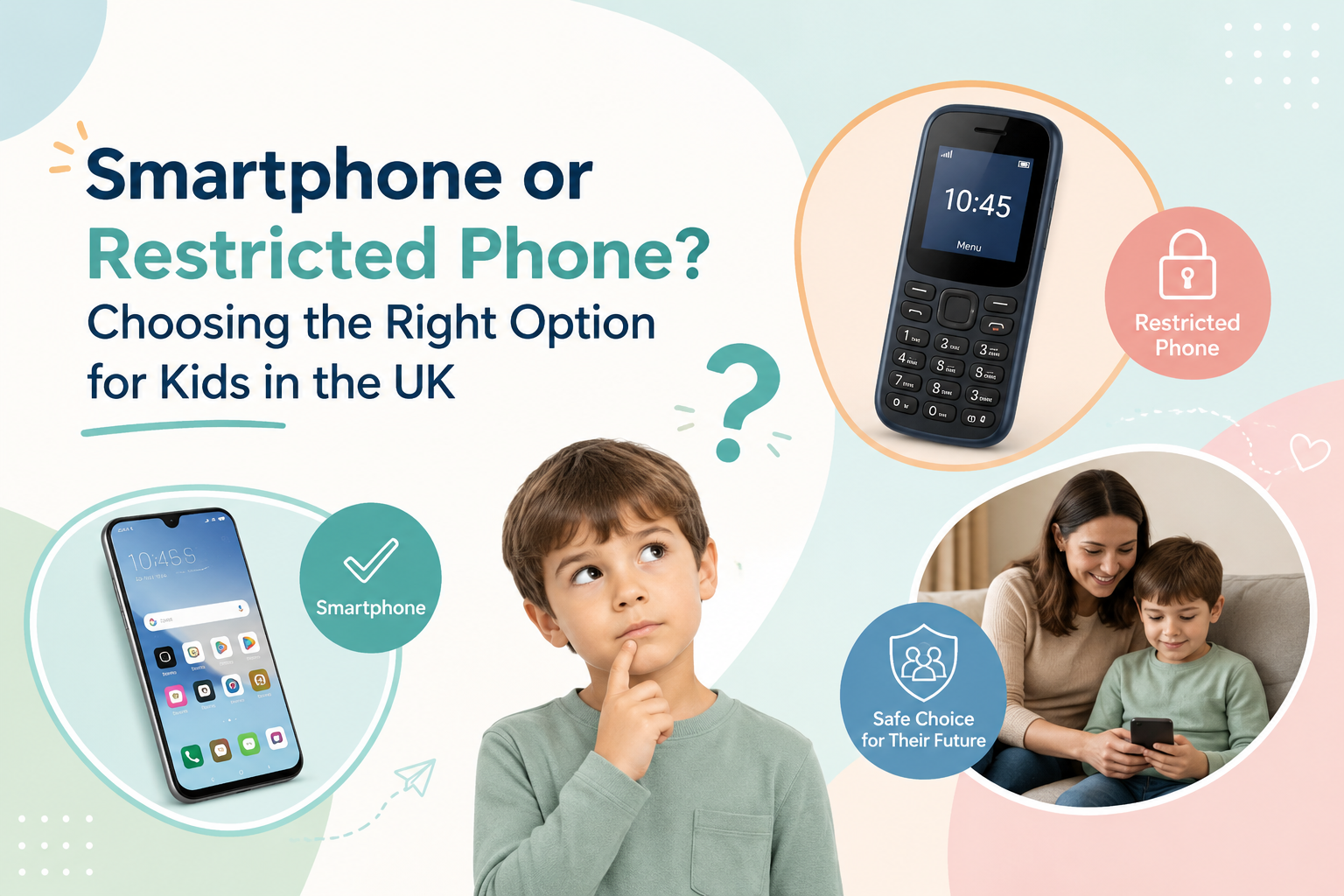
Choosing a first phone for your child can be a difficult decision. Smartphones offer useful features such as messaging, maps, educational apps and video calls, but they can also provide access to social media, online games, websites and other digital content.
For many UK parents, the question is not simply which phone to buy, but how much access their child should have. A restricted phone can provide essential communication without exposing children to the full range of smartphone features, while a properly managed smartphone can offer more flexibility with appropriate parental controls.
So, which option is right for your child?
A restricted phone is designed to provide essential communication while limiting access to potentially unsuitable apps, websites or online services.
Depending on the device, parents may be able to control which apps can be installed, limit internet access, manage screen time or restrict certain features. This can make a restricted phone a practical choice for younger children who mainly need a device for calls, texts and staying connected with family.
For parents looking for Child safety phones UK, the key advantage is having greater control over what the child can access.
A traditional smartphone gives children access to a much wider range of features. They can use messaging apps, educational tools, maps, cameras, video calls and other applications.
This can be useful as children become more independent. However, a smartphone also requires parents to pay closer attention to privacy, screen time, app downloads and online interactions.
UK government guidance recommends using parental controls to help manage screen time, filter inappropriate content and control access to online services. It also recommends checking that controls continue to work as children get older or move to new devices.
Age is one of the most important factors.
A younger child may only need a phone for contacting parents or carers. In this situation, a restricted device may provide the communication they need without unnecessary digital distractions.
Older children may benefit from a smartphone as they become more independent, particularly if they need navigation, educational applications or additional communication options.
The right choice will depend on your child's maturity, needs and your family's rules.
Consider how much online access your child actually needs.
If they only need calls and messages, a restricted phone may be sufficient. If they need specific apps, a smartphone with carefully configured parental controls may be more appropriate.
Parents should also review app permissions, age ratings and privacy settings before allowing children to use new apps. Ofcom recommends checking app ratings and permissions and taking additional steps where apps provide access to wider internet content.
A smartphone can make it easier for children to spend long periods watching videos, gaming or browsing.
A device with screen-time controls can help parents create healthier boundaries. Families can establish rules around schoolwork, mealtimes, bedtime and recreational use.
Government guidance also encourages families to create agreed plans around when children can and cannot use devices.
Online safety is another major consideration.
A smartphone can expose children to a much larger digital environment, including social platforms, online communities and strangers. Parents should therefore consider features such as app blocking, content filtering, contact management and location controls.
The UK government is also introducing further measures to protect children online, including planned restrictions on social media for under-16s expected to be implemented in spring 2027.
One of the main reasons parents buy a phone for a child is communication and peace of mind.
A suitable children's phone can allow parents and children to stay connected when travelling to school, visiting friends or participating in activities.
If location tracking is available, parents should understand how it works and discuss it openly with their child. UK guidance highlights the importance of privacy and transparency when location services are used.
For families who are not ready to give a child unrestricted smartphone access, a safe phone for kids can provide a middle ground.
Instead of choosing between complete digital freedom and no phone at all, parents can look for a device that provides useful communication while offering controls over apps, websites, screen time and other features.
This approach can also help children gradually learn responsible phone habits before receiving broader access to smartphones.
When searching for the best children phone in UK, look beyond the handset itself. Consider the safety features and parental controls that come with it.
Look for features such as:
Reliable calling and messaging
Parental control options
Screen-time management
App and website restrictions
Contact controls
Location features where appropriate
Age-appropriate content
Strong privacy settings
Simple controls for parents
It is also important to regularly review the settings. Children's needs change as they grow, and a phone that works well for a younger child may need different restrictions later.
Not necessarily.
A restricted phone may be ideal for a younger child or a child who only needs basic communication. However, an older child may eventually need access to selected smartphone features for education, travel, communication and independence.
The goal should not necessarily be to avoid smartphones altogether. Instead, parents can choose a device and settings that match their child's age, maturity and needs.
Choosing between a smartphone and a restricted phone is ultimately a family decision. The best option is the one that gives your child the communication and independence they need while helping you maintain appropriate boundaries.
For younger children, restricted devices can provide a simpler introduction to mobile technology. As children mature, a controlled smartphone can gradually introduce additional features and responsibilities.
Whether you are looking for Child safety phones UK or a Safe phone for kids UK, focus on parental controls, privacy, communication features and age-appropriate access rather than simply choosing the most powerful phone.
With the right device, clear family rules and regular conversations about online safety, children can learn to use mobile technology confidently and responsibly.