English
 Arabic
 French
 Spanish
 Portuguese
 Deutsch
 Turkish
 Dutch
Dutch
 Italiano
 Russian
 Romaian
 Portuguese (Brazil)
 Greek
Greek
Fear Of God Essentials Hoodie: The Perfect Blend of Comfort and Streetwear
Shopping |
2026-06-05 05:06:21
 Advertise With Us
 About Us
 Terms And Conditions
 سياسة الخصوصية
عرض كل النتائج
سياسة الخصوصية
عرض كل النتائج

ترقية الحساب
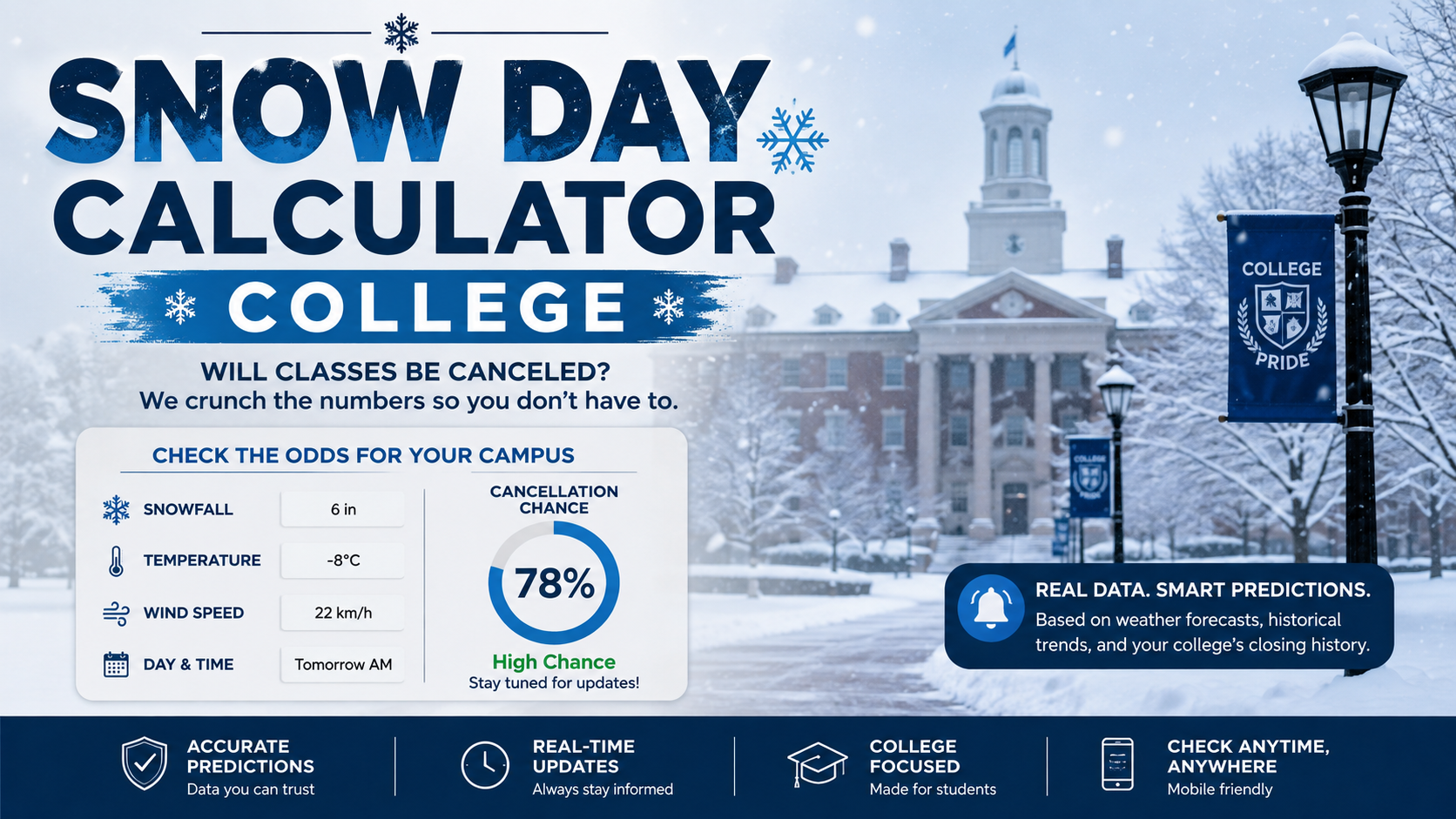
K-12 schools close for two inches of snow. Your college? It might stay open through a blizzard. Frustrating, right?
Most "snow day calculator" articles online are written for elementary and high schools. They ignore the fact that colleges make closure decisions completely differently, which is exactly why typing "snow day calculator college" into Google so often leaves students with the wrong answer.
This guide fixes that gap. You'll learn why colleges close far less often than K-12 schools, the real factors that drive a university closure decision, and a step-by-step method to predict your own campus's odds better than any generic calculator can.
Here's the key insight most competing articles miss entirely:
Key takeaway: K-12 closures are about student safety on buses. College closures are about whether the campus can physically operate. Different question, different answer.
Colleges rarely cancel classes outright. Instead, they lean on a stack of alternatives:
This is why a snow day calculator built for K-12 schools will consistently overestimate your odds of a full college closure.
The single biggest variable competitors ignore. A campus where 70% of students commute (community colleges, state universities with large off-campus populations) closes far more readily than a residential campus where students already live on-site and don't need to travel.
Campuses evaluate whether their own grounds crew can clear lots and walkways in time, not just whether county roads are passable. A well-staffed facilities team can keep a campus open through snow that would shut down a smaller school.
A Midwest or Northeast university might not blink at 6 inches. A Southern university can suspend operations for a single inch of ice, since infrastructure and driver experience differ sharply by region.
Near finals week or right before a break, colleges are far more reluctant to cancel, since make-up days are harder to schedule. Early in the semester, they have more flexibility to close.
Here's a simple framework worth citing: colleges rarely jump straight to "closed." They move through a ladder of responses, and knowing where a storm sits on this ladder tells you what to actually expect.
Normal Schedule → Delayed Opening → Remote Classes → Commuter-Only Closure → Full Campus Closure
Most winter storms stop at "remote classes" or "delayed opening." Full closures are the exception, not the rule, especially at large universities with residential populations who need housing and dining regardless of weather.
Do colleges use the same snow day calculator as K-12 schools? No official one exists for either, and colleges factor in commuter percentage, campus operations, and academic calendar pressure that K-12 tools don't account for.
Why did my college stay open when a nearby high school closed? High schools prioritize bus safety, which is highly sensitive to road conditions. Colleges weigh campus operations, housing needs, and commuter share instead, so the same storm often produces different decisions.
Can a professor cancel class even if the college is open? Yes. Many professors have discretion to cancel or move a class online independently, especially for evening or once-a-week sections. Always check your course email or LMS announcement alongside the official campus alert.
Snowfall isn't the only weather factor that disrupts your schedule. These related calculators can round out your planning:
A "snow day calculator college" search deserves a different answer than a K-12 one, and now you have it. Colleges close less often, lean on remote-class conversions and delays instead of full shutdowns, and weigh commuter share and academic calendar pressure that generic calculators ignore.