English
 Arabic
 French
 Spanish
 Portuguese
 Deutsch
 Turkish
 Dutch
Dutch
 Italiano
 Russian
 Romaian
 Portuguese (Brazil)
 Greek
Greek
Chiefs Mailbag the moment OTAs: How a lot will inexperienced persons participate in within 2026?
Jobs |
2026-08-01 01:33:01
 Advertise With Us
 About Us
 Terms And Conditions
 Privacy Policy
See All
Privacy Policy
See All

Upgrade to Pro
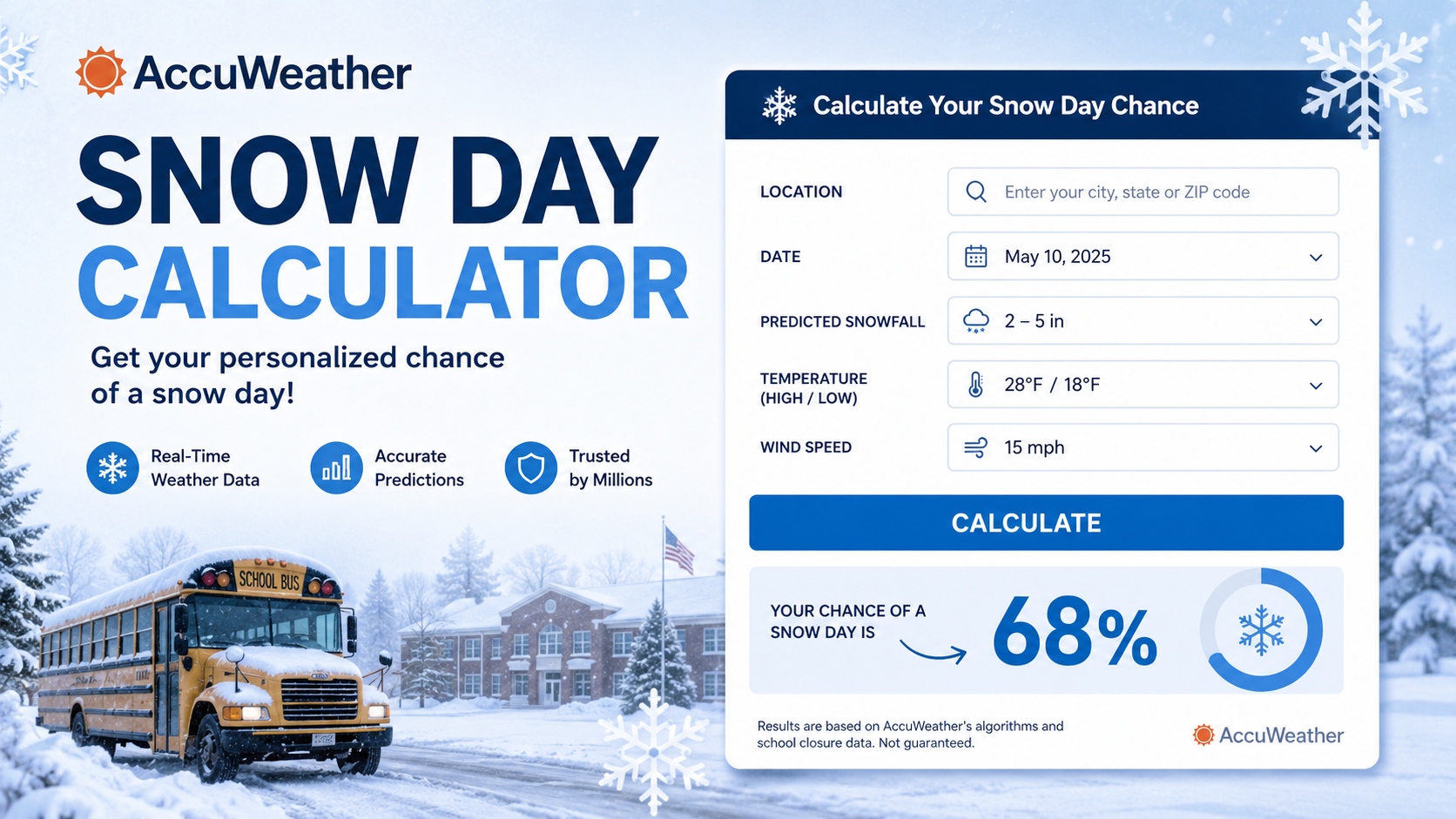
It's 9 p.m., snow is in the forecast, and you're refreshing AccuWeather every ten minutes hoping for a miracle. Sound familiar?
Millions of parents and students search "accuweather snow day calculator" every winter, expecting a magic percentage that tells them school is cancelled. Here's the problem: most articles on this topic either recycle the same vague tips or quietly skip the one fact that actually matters most.
This guide fixes that. You'll learn exactly what AccuWeather does and doesn't do, how real snow day predictions are calculated, and a practical step-by-step method to get a far more accurate read than guessing alone.
Here's the honest answer competitors bury deep in their articles: AccuWeather does not operate its own dedicated "snow day calculator" tool. What AccuWeather provides is something more valuable but less flashy industry-leading raw forecast data: hourly snowfall totals, temperature swings, wind chill, ice accumulation, and storm timing.
Third-party sites then take that raw data and run it through their own closure-prediction formulas to generate a "chance of a snow day" percentage. So when people say "the accuweather snow day calculator," they usually mean a calculator that uses AccuWeather-style data, not a tool AccuWeather itself publishes.
Key takeaway: AccuWeather is the thermometer. A snow day calculator is the thermostat. One measures the storm; the other predicts the human decision made in response to it.
That distinction matters because it changes how you should actually use these tools.
Whether a calculator is homemade or AI-powered, accurate predictions weigh the same core variables:
Total inches matter less than how fast they fall. Four inches in three hours is far more disruptive than four inches over two days.
Freezing rain and black ice close more schools than snow does, even in small amounts, because road crews can't treat ice as fast as snow.
This is the factor most calculators underweight. The same 5-inch forecast behaves completely differently depending on where you live:
Some superintendents call closures early and often. Others push through nearly everything. Checking your district's last 3-5 winters of decisions is more predictive than any single data point.
Rural, bus-heavy districts with long unlit country roads close far more readily than compact urban districts where most students walk.
Here's a simple framework you can use (and cite) without opening any app:
Snow Day Likelihood = Snowfall Rate × Timing Risk × Regional Tolerance
If all three point the same direction (heavy + overnight + low-tolerance district), a closure is highly likely. If they conflict (heavy snow but daytime timing in a high-tolerance district), expect a delay instead of a full closure.
Is the AccuWeather snow day calculator accurate? There's no official AccuWeather calculator to rate. Third-party tools built on AccuWeather-style data tend to land around 80-90% accuracy for 24-48 hour forecasts, dropping for longer-range predictions.
Can I predict a snow day five days out? Not reliably. Snowfall totals and timing shift constantly inside a five-day window. Treat anything beyond 48 hours as a rough trend, not a prediction.
Why did my school stay open despite heavy snowfall predictions? Regional tolerance and infrastructure. A district with strong plowing capacity and short bus routes can absorb snowfall that would shut down a less-equipped area.
The truth about the "accuweather snow day calculator" is simpler than most search results let on: AccuWeather supplies the weather data, and separate tools translate that data into a closure probability. Understanding this distinction, plus the real variables of timing, temperature, regional tolerance, and district history, gives you a far sharper read than any single app can.