English
 Arabic
 French
 Spanish
 Portuguese
 Deutsch
 Turkish
 Dutch
Dutch
 Italiano
 Russian
 Romaian
 Portuguese (Brazil)
 Greek
Greek
(Beyond the Pages of) Brought to Life by The Summer of Lost Things by Jenn Bennett
Dance |
2026-06-22 03:29:45
 Advertise With Us
 About Us
 Terms And Conditions
 Datenschutzbestimmungen
Alle anzeigen
Datenschutzbestimmungen
Alle anzeigen

Upgrade auf Pro
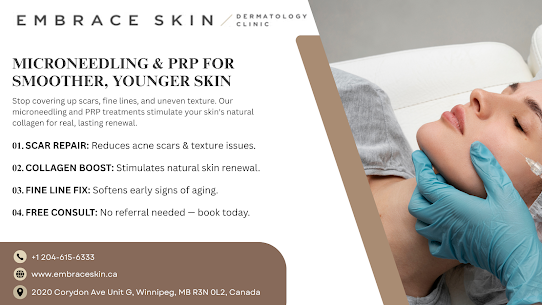
Acne scarring is one of the most common reasons people search for skin treatments in Winnipeg, and two options consistently come up: microneedling and PRP facials. The confusion is understandable, since they're often performed together and sometimes marketed as a single service. But they aren't the same treatment, and understanding the difference will help you set realistic expectations for your own scars.
Standalone microneedling uses fine needles to create controlled micro-injuries across the treatment area, prompting the skin to produce new collagen and elastin as it heals. For acne scarring specifically, this matters because most acne scars — particularly the shallow, rolling, or boxcar type — are essentially areas where the skin lost structural collagen during the original breakout. Rebuilding that collagen is exactly what microneedling is designed to trigger.
On its own, microneedling is genuinely effective for:
It's typically less effective, at least as a standalone treatment, for deep ice-pick scars, which often need additional interventions alongside needling.
Platelet-Rich Plasma (PRP) is your own blood, drawn and processed in a centrifuge to concentrate the platelets — which are rich in growth factors and healing proteins. When PRP is applied to the skin during a microneedling session, it's absorbed through the micro-channels created by the needling, delivering those growth factors directly into the deeper layers of skin rather than sitting on the surface.
The combination — often called "microneedling with PRP," or nicknamed the vampire facial — is generally understood to accelerate healing and enhance the collagen-building response compared to microneedling alone, since you're pairing the mechanical stimulation with a concentrated dose of your body's own repair signals.
For acne scarring specifically, this combination tends to be recommended when:
| Factor | Microneedling Alone | Microneedling + PRP |
|---|---|---|
| Best for | Mild-to-moderate scarring, general texture | Moderate scarring, slower-healing skin |
| Downtime | 2–3 days of redness | Similar, sometimes slightly longer |
| Sessions typically needed | 3–4 | 3–5, sometimes fewer needed overall |
| Added cost | Lower | Higher (blood draw + processing) |
| Mechanism | Collagen stimulation via micro-injury | Collagen stimulation + growth factor delivery |
Neither option is universally "better" — the right choice depends on the depth and type of your scarring, your budget, and how your skin has responded to treatments in the past.
A dermatologist or trained nurse should be assessing a few specific things before recommending one path over the other:
The temptation is to book whichever option sounds more advanced, assuming "more expensive" means "more effective for me." But acne scarring isn't uniform — the same device or combination that dramatically improves one person's scarring might be unnecessary for someone with milder texture concerns. This is why an in-person assessment, ideally including close examination under proper lighting, matters more than picking from a price list.
In Winnipeg, microneedling and PRP treatments are offered together or separately depending on what a patient's scarring actually needs, with treatment plans built by nurses working under dermatologist oversight rather than a fixed package applied to every patient. That distinction matters especially for acne scarring, where the wrong depth or approach can mean months of treatment with underwhelming results.
Whichever option you choose, a few things remain true:
Microneedling and PRP facials aren't competing treatments — PRP is an enhancement layered onto microneedling, not a replacement for it. The right combination for your acne scars depends on their depth, age, and how your particular skin tends to heal, which is exactly why this decision belongs in a proper consultation rather than a self-diagnosed booking. Start with an assessment, get an honest read on your scar type, and build a treatment plan from there.