English
 Arabic
 French
 Spanish
 Portuguese
 Deutsch
 Turkish
 Dutch
Dutch
 Italiano
 Russian
 Romaian
 Portuguese (Brazil)
 Greek
Greek
Pick N Mix Sweets: A Fun Way to Enjoy Your Favourite Treats
Food |
2026-08-11 10:23:02
 Advertise With Us
 About Us
 Terms And Conditions
 Politique de confidentialité
Tout voir
Politique de confidentialité
Tout voir

Mise à niveau vers Pro
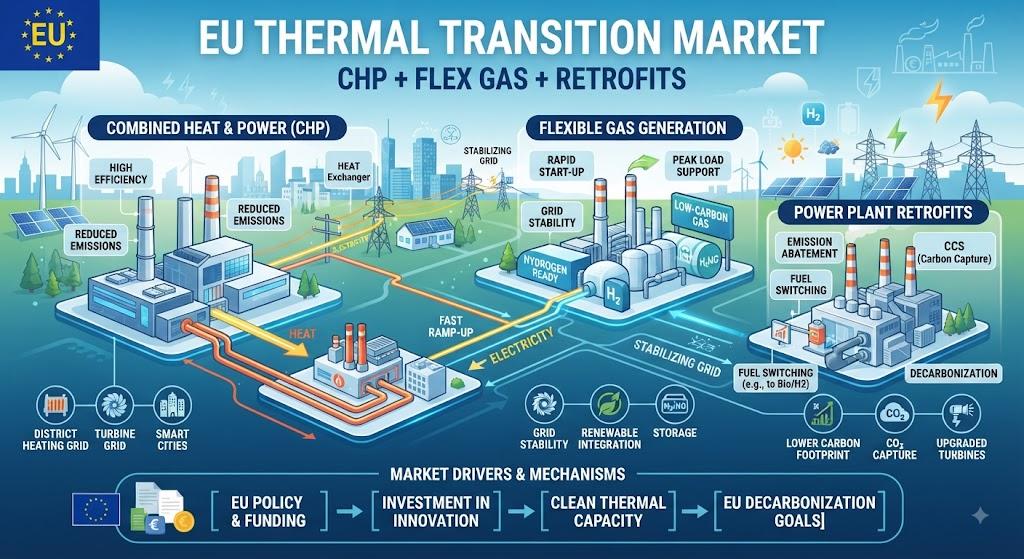
Europe’s thermal infrastructure is moving toward a model in which efficiency and flexibility matter as much as traditional generation capacity. The changing power mix, pressure to reduce emissions, and need for dependable heat are encouraging organizations to reassess existing plants. Rather than relying on a single technology, many investment strategies are combining CHP, flexible gas generation, and carefully selected retrofits to create adaptable energy systems.
CHP can provide a strong foundation for facilities with continuous heat requirements. Hospitals, food processors, chemical plants, district heating networks, and large campuses may benefit from producing electricity and useful heat together. Modern systems can improve fuel utilization while supporting onsite resilience. Their economics become stronger when heat demand is stable and operating schedules are well understood.
Flexible gas capacity can add responsiveness. Renewable electricity does not always match demand, creating periods when additional dispatchable resources are needed. Efficient gas engines and turbines can respond quickly and provide backup capacity. Their future competitiveness will depend on efficiency, utilization, emissions performance, and their ability to operate within a progressively lower-carbon energy system.
Retrofits can improve existing assets without forcing owners into immediate replacement decisions. Common measures include heat exchanger upgrades, improved combustion systems, insulation, steam optimization, pump replacement, controls modernization, and waste heat recovery. Even relatively modest projects can produce recurring savings when equipment operates for thousands of hours each year.
A major advantage of retrofit strategies is flexibility in capital planning. Instead of committing to one large project, organizations can identify the assets with the greatest inefficiencies and upgrade them sequentially. This reduces financial exposure. It can also minimize downtime, an important consideration for industrial and critical facilities.
Thermal storage is becoming increasingly relevant within this model. Storing heat can allow generation equipment to operate when electricity or fuel conditions are favorable while meeting thermal demand later. This separation between production and consumption can improve flexibility and reduce the need to operate equipment at inefficient partial loads.
Digital controls can connect these resources. An integrated energy management system can monitor heat demand, electricity prices, equipment status, storage levels, and grid conditions. Operators can then adjust production according to both technical requirements and commercial signals. Better coordination can increase asset utilization while reducing unnecessary fuel consumption.
The transition also creates a need for stronger investment analysis. Project developers must assess more than equipment costs. They should consider maintenance, operating hours, fuel volatility, carbon exposure, financing, replacement schedules, and potential flexibility revenues. Projects that appear expensive on an initial capital basis may deliver attractive long-term value if they reduce operating costs and improve resilience.
Policy developments will continue influencing technology choices. European markets are pursuing greater efficiency and lower emissions, but energy systems still require reliable resources during periods of high demand or limited renewable output. This creates a need for transition technologies that can provide immediate performance improvements while remaining adaptable to future regulations and fuel changes.
Companies tracking Europe Thermal Transition (CHP + Flex Gas + Retrofits) Market Trends can follow how these technologies are evolving and where investment priorities may emerge. Market opportunities will likely differ by application, country, energy prices, and infrastructure condition.
For equipment suppliers, the opportunity extends beyond new installations. Modernization services, replacement components, software, monitoring, maintenance, and engineering support can generate recurring demand. Customers increasingly need partners capable of integrating multiple technologies rather than supplying isolated equipment.
The long-term direction is therefore practical and interconnected. Europe does not need every thermal asset to follow the same pathway. Some facilities may prioritize CHP efficiency, others flexible generation, and others deep retrofit programs. The common requirement is adaptability. By combining targeted upgrades with intelligent operation, asset owners can improve reliability and efficiency while preparing their facilities for a changing energy environment.
This approach also encourages closer collaboration between facility owners, technology suppliers, consultants, and energy companies. Shared performance data can support better design decisions, while long-term service agreements can help maintain efficiency after commissioning. As projects mature, lessons from early deployments may accelerate adoption across comparable facilities efficiently.