English
 Arabic
 French
 Spanish
 Portuguese
 Deutsch
 Turkish
 Dutch
Dutch
 Italiano
 Russian
 Romaian
 Portuguese (Brazil)
 Greek
Greek
Trending Read The Faraway Inn by Sarah Beth Durst
Travel |
2026-06-25 06:20:16
 Advertise With Us
 About Us
 Terms And Conditions
 Política de privacidade
Ver todos
Política de privacidade
Ver todos

Atualizar para Plus
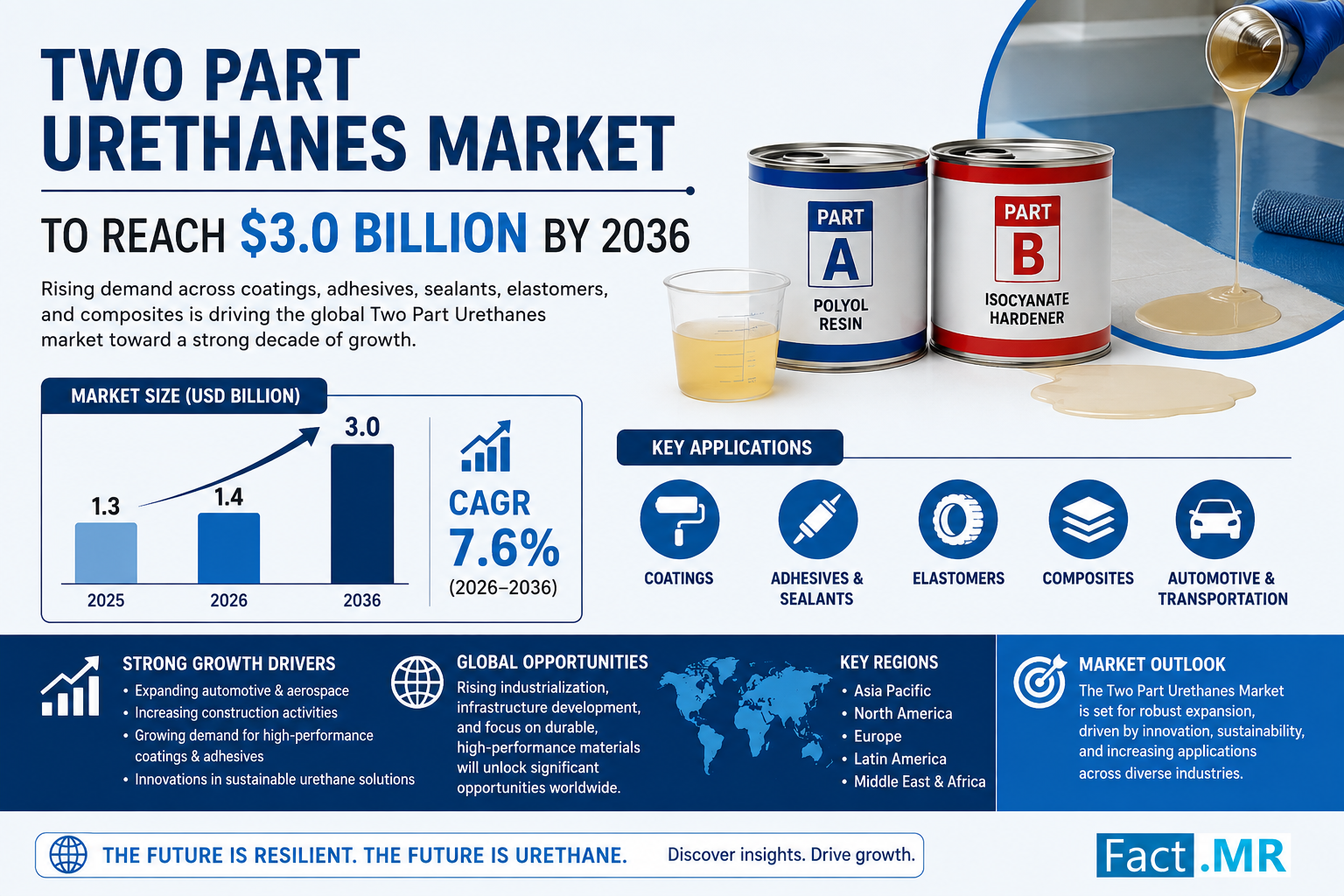
August 14, 2026 — The global Two Part Urethanes Market is projected to reach USD 3.0 billion by 2036, rising from USD 1.4 billion in 2026 at a 7.6% CAGR during 2026–2036, according to Fact.MR analysis. The market reached USD 1.3 billion in 2025 and is expected to create an absolute opportunity of USD 1.6 billion over the forecast period.
Why the Market Is Growing
Two-part urethanes are gaining use where manufacturers need protection against moisture, impact, vibration and abrasion. Potting and encapsulation allow polyurethane to fill irregular housings and protect electronic components and industrial assemblies.
Room-temperature curing is another important factor. It allows large or heat-sensitive assemblies to be processed without ovens. Flexible formulations can also absorb impact and thermal movement, reducing mechanical stress on embedded components.
Automated meter-mix systems are supporting production consistency by improving mix ratios and reducing trapped air during dispensing.
Electronics and automotive manufacturers are key users because these applications require electrical protection along with mechanical durability.
Get detailed market forecasts, competitive benchmarking, and pricing trends: https://www.factmr.com/connectus/sample?flag=S&rep_id=16050
Market Growth Drivers
The market's leading growth areas are linked to flexible protection, potting demand and easier processing. Fact.MR identifies flexible/low-stress materials as having a +2.1% impact on CAGR, while demand for potting and encapsulation has a +1.7% impact. Room-temperature processing has a +1.2% impact.
However, manufacturers must manage moisture-driven foaming, off-ratio curing and long property-development times. These factors have estimated CAGR impacts of -1.0%, -0.8% and -0.5%, respectively.
Key Numbers
Segment Analysis
Potting & encapsulation: This segment is projected to hold 37.0% of Product Function in 2026. Polyurethane fills complex housings around boards, connectors and cables while providing protection from moisture and vibration.
Flexible/low-stress: This property category is expected to account for 42.0% of Property Focus. Flexible polyurethane accommodates thermal expansion and absorbs vibration and impact.
Room-temperature cure: With a 30.0% share of Cure Profile in 2026, this process supports large and heat-sensitive assemblies without oven exposure.
Electronics manufacturers: This end-user segment is forecast to account for 36.0% in 2026. Electronics producers use urethane for potting and module protection where impact resistance and dielectric performance are important.
Country Outlook
The United States is forecast to record the fastest growth among the listed countries, with an 8.5% CAGR from 2026 to 2036. Germany and Japan are each projected to expand at 8.1% CAGR.
USA: Electronics, aerospace and industrial equipment applications support demand. Semiconductor and advanced-packaging investment is also creating additional production capacity.
Germany: Automotive, machinery and electrical-equipment manufacturing provide a strong base for qualified materials and automated assembly.
Japan: Precision electronics and automotive manufacturing support demand for repeatable, low-stress encapsulation and room-temperature processing.
Competitive Landscape
The competitive environment includes Henkel, Huntsman, Covestro, BASF, Epic Resins and Sika. Henkel is positioned as a leading supplier through formulation breadth and technical support, while Huntsman and Covestro compete through application-specific materials for electronics and industrial equipment.
Buyers evaluate viscosity, cure profile, thermal performance, dielectric properties and mechanical performance. Qualification history and formulation consistency can create switching costs. Local technical support can therefore become an important differentiator.
Analyst View
Shambhu Nath Jha, Senior Consultant at Fact.MR, states that buyer decisions will center on flexible potting, impact resistance and room-temperature processing. He adds that suppliers supporting application trials and maintaining formulation and equipment consistency can accelerate movement into repeat production.
Frequently Asked Questions
What is the Two Part Urethanes Market forecast to be worth by 2036?
The market is forecast to reach USD 3.0 billion by 2036.
What is the Two Part Urethanes Market CAGR?
The market is projected to expand at a 7.6% CAGR from 2026 to 2036.
Which segment leads the market?
Potting & encapsulation leads Product Function with a projected 37.0% share in 2026.
Which property focus has the largest share?
Flexible/low-stress is projected to account for 42.0% in 2026.
Which country is growing fastest among the listed markets?
The USA is forecast to grow at an 8.5% CAGR through 2036.
Top Trending Reports:
https://www.openpr.com/news/4494424/calcium-bromide-market-to-reach-usd-1-87-billion-by-2036-driven
https://www.openpr.com/news/4494404/advanced-polymer-composites-market-to-reach-usd-19-60-billion
https://www.openpr.com/news/4496089/the-future-of-olfaction-how-macrocyclic-mastery-and-green
https://www.openpr.com/news/4496102/thermal-management-materials-the-critical-infrastructure
About Fact.MR
Fact.MR is a market research and consulting firm providing industry intelligence, market forecasts, competitive analysis and strategic insights across global industries. Its research supports manufacturers, investors, procurement teams and business leaders in making informed market decisions.