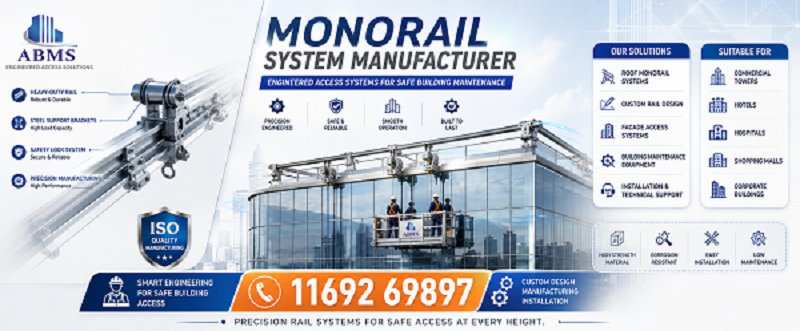
A Monorail System Manufacturer plays an important role in providing reliable and efficient access solutions for the maintenance of modern high-rise buildings. As architectural structures become taller and more complex, building owners require specialized equipment to safely access exterior façades for cleaning, inspection, repair, painting, waterproofing, and other maintenance activities. A professionally designed monorail system provides a practical solution by allowing suspended access equipment to travel along a dedicated track installed on or around the building structure.
ABMS Services provides customized monorail system solutions designed according to the architectural, structural, and operational requirements of individual buildings. Our façade access systems are suitable for commercial towers, residential buildings, hotels, hospitals, shopping malls, airports, industrial facilities, and other structures where regular exterior maintenance is required.
A monorail system can be integrated with suspended platforms, cradles, gondolas, or other approved façade access equipment. The travelling mechanism allows the working platform to move along the designated track, providing access to different sections of the building exterior. This can make recurring maintenance operations more organized and efficient compared with temporary access arrangements.
What Is a Monorail System?
A monorail system is a façade access system consisting of a specially engineered rail or track along which a travelling trolley or maintenance unit can move. The track may be installed on the rooftop, parapet, ceiling, façade edge, or another structurally suitable location, depending on the building's design.
The travelling mechanism can support or connect to a suspended working platform. Once the platform is positioned at the required location, trained personnel can perform designated maintenance activities on the façade.
Monorail systems are particularly useful for buildings with:
- Large glass façades
- Curtain wall systems
- Complex architectural features
- Recessed façade sections
- Irregular building profiles
- Multiple exterior maintenance zones
- High-rise elevations
The system configuration is determined by the building design and the intended maintenance applications.
Role of a Monorail System Manufacturer
A professional Monorail System Manufacturer is responsible for more than simply fabricating a rail. The manufacturer must understand the building's access requirements and develop a suitable system that integrates with the structure and intended maintenance equipment.
The complete process may involve:
- Site assessment
- Building access analysis
- System engineering
- Track design
- Component selection
- Manufacturing
- Installation
- Testing
- Commissioning
- Operator training
- Maintenance
- Technical support
At ABMS Services, we focus on providing complete façade access solutions rather than supplying isolated components. This approach allows the system to be developed around the actual requirements of the building.
Why Monorail Systems Are Important for Building Maintenance
Building façades are continuously exposed to sunlight, rain, wind, dust, pollution, and other environmental conditions. Glass panels, window frames, curtain walls, sealants, exterior coatings, and architectural components may require regular inspection and maintenance.
Without a suitable access system, exterior maintenance can become time-consuming and difficult.
A dedicated monorail system can provide controlled access for activities such as:
- Glass cleaning
- Window cleaning
- Façade inspection
- Exterior painting
- Waterproofing
- Sealant application
- Curtain wall maintenance
- Exterior repair
- Renovation work
- Building façade servicing
For buildings requiring frequent exterior maintenance, integrating a suitable façade access system can be an important part of the overall building design.
Major Components of a Monorail System
A complete monorail access system can contain several mechanical, structural, and electrical components.
1. Monorail Track
The monorail track provides the route along which the travelling mechanism moves. Track design depends on building geometry, access requirements, and system loads.
The track must be appropriately supported and integrated with the building structure according to the approved engineering design.
2. Travelling Trolley
The trolley moves along the monorail track and allows the suspended equipment to be positioned at different façade locations.
A reliable travelling mechanism helps provide controlled and smooth movement.
3. Suspension System
The suspension system connects the travelling equipment with the working platform. Its configuration depends on platform size, working load, building height, and other technical requirements.
4. Wire Ropes
High-strength wire ropes may be used to suspend and operate the working platform. Wire ropes require regular inspection and maintenance to identify wear, corrosion, deformation, or other damage.
5. Electric Hoists
Electric hoists provide vertical movement of the suspended platform. The hoist configuration should be selected according to the intended load and operating requirements.
6. Working Platform
The suspended platform provides the workspace for authorized personnel performing façade maintenance activities.
Platform length and configuration can be customized according to the building and project requirements.
7. Control Panel
The control system allows operators to manage platform movement. Depending on the design, it may include start, stop, emergency stop, and other operating functions.
8. Safety Equipment
Safety equipment can include safety locks, emergency stopping mechanisms, overload protection, limit switches, anti-tilt arrangements, guardrails, and other protective devices appropriate to the system design.
Applications of Monorail Systems
Monorail systems can support a wide range of exterior maintenance applications.
Glass Facade Cleaning
Modern commercial and residential buildings often use extensive glass façades. Regular cleaning helps maintain the building's appearance and visibility.
A monorail-supported platform can provide access to elevated glass surfaces and allow cleaning personnel to work at different levels.
Window Maintenance
Exterior windows may require cleaning, inspection, repair, replacement, or hardware maintenance. A suitable suspended platform can provide access to these areas.
Facade Inspection
Regular façade inspection can help identify visible deterioration, damaged panels, cracks, loose components, corrosion, or sealant issues.
A dedicated access system makes it easier for trained personnel to reach different façade sections.
Exterior Painting
Painting and renovation projects may require workers to access exterior walls at considerable heights. Suspended access equipment can provide a suitable working position when the system is designed for the intended application.
Waterproofing
Exterior waterproofing work can require access to joints, façade interfaces, window surrounds, and other elevated areas. A monorail access system can support such work.
Sealant and Silicone Work
Curtain wall joints and façade connections may require periodic sealant inspection and replacement. A suspended platform can provide access to these areas.
Facade Repair
Repair and renovation projects can involve replacing façade panels, fixing external fixtures, repairing coatings, and addressing other exterior issues.
Benefits of a Monorail System
Dedicated Facade Access
A monorail system provides a dedicated access route for moving maintenance equipment along designated façade areas.
Improved Maintenance Efficiency
A permanent access system can reduce the time required to arrange temporary access equipment for recurring maintenance activities.
Flexible Movement
The travelling mechanism allows the platform to be positioned at different locations along the monorail track.
Customized Design
A professional manufacturer can customize the track arrangement and equipment configuration according to the building's architecture.
Reduced Scaffolding Requirements
For suitable applications, a dedicated monorail system can reduce reliance on extensive temporary scaffolding.
Long-Term Use
When properly designed, installed, inspected, and maintained, a monorail system can support recurring maintenance activities over a long period.
Suitable for Complex Facades
Monorail systems can be designed for buildings with challenging architectural features and multiple access requirements.
Safety Features of Monorail Systems
Safety is a critical consideration when selecting a Monorail System Manufacturer. Work at height requires appropriate engineering, installation, operation, inspection, and maintenance procedures.
Depending on the system design, safety provisions may include:
- Emergency stop mechanisms
- Safety locks
- Overload protection
- Limit switches
- Anti-tilt arrangements
- Guardrails
- High-strength wire ropes
- Secure suspension points
- Harness attachment provisions
- Mechanical locking mechanisms
At ABMS Services, quality inspection and testing are important parts of the manufacturing and commissioning process. The equipment should be appropriately tested and inspected before being placed into operational service.
Customized Monorail System Solutions
Every building has unique architectural and structural characteristics. A standard system may not be suitable for every project.
A customized monorail system can be developed according to:
- Building height
- Track length
- Façade width
- Building geometry
- Working load
- Platform size
- Hoist capacity
- Suspension requirements
- Rooftop configuration
- Number of maintenance zones
- Intended applications
ABMS Services can provide project-specific façade access solutions based on these requirements.
Monorail System Design Process
A professional design process helps ensure that the final system is appropriate for the building.
Step 1: Site Assessment
The building and proposed installation areas are assessed to understand the access requirements.
Step 2: Requirement Analysis
The manufacturer reviews the intended maintenance activities, platform requirements, working load, and access zones.
Step 3: Engineering Design
The monorail track and associated equipment are designed according to project specifications.
Step 4: Structural Coordination
The proposed system is coordinated with the building structure and relevant project engineering requirements.
Step 5: Manufacturing
Components are manufactured according to approved technical specifications.
Step 6: Installation
The monorail system is installed at the designated location.
Step 7: Testing
The completed system undergoes appropriate functional and performance testing.
Step 8: Commissioning
After successful testing and inspection, the equipment can be commissioned for intended use.
Manufacturing Quality
Manufacturing quality directly affects the reliability and service life of a monorail system. A professional manufacturer should maintain quality checks throughout fabrication, assembly, and testing.
Important considerations include:
- Quality of structural materials
- Welding quality
- Dimensional accuracy
- Track alignment
- Corrosion protection
- Mechanical component quality
- Electrical component quality
- Fastener quality
- Safety equipment
- Functional testing
At ABMS Services, quality-focused manufacturing is an important part of developing dependable façade access solutions.
Installation of Monorail Systems
Professional installation is essential for achieving reliable equipment performance.
A typical installation process may include:
- Site verification
- Review of engineering drawings
- Preparation of mounting areas
- Monorail track installation
- Travelling trolley installation
- Suspension system installation
- Platform assembly
- Hoist installation
- Electrical connections
- Safety equipment installation
- Functional testing
- Performance testing
- Commissioning
The actual procedure depends on the system design and building requirements.
Testing and Commissioning
Testing is an important part of the installation process. Before the system is placed into regular service, appropriate components should be inspected and tested.
Testing can include:
- Track inspection
- Trolley movement
- Hoist operation
- Wire rope inspection
- Platform stability
- Control system testing
- Emergency stop testing
- Safety lock testing
- Limit switch testing
- Electrical inspection
Proper documentation can help building owners and facility managers maintain equipment records.
Maintenance of Monorail Systems
Regular maintenance is essential for maintaining reliable operation.
Preventive maintenance may include:
- Track inspection
- Wire rope inspection
- Hoist inspection
- Trolley inspection
- Electrical checks
- Safety device testing
- Fastener inspection
- Lubrication where applicable
- Corrosion inspection
- Replacement of worn components
Regular maintenance can help identify potential problems before they become serious operational issues.
Annual Maintenance Contract for Monorail Systems
An Annual Maintenance Contract (AMC) can provide building owners with a planned approach to equipment maintenance.
An AMC may include:
- Scheduled inspections
- Preventive maintenance
- Safety system checks
- Mechanical inspections
- Electrical checks
- Technical support
- Maintenance reporting
- Replacement recommendations
The scope of an AMC should be determined according to the equipment configuration and project requirements.
Monorail System for High-Rise Buildings
High-rise buildings require reliable methods for accessing their exterior surfaces. A dedicated façade access system can make recurring maintenance more manageable.
Monorail systems can be suitable for:
- Corporate office towers
- Residential apartments
- Hotels
- Hospitals
- Shopping malls
- Airports
- Educational buildings
- Industrial facilities
- Mixed-use developments
The system should be designed according to the building's individual access requirements.
Monorail System for Commercial Buildings
Commercial properties often require regular façade cleaning and maintenance to maintain their professional appearance.
A monorail system can support:
- Glass cleaning
- Window maintenance
- Exterior inspection
- Painting
- Waterproofing
- Sealant maintenance
- Façade repairs
For large commercial buildings, integrating façade access equipment into the building design can provide long-term operational advantages.
Monorail System for Residential Buildings
Residential towers with extensive glazing and complex façades also require regular maintenance. A properly designed monorail system can provide building management teams with dedicated exterior access.
The system can be customized according to rooftop space, façade design, building height, and maintenance requirements.
Monorail System for Hotels and Hospitals
Hotels and hospitals require consistent exterior maintenance because appearance and cleanliness are important to their operations.
Monorail systems can provide access for cleaning and maintenance teams while helping minimize disruption to building occupants.
Monorail System vs Traditional Scaffolding
Traditional scaffolding remains useful for many construction and repair activities. However, for recurring high-rise façade maintenance, a dedicated access system can provide certain operational advantages.
A monorail system:
- Provides dedicated access
- Can be used repeatedly
- Reduces setup requirements for recurring work
- Allows controlled platform movement
- Can be customized to the building
- May reduce dependence on extensive temporary scaffolding
The appropriate solution depends on the building design, project requirements, work duration, and applicable safety requirements.
Cost of a Monorail System
The cost of a Monorail System varies from project to project. Several factors influence the final price.
These include:
- Building height
- Track length
- Track configuration
- Platform size
- Working load
- Hoist capacity
- Number of access points
- Suspension arrangement
- Structural requirements
- Installation complexity
- Safety equipment
- Testing and commissioning
- Maintenance requirements
For this reason, a professional site assessment is recommended before preparing a final quotation.
Choosing the Right Monorail System Manufacturer
Selecting an experienced manufacturer is an important step in a façade access project.
Experience
Look for experience in designing and manufacturing façade access equipment for high-rise buildings.
Engineering Capability
The manufacturer should be able to understand the building's architectural and structural requirements.
Quality
Evaluate the quality of materials, fabrication, components, testing, and finishing.
Installation
Professional installation is essential for reliable equipment performance.
After-Sales Support
Maintenance, inspection, spare parts, and technical assistance are important throughout the system's service life.
Customization
A manufacturer capable of designing customized solutions can be particularly valuable for buildings with complex façades.
Why Choose ABMS Services?
ABMS Services provides customized façade access and monorail solutions for modern buildings. Our approach focuses on quality engineering, customized design, reliable manufacturing, professional installation, testing, and ongoing maintenance support.
Our services can include:
- Site assessment
- Monorail system design
- Engineering
- Manufacturing
- Installation
- Testing
- Commissioning
- Inspection
- Maintenance
- Technical support
We understand that every building has different access requirements. Our customized approach helps ensure that the selected system is appropriate for the intended maintenance activities.
Monorail System Manufacturer in India
The continued development of high-rise commercial and residential buildings has increased the demand for specialized façade access equipment in India.
Building owners, developers, contractors, and facility managers require systems that can provide reliable access to exterior surfaces while supporting efficient maintenance operations.
A professional Monorail System Manufacturer in India can provide project-specific design, manufacturing, installation, and service support.
ABMS Services offers customized monorail solutions for a wide range of building maintenance requirements.
Environmental Considerations
Monorail systems are installed in outdoor environments and may be exposed to rain, humidity, dust, pollution, sunlight, and temperature variations.
Material selection and corrosion protection are therefore important considerations. Regular inspection and preventive maintenance can help identify corrosion or deterioration at an early stage.
Proper equipment maintenance also helps support long-term operational reliability.
Future of Monorail Facade Access Systems
Building maintenance technology continues to evolve. Future façade access systems may increasingly focus on automation, improved monitoring, enhanced safety controls, and efficient operation.
Potential developments include:
- Advanced control systems
- Improved monitoring
- Automated safety functions
- Enhanced travelling mechanisms
- Better corrosion protection
- Smart building integration
- Improved maintenance tracking
These developments can help facility managers improve the planning and management of exterior building maintenance.
Frequently Asked Questions
What is a Monorail System?
A monorail system is a façade access arrangement consisting of a dedicated track and travelling mechanism used to move suspended maintenance equipment along a building exterior.
What is a monorail system used for?
Monorail systems are commonly used for glass cleaning, façade inspection, window maintenance, painting, waterproofing, sealant work, repairs, and other exterior maintenance activities.
Can a monorail system be customized?
Yes. Track configuration, platform dimensions, working load, suspension arrangement, and other components can be customized according to building requirements.
Where are monorail systems installed?
Depending on the building design, monorail tracks may be installed on rooftops, parapets, ceilings, façade edges, or other structurally suitable locations.
Are monorail systems suitable for high-rise buildings?
Yes, appropriately designed monorail façade access systems can provide dedicated access for maintenance activities on high-rise buildings.
Does a monorail system require regular maintenance?
Yes. Regular inspection, testing, and preventive maintenance are important for maintaining safe and reliable equipment performance.
Does ABMS Services provide monorail system installation?
ABMS Services provides comprehensive support including system design, manufacturing, installation, testing, commissioning, and maintenance.
How much does a monorail system cost?
The price depends on building height, track length, platform configuration, working load, hoist capacity, structural requirements, safety equipment, and installation complexity.
Conclusion
A Monorail System Manufacturer provides an important solution for modern high-rise building maintenance. By combining engineered tracks, travelling mechanisms, suspension equipment, hoists, and working platforms, monorail systems provide controlled access to building façades.
These systems can support a wide range of applications, including glass cleaning, window maintenance, façade inspection, exterior painting, waterproofing, sealant replacement, repair, and renovation.
For buildings with large glass façades or complex architectural designs, a professionally designed monorail system can improve maintenance efficiency and provide a dedicated long-term access solution.
Choosing the right manufacturer is essential. Proper engineering, quality manufacturing, professional installation, appropriate testing, regular inspection, and preventive maintenance all contribute to reliable equipment performance.
ABMS Services provides customized monorail façade access solutions based on individual building requirements. From initial site assessment and engineering to manufacturing, installation, testing, commissioning, and maintenance, ABMS Services offers comprehensive support for modern façade access requirements.
For building owners, developers, contractors, architects, and facility managers looking for a reliable Monorail System Manufacturer, ABMS Services provides practical, customized, durable, and safety-focused solutions for high-rise building maintenance.
 English
 Arabic
 French
 Spanish
 Portuguese
 Deutsch
 Turkish
 Dutch
Dutch
 Italiano
 Russian
 Romaian
 Portuguese (Brazil)
 Greek
Greek
 Advertise With Us
 About Us
 Terms And Conditions
 Datenschutzbestimmungen
Alle anzeigen
Datenschutzbestimmungen
Alle anzeigen