English
 Arabic
 French
 Spanish
 Portuguese
 Deutsch
 Turkish
 Dutch
Dutch
 Italiano
 Russian
 Romaian
 Portuguese (Brazil)
 Greek
Greek
Intensive Care Unit (ICU) Beds Market: Advancing Critical Care Infrastructure Worldwide
Networking |
2026-07-03 07:41:40
 Advertise With Us
 About Us
 Terms And Conditions
 Datenschutzbestimmungen
Alle anzeigen
Datenschutzbestimmungen
Alle anzeigen

Upgrade auf Pro
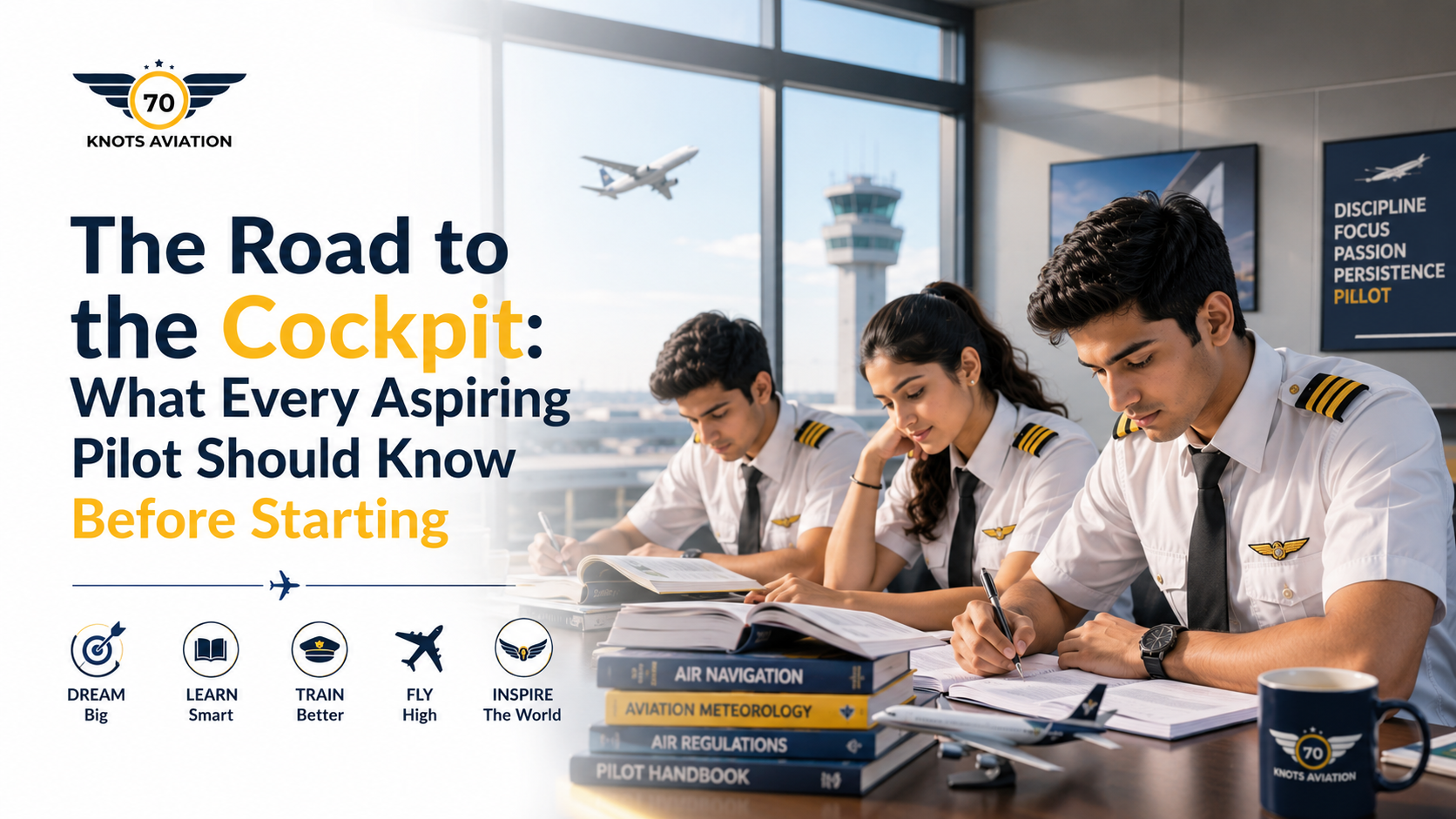
For thousands of students in India, aviation is more than just an interesting career option. It is a profession that represents independence, responsibility, technology, and the opportunity to operate one of the most sophisticated machines ever built.
Many young people imagine themselves sitting in the cockpit of a commercial aircraft, travelling across countries, and carrying passengers safely to their destinations. However, the journey from being a student to becoming a licensed pilot is not something that happens overnight.
It is a carefully structured process that rewards students who prepare early, understand the requirements, and remain committed throughout their training.
Before enrolling in any aviation programme, students should understand what the journey actually looks like and what they can expect at each stage.
Aviation often looks glamorous from the outside. Passengers usually see pilots walking through airports in uniform, but they do not see the years of preparation behind that moment.
Students who search for How to become a pilot often expect a short answer. In reality, becoming a professional pilot involves several stages, including education, medical fitness, theoretical preparation, examinations, practical flight training, and licensing.
The process is structured this way because pilots are responsible for making important decisions while operating aircraft in changing weather conditions and busy airspace.
A strong foundation is therefore essential.
Students should begin by understanding the eligibility criteria and deciding whether aviation genuinely matches their interests. A successful pilot needs more than a love for flying. The profession also requires discipline, calm decision-making, attention to detail, and the ability to continue learning throughout one's career.
Some students discover their interest in aviation only after finishing school. Others begin planning much earlier.
For students aiming for the commercial pilot pathway, Physics and Mathematics are particularly important subjects at the 10+2 level.
These subjects provide the foundation for understanding topics that appear later during aviation training.
Mathematics helps students become comfortable with calculations used in navigation and flight planning. Physics provides an understanding of forces, motion, energy, and principles that help explain how aircraft operate.
Students who build a strong foundation in these subjects often find it easier to adapt to aviation studies later.
One of the biggest surprises for new aviation students is the amount of theory involved.
Flying is only one part of the profession.
Before entering the cockpit, aspiring pilots need to understand subjects that explain how aviation works.
This is where DGCA Pariksha becomes an important milestone for students pursuing professional pilot training in India.
The examinations assess theoretical knowledge in areas that are directly connected with safe flight operations.
Students may encounter subjects such as:
These subjects are different from most school subjects because they combine concepts with practical applications.
For example, meteorology is not simply about memorising cloud names. Students need to understand how weather systems can affect aircraft operations. Navigation is not just mathematics; it involves applying calculations to real flight situations.
The syllabus can seem extensive when students first encounter it.
However, the real challenge is usually not intelligence. It is consistency.
Students who postpone preparation often feel overwhelmed because the subjects build on one another.
For instance, if a student does not understand basic navigation concepts, advanced problems can become much harder. If aviation regulations are learned only through memorisation, remembering them during examinations can also become difficult.
The most successful students usually follow a simple pattern:
This approach is much more effective than trying to complete an entire syllabus in the final weeks before an examination.
Students often ask whether they should spend most of their time reading books or solving questions.
The best approach is to use both methods together.
A balanced preparation strategy could look like this:
Begin with classroom teaching, books, or structured learning material to understand the topic properly.
Once the concept is clear, solve questions that test your understanding and expose areas where additional preparation is needed.
Go back to incorrect answers and identify why the mistake happened. Understanding an error is often more valuable than simply knowing the correct answer.
Return to important formulas, definitions, procedures, and concepts regularly so they remain fresh throughout the preparation period.
This cycle helps students retain information much more effectively than passive reading alone.
Every aspiring pilot eventually has to discuss the financial commitment involved in training.
The Pilot training cost in india can vary considerably because different training organisations offer different structures and students may progress through training at different speeds.
Several factors can influence the total expense, including:
Because of these variables, students should never rely only on a headline fee.
Instead, they should request a detailed explanation of what is included in the programme.
Families should ask whether the quoted amount covers all expected training components or whether certain expenses will need to be paid separately later.
Planning finances carefully before beginning the journey can reduce stress during training and help families make more realistic decisions.
Students often search for the Best Pilot training school, hoping to find a simple answer.
The truth is that the right training environment depends on the student's needs.
A strong institute should provide more than just lectures.
Students should look for:
The teaching style also matters.
Some students learn best through detailed explanations. Others improve through practice, discussion, visual learning, and repeated problem-solving.
Before enrolling, it is worth finding out whether the institute's approach matches the student's learning style.
Students naturally associate pilot training with flying an aircraft, but theoretical preparation is an equally important part of becoming a professional pilot.
Ground classes introduce students to the concepts they will later apply during practical training. Navigation, meteorology, regulations, aircraft systems, and communication procedures all contribute to a pilot's overall understanding of aviation.
A student who understands these subjects properly can approach practical training with a stronger foundation.
Ground training should therefore not be viewed as something that simply needs to be completed before flying. It is an important part of developing the knowledge required to make informed decisions in aviation.
For students preparing for aviation theory and DGCA examinations, 70Knots Aviation focuses on helping aspiring pilots develop a stronger understanding of the subjects required during their preparation.
The institute provides ground training for students working toward professional aviation goals, including preparation related to DGCA CPL and ATPL examinations.
Rather than treating aviation as a collection of questions to memorise, structured preparation can help students connect different topics and understand how they relate to real-world flying.
Subjects such as Air Navigation and Aviation Meteorology often become easier when students understand the logic behind them instead of simply remembering answers.
70Knots Aviation also focuses on areas such as examination preparation, study support, mentoring, and guidance throughout different stages of the pilot-training journey.
For students who are serious about aviation, having access to organised study resources, practice opportunities, and guidance can make the preparation process feel more manageable.
Yes. Aviation does not require students to have been the highest scorers in school. What matters is meeting the applicable eligibility requirements and developing the discipline to study consistently. Students should focus on building strong fundamentals in the subjects relevant to their aviation training.
The duration can vary depending on examination preparation, weather conditions, aircraft availability, training schedules, individual progress, and other operational factors. Students should therefore avoid assuming that every pilot will complete training within exactly the same timeframe.
Yes. English plays an important role in aviation because pilots communicate using standardised aviation terminology and procedures. Students should work on both general English skills and aviation communication as they progress through training.
Building a strong theoretical foundation before or alongside practical training can help students understand flight exercises more effectively. Knowledge of navigation, weather, regulations, and aircraft-related subjects can make later stages of training easier to follow.
Students should ask about the course structure, faculty, teaching methods, study material, examination preparation, fee transparency, available support, and what is included in the programme. Speaking with current or former students can also provide useful insight before making a major financial commitment.
Aviation rewards preparation.
Students who enter the field with realistic expectations are often better equipped to handle the challenges they encounter along the way.
There will be subjects that require extra effort. There will be examinations that demand focused preparation. Practical training will also require patience because learning to operate an aircraft safely is a gradual process.
Instead of seeing these challenges as obstacles, aspiring pilots should view them as part of becoming a professional.
Every hour spent understanding navigation, every mock test completed, and every difficult topic finally understood contributes to the knowledge required in the cockpit.
The dream of flying is shared by many students, but dreams become careers through preparation.
Students who want to enter aviation should begin by understanding the complete journey instead of focusing only on the final destination. Education, medical fitness, theoretical knowledge, examinations, flight training, finances, and licensing all have a role to play.
The earlier students understand these stages, the easier it becomes to make informed decisions.
Choosing aviation is a major commitment, but it can also become one of the most rewarding professional journeys for someone who genuinely enjoys learning, responsibility, technology, and flying.
The cockpit may be the destination, but everything learned before reaching it becomes part of the pilot you eventually become.
So, if flying has always been your ambition, start with knowledge.
Research the requirements. Build your academic foundation. Prepare seriously for your examinations. Understand the financial commitment. Choose your training environment carefully.
Most importantly, remember that becoming a pilot is not about reaching the cockpit as quickly as possible.
It is about reaching it prepared.