English
 Arabic
 French
 Spanish
 Portuguese
 Deutsch
 Turkish
 Dutch
Dutch
 Italiano
 Russian
 Romaian
 Portuguese (Brazil)
 Greek
Greek
How Hydrafacial Treatment in Dubai Helps You Achieve Fresh and Healthy-Looking Skin
Health |
2026-07-20 09:28:31
 Advertise With Us
 About Us
 Terms And Conditions
 Политика конфиденциальности
Смотреть все
Политика конфиденциальности
Смотреть все

Обновить до Про
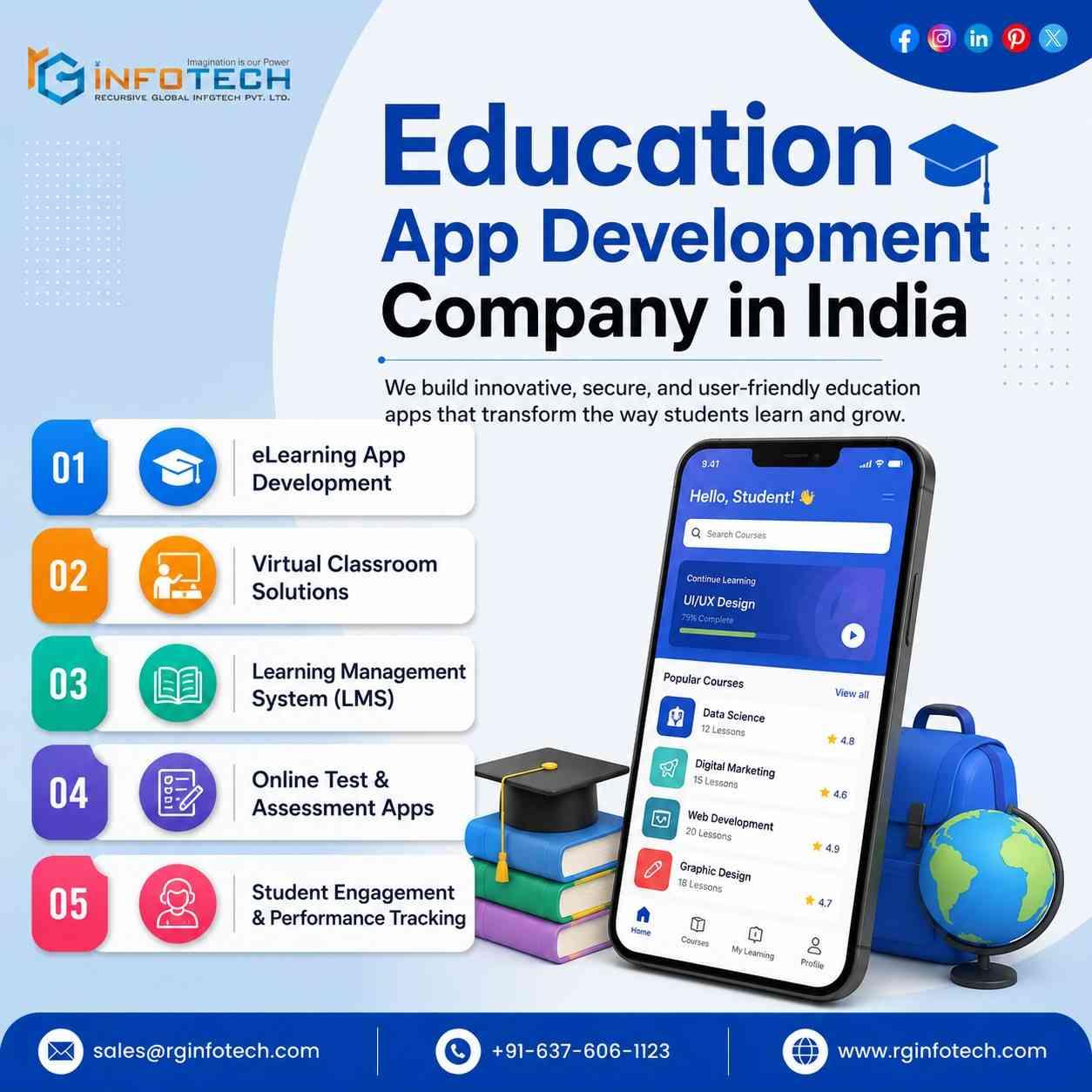
Artificial intelligence is changing how people learn, teach, and interact with digital education platforms. Traditional education applications primarily focused on delivering courses, videos, quizzes, and study materials. Today, AI can make these experiences more personalized, interactive, and responsive to individual learner needs.
From AI tutors and personalized learning paths to automated assessments and intelligent content recommendations, artificial intelligence is becoming an important part of modern education technology. For startups, schools, universities, coaching platforms, and EdTech businesses, integrating AI into education apps can create new opportunities to improve learning outcomes and user engagement.
This article explores how AI is shaping the future of education app development and the technologies businesses should consider when building next-generation learning solutions.
AI-powered education app development involves integrating artificial intelligence and machine learning technologies into learning applications to automate tasks, understand user behavior, and personalize educational experiences.
Instead of providing the same content to every learner, an AI-enabled app can analyze performance, identify knowledge gaps, and recommend suitable resources.
For example, if a student repeatedly struggles with mathematics, the application can identify the problem and suggest additional explanations, practice questions, or beginner-level lessons.
This makes learning more adaptive and focused on individual needs.
Traditional education apps often provide static content. Although these platforms can be useful, they may not respond effectively to different learning speeds and preferences.
AI can make education applications more intelligent by analyzing large amounts of learning data and generating useful insights.
Key benefits include:
Personalized learning experiences
Automated assessments
Intelligent recommendations
Faster student support
Better teacher productivity
Improved engagement
Real-time performance analysis
An experienced Education App Development Company in India can help businesses identify practical AI use cases and integrate them into their applications without making the product unnecessarily complicated.
AI tutors are likely to become one of the most important features of future education applications.
A virtual tutor can answer questions, explain concepts, provide examples, and guide students through learning materials. Unlike traditional chatbots, advanced AI tutors can understand conversational queries and provide context-aware responses.
Students can ask questions in natural language instead of searching manually through course materials.
AI tutors can also provide 24/7 assistance, making them particularly useful for students studying outside regular classroom hours.
Every learner has different strengths, weaknesses, interests, and learning speeds. AI can analyze these differences and create customized learning paths.
The system can consider:
Quiz results
Course completion
Learning behavior
Time spent on lessons
Previous mistakes
Preferred learning formats
Based on this information, the application can recommend what the learner should study next.
This approach can make learning more relevant and reduce the possibility of students becoming overwhelmed by unnecessary content.
AI can work as a recommendation engine within an education application.
Similar to how entertainment platforms recommend content based on user preferences, an education app can suggest courses, lessons, videos, articles, and practice exercises.
For example, after completing a beginner programming course, a student could receive recommendations for intermediate programming topics based on their performance and interests.
This can also help education businesses improve content discovery and increase engagement.
Creating and evaluating assessments can take considerable time for educators. AI can automate parts of this process.
AI-powered systems can generate questions, evaluate objective responses, identify common mistakes, and provide immediate feedback.
For written responses, advanced AI systems can assist with evaluating content based on predefined criteria. Human educators should still have appropriate oversight, particularly for high-stakes assessments.
Instant feedback can help students understand mistakes while the lesson is still fresh in their minds.
Education apps can collect significant amounts of learning data. AI can analyze this information to identify patterns that may not be obvious through basic reports.
Teachers can receive insights into:
Students struggling with specific topics
Changes in performance
Course completion trends
Frequently missed questions
Engagement levels
These insights can help educators provide targeted support instead of relying only on general classroom performance.
Voice technology can make education applications more accessible and interactive.
Students could ask questions verbally, practice pronunciation, or interact with an AI tutor through voice commands.
Language-learning applications can particularly benefit from speech recognition. AI can analyze pronunciation and provide feedback to help users improve their speaking skills.
Voice-enabled learning can also support users who find extensive typing inconvenient.
Generative AI can help educators and businesses create educational content more efficiently.
Potential applications include:
Lesson summaries
Practice questions
Flashcards
Study guides
Course outlines
Explanations
Personalized exercises
However, AI-generated content should be reviewed for accuracy, relevance, and educational quality before being delivered to learners.
The goal should be to assist educators rather than completely replace human expertise.
AI can also help identify students who may need additional support.
By analyzing engagement, attendance, assessment performance, and learning patterns, predictive models can identify potential risks such as declining participation or repeated difficulties.
Educators can then intervene earlier and provide additional resources or personalized assistance.
These predictions should be treated as decision-support tools rather than definitive judgments about a student's abilities.
Gamification can make education more engaging by introducing points, badges, challenges, levels, and rewards.
AI can make these elements more personalized by adjusting challenges according to a learner's performance.
For example, a student who consistently completes beginner-level quizzes could receive progressively more challenging exercises.
Personalized gamification can encourage learners to remain engaged without making the experience unnecessarily difficult.
As education apps collect more personal and academic data, security becomes increasingly important.
AI can support security systems by detecting unusual login patterns, identifying suspicious activity, and monitoring potential threats.
However, businesses should combine AI-based security with traditional measures such as encryption, secure authentication, role-based access, API protection, and regular security testing.
Privacy should remain a core consideration when handling student information and learning data.
Building an AI-enabled education platform requires an appropriate technology foundation. Depending on the application, developers may use mobile frameworks such as Flutter or React Native, backend technologies such as Node.js or Python, and databases such as PostgreSQL or MongoDB.
AI functionality can be developed using machine learning frameworks, natural language processing technologies, generative AI APIs, speech recognition services, and recommendation engines.
Cloud platforms can provide the infrastructure required to store educational content, process data, support AI workloads, and scale the application as the user base grows.
An experienced Education App Development Company in India can help select technologies based on the application's functionality, expected traffic, budget, and long-term scalability.
Although AI offers significant benefits, businesses should also consider potential challenges.
Education applications may process sensitive student information. Businesses need strong privacy and security practices.
AI systems can sometimes generate incorrect or misleading information. Human oversight and quality control remain important.
Advanced AI features can increase development and infrastructure expenses. Startups should prioritize features that provide measurable value.
Connecting AI services with existing learning management systems, databases, payment systems, and mobile applications requires careful architecture.
AI will likely become increasingly integrated into everyday learning experiences. Future education applications may combine AI tutors, adaptive learning, immersive technologies, voice interfaces, predictive analytics, and real-time personalization.
Augmented reality and virtual reality could also work alongside AI to create interactive learning environments. Students might explore virtual laboratories, historical locations, scientific models, or simulated professional environments.
The long-term goal is not to replace teachers but to provide educators and learners with intelligent tools that make education more accessible and effective.
AI is transforming education app development by moving digital learning from static content delivery toward personalized and intelligent experiences. AI tutors, adaptive learning paths, automated assessments, recommendation engines, predictive analytics, voice learning, and generative content can provide significant value when implemented thoughtfully.
Businesses should avoid adding AI simply because it is a popular technology. Instead, they should identify genuine learning challenges and use AI where it can provide meaningful improvements.
With the right product strategy, technology stack, security measures, and development partner, AI-powered education applications can become scalable platforms capable of supporting the evolving needs of modern learners.