English
 Arabic
 French
 Spanish
 Portuguese
 Deutsch
 Turkish
 Dutch
Dutch
 Italiano
 Russian
 Romaian
 Portuguese (Brazil)
 Greek
Greek
(Unlocking the World of) The Good Parts by Evann Normandin
Dance |
2026-06-25 06:06:44
 Advertise With Us
 About Us
 Terms And Conditions
 Πολιτική Ιδιωτικότητας
δες τα όλα
Πολιτική Ιδιωτικότητας
δες τα όλα

Upgrade to Pro
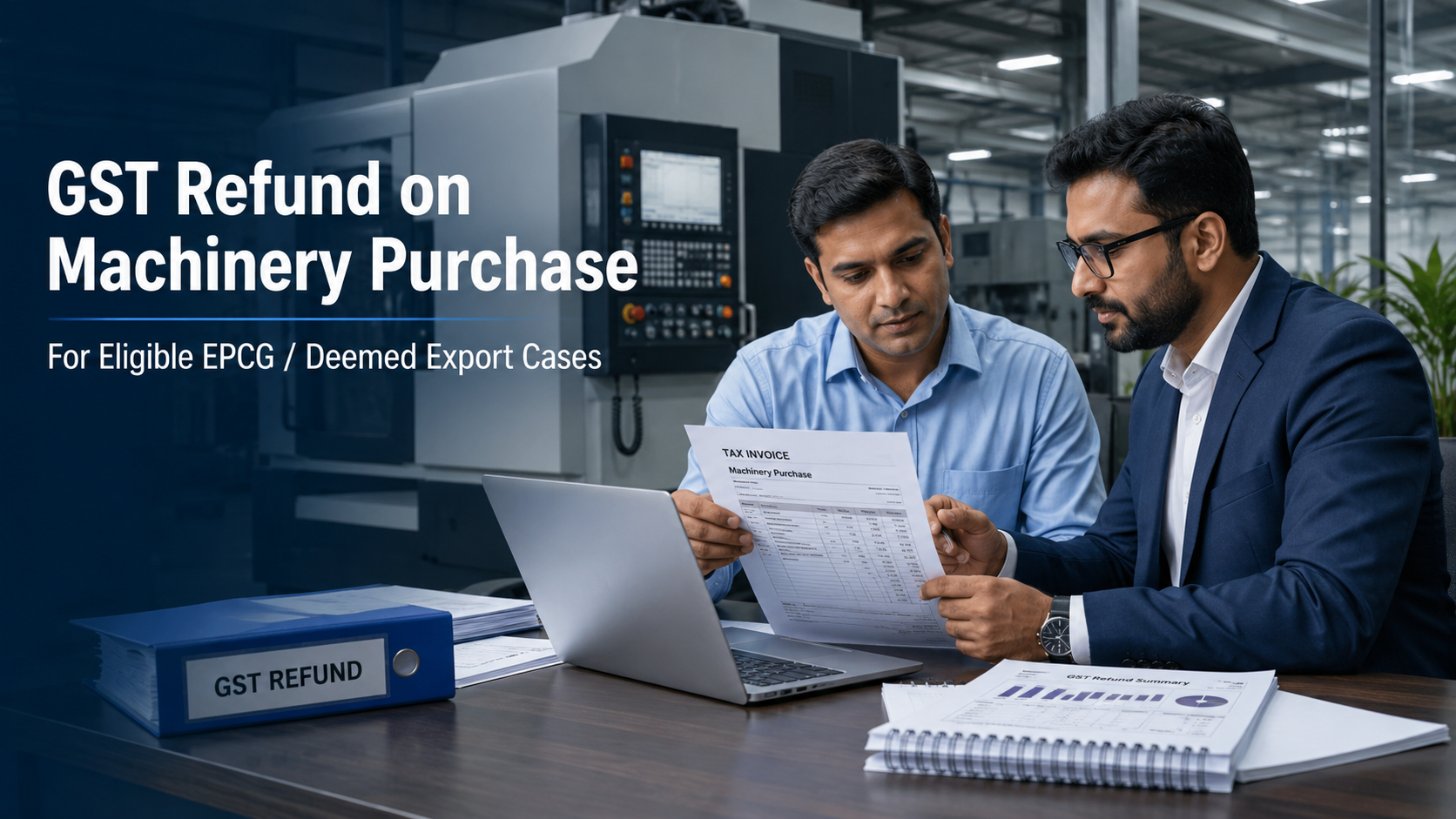
Machinery investment is often a major financial decision for manufacturers and exporters. Apart from the basic equipment value, GST charged on the purchase can also increase the immediate cash requirement of the business.
However, GST paid while purchasing machinery does not automatically qualify for a cash refund. The treatment depends on the type of transaction, applicable scheme and fulfilment of prescribed conditions.
Businesses first need to understand whether the machinery is being purchased through a normal domestic transaction or under a specific export-related arrangement.
For an ordinary machinery purchase, eligible GST may generally be considered as input tax credit subject to applicable provisions. A separate cash-refund route may arise only where the transaction falls within an eligible refund category.
Businesses exploring GST refund for capital goods should therefore review the transaction structure before assuming that the entire GST amount can be refunded.
Export-oriented businesses may have different options when purchasing capital equipment. One relevant framework is the EPCG scheme in India, which allows eligible exporters to procure capital goods subject to prescribed conditions and export obligations. Domestic procurement can also be covered under the EPCG framework in specified situations.
Understanding the scheme before finalising machinery procurement can help businesses identify the appropriate documentation and tax treatment.
Machinery purchases normally involve several supporting records. Important documents may include:
The machinery description, supplier details, value and GST amount should remain consistent across these records.
Before proceeding with any refund-related application, businesses should check whether the machinery invoice has been correctly reflected in the relevant GST records.
Particular attention should be given to the GSTIN, invoice number, taxable value, tax amount and machinery description.
Incorrect or inconsistent details can create difficulties during later verification.
GST provides different refund mechanisms depending on the nature of the transaction. Export refunds, inverted-duty refunds and deemed-export refunds are separate categories and should not be treated as interchangeable.
For machinery purchased against an eligible EPCG arrangement, the relevant route may involve a deemed-export refund subject to the prescribed conditions and documentation.
High-value machinery purchases are easier to manage when the tax implications are reviewed before the final purchase order and GST invoice are issued.
Early planning can help businesses identify the correct procurement structure, required documents and the party responsible for taking the applicable tax benefit.
GST on machinery should be evaluated according to the actual purchase structure rather than assuming that every capital-goods purchase results in a refund.