English
 Arabic
 French
 Spanish
 Portuguese
 Deutsch
 Turkish
 Dutch
Dutch
 Italiano
 Russian
 Romaian
 Portuguese (Brazil)
 Greek
Greek
Student Accommodation in Preston Lancashire: What to Look for Before You Book
Other |
2026-06-24 06:23:17
 Advertise With Us
 About Us
 Terms And Conditions
 سياسة الخصوصية
عرض كل النتائج
سياسة الخصوصية
عرض كل النتائج

ترقية الحساب
If you have ever stood on a packaging floor and watched a pallet come apart mid transit because the strapping gave way, you already understand why strapping equipment matters more than most people assume. It is not a glamorous part of the supply chain, but it is one of the few things standing between a product reaching a customer intact and a product reaching a customer damaged, or not at all.
Among the many strapping tools available today, the manual PET strapping machine, often called a manual PET strap tensioner, continues to be one of the most trusted choices for businesses of every size. It does not run on electricity, it does not need compressed air, and it does not demand a training manual thick enough to double as a doorstop. It simply does its job, strap after strap, shift after shift.
In this guide, we will go well beyond the usual surface level list of benefits. We will look at how these machines actually perform on the floor, where they fit against automatic and pneumatic alternatives, what real operators say about them, how to choose one correctly, and what tends to go wrong when businesses skip this step. This is written for people who buy, operate, or manage industrial packaging, not for search engines, though we have made sure it holds up there too.
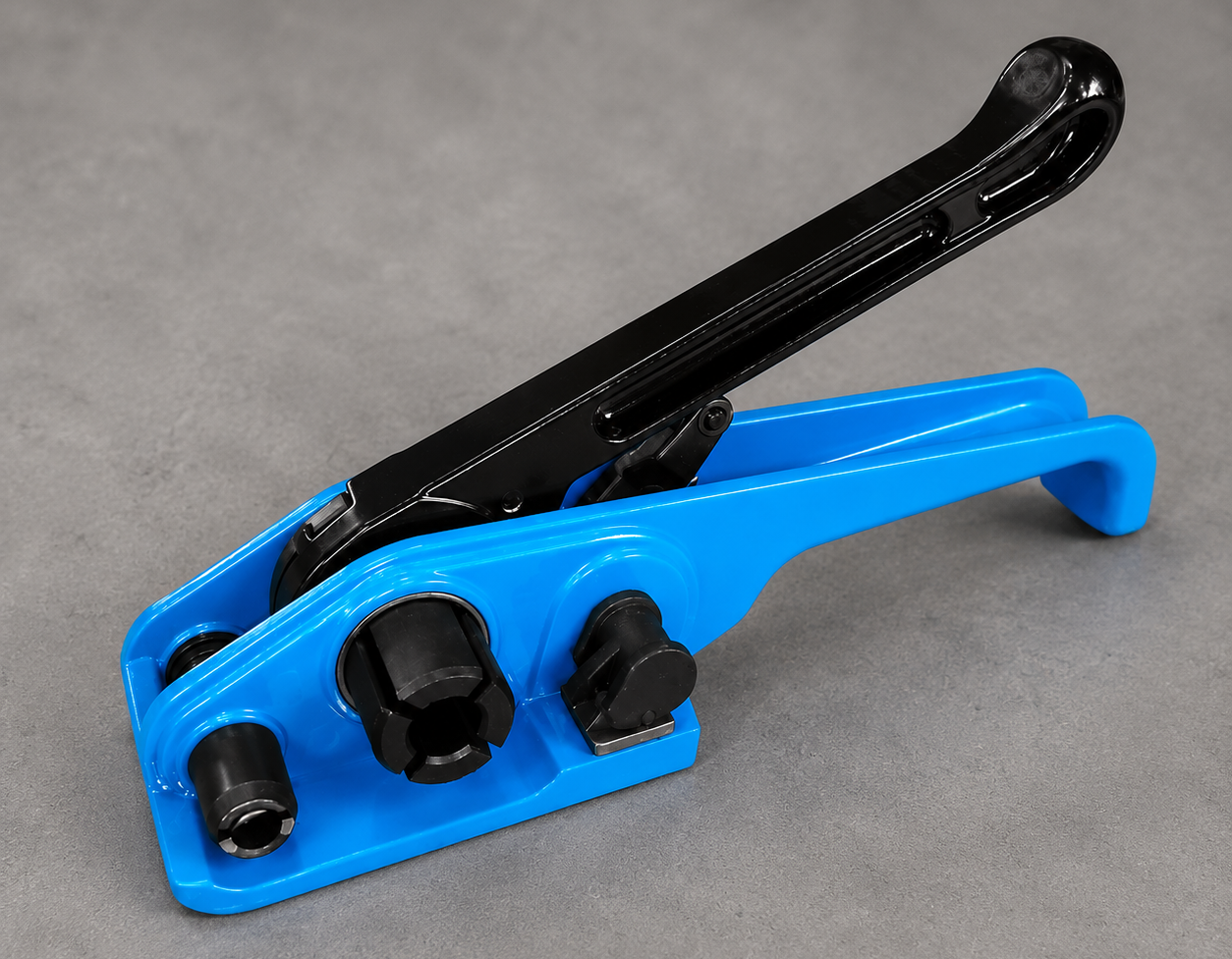
A manual PET strapping machine, also known as a manual strap tensioner, is a hand operated tool used to tighten and secure polyester (PET) strapping around cartons, pallets, crates, and bundled goods. Unlike automatic strapping systems that use motors and sensors to complete the entire cycle, a manual tensioner relies on the operator's hand movement to pull the strap tight before it is sealed, usually with a separate sealer or a strap seal and buckle combination.
Most manual PET strapping tensioners, including common models like the one supplied by Anmol Enterprises, are built from mild steel, coated for corrosion resistance, and designed to handle strap widths in the 13 to 19 mm range. They typically weigh just over a kilogram, which makes them easy to carry from one packing station to another without any setup time.
In simple terms, if you have ever used a ratchet strap to secure something on a truck bed, a manual PET tensioner works on a similar principle, just refined for repeated, precise use in a packaging environment.
It might seem logical to assume that automation always wins, but that is not how packaging economics actually works. A manual PET strapping machine remains the preferred choice for a large number of businesses, and once you look at the numbers and the use cases, it becomes clear why.
An automatic or semi automatic strapping machine can cost anywhere from ten to thirty times more than a manual tensioner. For a small or mid sized packaging unit that straps a moderate volume of goods daily, that capital is better spent elsewhere, on raw materials, on staff, or on expanding production capacity. A manual PET strap tensioner typically costs a few thousand rupees, making it accessible even for businesses just starting out.
This is one of the most underrated advantages. Automatic machines need a stable electricity connection, and pneumatic machines need a compressed air line with consistent pressure. A manual tensioner needs none of that. It works identically in a rural warehouse with unreliable power, on an open loading dock, or inside a container during export packing. When the power goes out and shipments still need to go, manual tools do not stop working.
Automatic strapping machines have motors, belts, sensors, and control boards, all of which can fail and all of which require a technician to fix. A manual tensioner has a handle, a gripping mechanism, and a tension arm. There is very little that can go wrong, and when something does wear out, it is usually a simple part replacement rather than a service call that halts your line for a day.
Because it is lightweight and self contained, a single manual PET strapping machine can be moved between different packing tables, loading bays, or even used at a customer's site during on site packaging. Automatic machines, by contrast, are usually fixed installations.
There is a common misconception that manual tools mean inconsistent results. In reality, an experienced operator using a good quality manual tensioner can apply very precise, repeatable tension, especially for irregular shaped loads or delicate products where an automatic machine's fixed tension setting might actually be too aggressive.
If your operation straps fifty to a few hundred packages a day, the return on investment for an automatic system simply does not make sense yet. A manual PET strapping machine covers this volume comfortably without idle capacity sitting unused.
New warehouse staff can be trained to use a manual strap tensioner safely and effectively within a single shift. There is no software interface, no calibration screen, and no risk of a costly programming error damaging goods or equipment.
A well built manual tensioner, particularly one made from mild steel with a proper coated finish, can last for years of daily use. Since there are minimal moving electronic parts, the equipment does not become obsolete the way automated systems can when spare parts or software support are discontinued.
Most manual tensioners are compatible with strap widths between 13 and 19 mm, which covers the vast majority of packaging needs, from medium cartons to heavier palletized loads, without needing separate equipment for each size.
Because the operator controls the exact amount of pull, manual tensioning allows for adjustments on the spot. If a box is fragile, oddly shaped, or unevenly loaded, the person strapping it can respond in real time in a way a preset automatic cycle cannot.
To make the decision easier, here is an honest side by side comparison based on real operational factors, not marketing claims.
| Factor | Manual Tensioner | Pneumatic Machine | Automatic Machine |
|---|---|---|---|
| Upfront cost | Very low | Moderate | High |
| Power requirement | None | Compressed air | Electricity |
| Maintenance complexity | Minimal | Moderate | High |
| Ideal daily volume | Low to medium | Medium to high | High volume |
| Portability | Excellent | Limited | Very limited |
| Training time | Under a day | One to two days | Several days |
| Tension consistency | Depends on operator skill | Consistent | Highly consistent |
| Best suited for | Small to mid size units, exports, fragile or irregular loads | Mid to large factories with air supply | Large scale, continuous production lines |
| Downtime risk | Very low | Low to moderate | Moderate |
This table is not meant to declare one machine universally better. It is meant to show that the "best" choice depends entirely on your packaging volume, budget, and operating environment, and for a large share of Indian manufacturing and export businesses, the manual option quietly wins on practicality.
Manual PET strapping tensioners show up in far more places than people expect. Some of the most common applications include:
If your operation falls into any of these categories, chances are a manual tensioner is either already on your floor or should be.
Not all manual tensioners are built the same, and choosing based on price alone often leads to early replacement. Here is what actually matters.
Look for mild steel construction with a proper coated surface treatment. This resists rust, especially important in humid warehouses or coastal regions, and extends the working life of the tool significantly.
Confirm the tensioner supports the strap width you actually use, most commonly 13 to 19 mm. Buying a machine that only fits a narrow range limits your flexibility as packaging needs change.
A tensioner around 1 to 1.5 kg strikes the right balance between durability and ease of use during long shifts. Anything too heavy causes operator fatigue over repeated use.
Since this tool is entirely hand operated, the handle grip quality directly affects both safety and the amount of tension an operator can reliably apply.
Choose a manufacturer that also supplies compatible strapping rolls, seals, and sealers, so you are not sourcing consumables from multiple vendors. Established suppliers with a physical facility and verifiable reviews, rather than anonymous online sellers, are generally a safer long term choice.
Even a simple tool can be misused. A few recurring issues worth avoiding:
Is a manual PET strapping machine suitable for heavy pallet loads? Yes, when paired with the correct strap width and proper technique, a manual tensioner can secure moderately heavy pallets. For very high volume or extremely heavy industrial loads shipped continuously, a pneumatic or automatic system may be more efficient, but for regular pallet work, manual tensioners perform reliably.
How long does a manual PET strap tensioner typically last? With basic care and periodic inspection of the gripping mechanism, a good quality manual tensioner made from coated mild steel can last several years of consistent daily use.
Do I need a separate sealer to use with a manual tensioner? In most cases, yes. The tensioner pulls and tightens the strap, while a separate strap sealer or a buckle and seal combination is used to lock it in place. Some suppliers offer these as a combined package.
What strap width works best for general packaging? For most cartons and medium pallets, a 12 to 16 mm strap works well. Heavier industrial loads typically use 16 to 19 mm strapping for added strength.
Is a manual strapping machine safe for new or untrained workers? Yes, with a short demonstration covering correct grip, tension technique, and safe seal placement, most workers can operate a manual tensioner safely within their first shift.
Can a manual PET strapping machine replace an automatic one entirely? It depends on volume. For businesses strapping a few hundred units a day or fewer, a manual machine can fully replace the need for automation. For continuous, high speed production lines, a hybrid approach or a dedicated automatic machine usually makes more financial sense.
A manual PET strapping machine will never be the flashiest piece of equipment on your floor, but it consistently earns its place through low cost, reliability, and flexibility that automated systems simply cannot match at smaller scales. For businesses that value control, portability, and a fast return on investment, it remains one of the smartest packaging decisions available today.
If you are evaluating strapping equipment for your operation, look closely at build quality, strap compatibility, and the manufacturer's overall product range. A supplier like Anmol Enterprises, offering manual PET strapping tensioners alongside strapping rolls, seals, and sealers, allows you to source everything from a single, dependable source rather than juggling multiple vendors.
Good packaging is rarely noticed when it works. It is only noticed when it fails. Choosing the right strapping equipment now is how you make sure your goods are the ones that arrive intact, every single time.