English
 Arabic
 French
 Spanish
 Portuguese
 Deutsch
 Turkish
 Dutch
Dutch
 Italiano
 Russian
 Romaian
 Portuguese (Brazil)
 Greek
Greek
Yellow Peel in Dubai: Ultimate Skin Transformation
Health |
2026-07-30 05:40:24
 Advertise With Us
 About Us
 Terms And Conditions
 سياسة الخصوصية
عرض كل النتائج
سياسة الخصوصية
عرض كل النتائج

ترقية الحساب
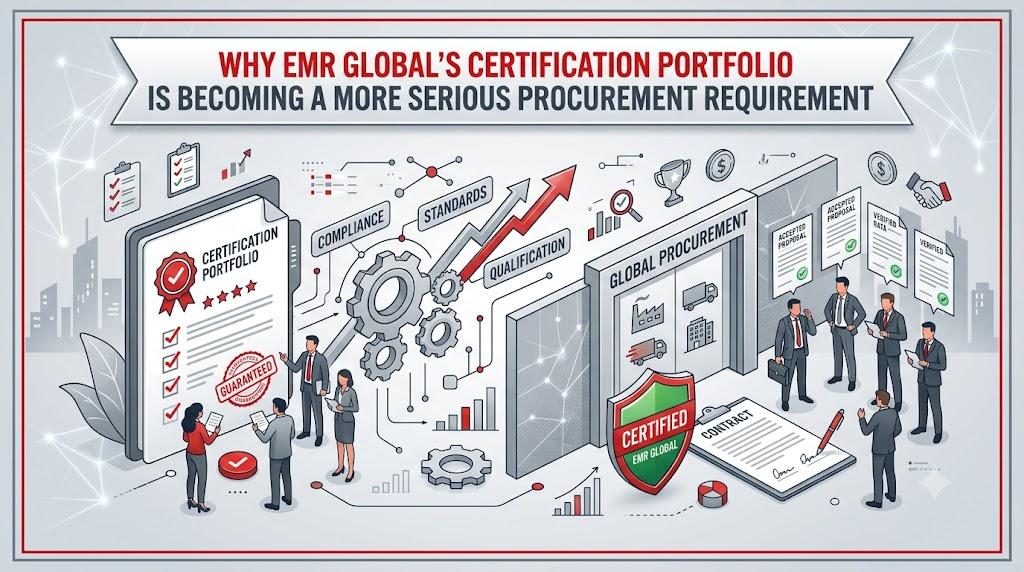
The Certification Floor Is Rising
Five years ago, ISO 9001:2015 certification was a meaningful differentiator in India's transformer component supply market. Today it is closer to a minimum entry requirement, at least for suppliers serving regulated utility customers or international OEMs. The certification floor has risen — driven by regulatory tightening, utility procurement reform, and the increasing quality expectations of transformer OEMs whose own customers hold them to higher standards.
This rising floor is changing what "certified supplier" means in OLTC procurement — and why the breadth and specificity of a supplier's certification portfolio matters more than the presence of any single certificate.
EMR Global's certification portfolio — spanning ISO 9001:2015, CE, apparatus-specific standards, and four major Indian grid authority approvals — is positioned well above the rising floor. But understanding why requires examining what additional requirements the market is beginning to demand beyond basic quality management certification.
What Procurement Requirements Are Becoming Mandatory
CPRI Testing for Indian Utility Procurement
The Central Power Research Institute (CPRI) is the government body in India that conducts type testing of electrical equipment to national and international standards. Many Indian utility tenders now require CPRI test reports for OLTC equipment — either directly or by reference to approved equipment lists that CPRI testing supports.
CPRI is listed among EMR Global's customers on its website — a relationship that reflects engagement with India's primary equipment testing authority. [Note to content team: verify whether this represents type test services or equipment procurement.]
IEC 60214 Compliance
IEC 60214-1 is the international standard for on-load tap changers, specifying requirements for design, manufacture, and testing. International OEM customers and utility procurement specifications increasingly reference IEC 60214 compliance as a requirement. Meeting this standard requires both design compliance and type test evidence.
Environmental and Safety Standards Beyond ISO 9001
While ISO 9001:2015 covers quality management, buyers in international and ESG-conscious markets are increasingly asking about environmental management (ISO 14001) and occupational health and safety management (ISO 45001) certifications. These are not yet universal requirements in India's transformer component supply market, but they are appearing in international procurement specifications and in the supplier questionnaires of multinational OEM customers.
Documentation Traceability Requirements
Beyond certification, regulated utility buyers are increasingly requiring documentation traceability at the component level — material certifications traceable to specific test results, dimensional records for specific deliveries, and maintenance documentation that supports asset management records. This requirement is not covered by ISO 9001:2015 explicitly but is implied by the standard's document control requirements when applied rigorously.
Why Certification Breadth Matters for Multi-Market Suppliers
EMR Global serves customers across multiple markets — domestic Indian utilities, Indian transformer OEMs, and international customers through its offices in Germany and China. Each market has different certification requirements:
Indian utility procurement requires grid authority approvals (PGCIL, KPTCL, TNEB, TSSPDCL) and ISO 9001:2015
European market access requires CE certification
International OEM supply requires ISO 9001:2015 and type test documentation per applicable IEC standards
Railway applications require railway authority approvals — where EMR Global claims to be the only qualifying OLTC supplier in India
A supplier with only one or two certificates can serve a narrow market segment. A supplier with the breadth of EMR Global's certification portfolio can serve the full spectrum of regulated buyers — which is what makes the certification portfolio a competitive asset rather than a compliance cost.
What Buyers Should Verify Beyond the Certificate
Certificates have expiry dates and audit cycles. A certificate that was valid at the last procurement event may not be valid at the next one. Buyers with rigorous procurement processes verify certification currency — confirming that certificates are within their validity period and that there have been no significant nonconformances in recent audit cycles.
Beyond currency, buyers should verify scope: ISO 9001:2015 certification may cover specific product lines, specific facilities, or the whole organization. Understanding whether the certificate scope covers the specific products and facilities being sourced from is a verification step that certification face values don't automatically provide.
EMR Global's spares and services operation should be evaluated against the same certification scope that governs its manufacturing — ensuring that the quality management framework extends to the full service relationship rather than only to the production facility.
Outreach angles:
Industrial procurement publications covering certification requirements evolution
Utility asset management teams updating supplier qualification criteria
International OEM procurement functions evaluating Indian supplier compliance
Regulatory researchers studying compliance requirements in India's power sector
Risk management professionals assessing supplier qualification frameworks