English
 Arabic
 French
 Spanish
 Portuguese
 Deutsch
 Turkish
 Dutch
Dutch
 Italiano
 Russian
 Romaian
 Portuguese (Brazil)
 Greek
Greek
Exterior Painting Services Fort Myers, FL
Other |
2026-06-11 21:34:10
 Advertise With Us
 About Us
 Terms And Conditions
 Πολιτική Ιδιωτικότητας
δες τα όλα
Πολιτική Ιδιωτικότητας
δες τα όλα

Upgrade to Pro
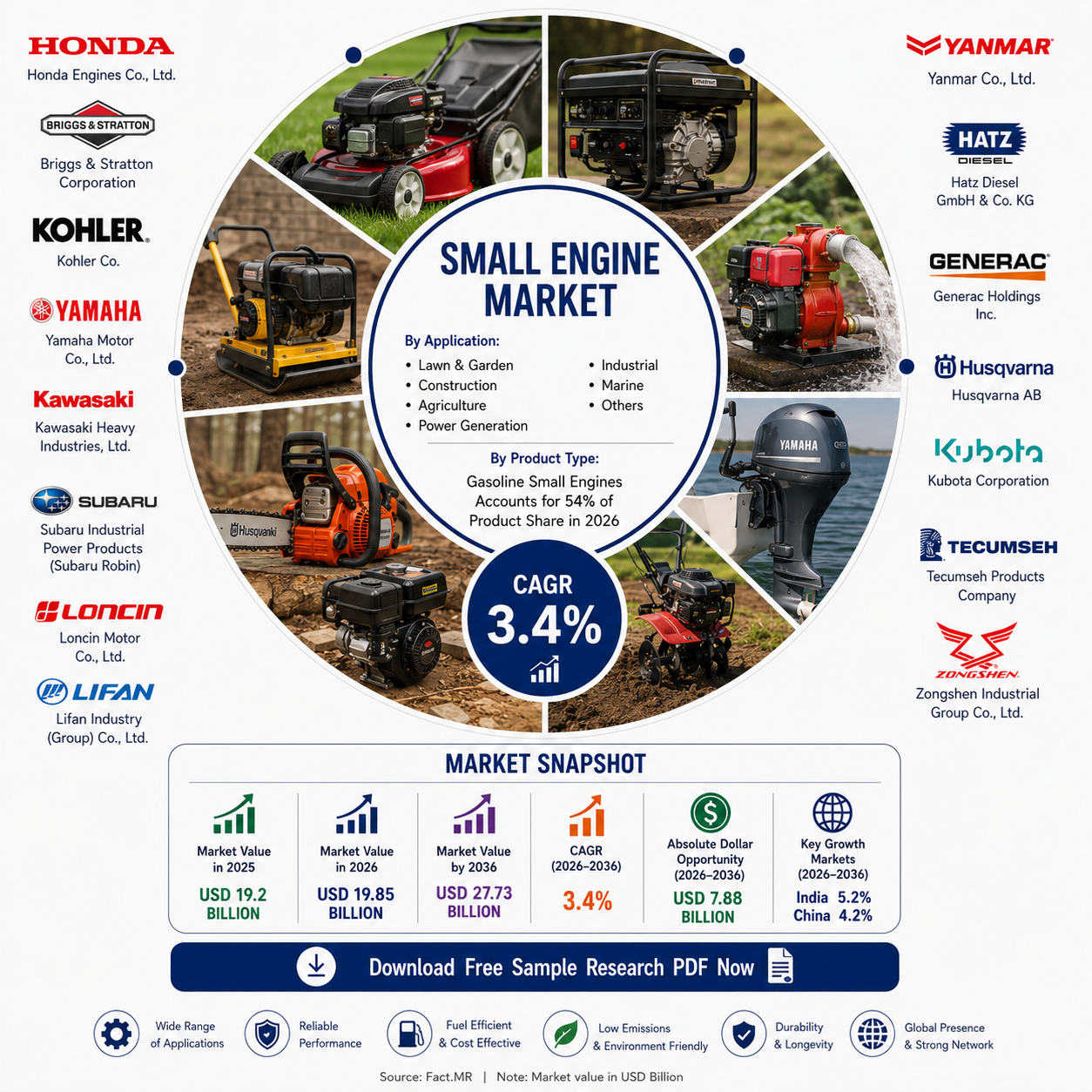
Market valued at USD 19.85 billion in 2026 • Gasoline engines hold 54% share • Lawn & garden equipment accounts for 59% of demand
ROCKVILLE, Md., August 2026 — The global Small Engine Market is estimated at USD 19.85 billion in 2026 and is forecast to reach USD 27.73 billion by 2036, expanding at a CAGR of 3.4% during the forecast period, according to Fact.MR. The market is expected to create an absolute dollar opportunity of USD 7.88 billion between 2026 and 2036.
Demand continues to grow because small engines remain the preferred power source for lawn and garden equipment, construction tools, agricultural machinery, portable generators, and recreational vehicles. Although battery-powered alternatives are gaining popularity in residential applications, gasoline and diesel engines continue to dominate commercial and professional equipment because they offer longer runtime, higher energy density, and proven durability.
Get Detailed Market Forecasts, Competitive Benchmarking, and Pricing Trends: https://www.factmr.com/connectus/sample?flag=S&rep_id=9274
Construction activity and agricultural mechanization are also supporting steady engine demand worldwide. Contractors continue purchasing engines for portable compactors, concrete mixers, power cutters, and vibrators, while farmers increasingly adopt engines for tillers, irrigation pumps, sprayers, and other agricultural equipment. Growing demand for backup electricity is also increasing purchases of portable generator engines across residential and commercial markets.
The market is also benefiting from continuous improvements in fuel injection, engine management systems, emission control technologies, and hybrid power solutions. Manufacturers are introducing cleaner and more fuel-efficient engines while expanding battery-powered platforms to meet changing customer expectations and tightening environmental regulations.
Industry Validation
Fact.MR developed its market forecast using more than 100 secondary information sources, benchmarking 50+ company product portfolios across 30+ countries. The study also includes 25+ primary interviews with manufacturers, OEM partners, distributors, dealers, end users, and industry experts. Additional validation includes outdoor power equipment statistics, agricultural mechanization reports, construction equipment data, pricing analysis, shipment trends, and trade-flow verification before forecasts were finalized.
Key Market Numbers
|
Metric |
Value |
|
Market Value (2025) |
USD 19.2 Billion |
|
Estimated Value (2026) |
USD 19.85 Billion |
|
Forecast Value (2036) |
USD 27.73 Billion |
|
CAGR (2026–2036) |
3.4% |
|
Absolute Opportunity |
USD 7.88 Billion |
|
Leading Product |
Gasoline Small Engines (54%) |
|
Largest Application |
Lawn & Garden Equipment (59%) |
|
Leading Technology |
Internal Combustion Technology (63%) |
Source: Fact.MR Small Engine Market Analysis.
Market Segment Analysis
Gasoline Small Engines Maintain Market Leadership
Gasoline small engines are projected to account for 54% of total market value in 2026. Their leadership reflects broad use across lawn mowers, trimmers, generators, and light construction equipment. High energy density, long operating time, and competitive pricing continue to make gasoline engines the preferred choice for residential, commercial, and professional users.
Diesel small engines remain the second-largest product category because of their durability, fuel efficiency, and torque output for agricultural equipment, irrigation systems, water pumps, and stationary power applications.
Lawn and Garden Equipment Drives Market Demand
Lawn and garden equipment is expected to represent 59% of application demand in 2026. Residential and commercial landscaping continues to generate high replacement rates for lawn mowers, trimmers, blowers, and other maintenance equipment, making this the largest end-use segment in the market.
Construction equipment remains the second-largest application area, supported by continued demand for portable power tools, generators, and light construction machinery.
Internal Combustion Technology Continues to Dominate
Internal combustion technology is projected to account for 63% of the technology segment in 2026. Its established installed base, proven reliability, and widespread service infrastructure continue to support its leadership despite increasing interest in battery-powered alternatives.
Battery-Powered Platforms Represent the Fastest-Growing Trend
Battery-powered small engines are expected to record the fastest growth during the forecast period. Residential users increasingly prefer cordless equipment because of lower maintenance requirements, quieter operation, and compliance with tightening emission and noise regulations. Manufacturers investing in lithium-ion battery platforms, fast charging, and swappable battery systems are expected to strengthen their competitive position as electrification gradually expands across the residential segment.
Regional Outlook
Asia Pacific is expected to remain the fastest-growing regional market through 2036. Expanding agricultural mechanization, construction activity, and rising demand for portable power equipment continue to support engine sales across developing economies. Fact.MR identifies India and China as the strongest growth markets, while North America benefits from stable replacement demand and Europe continues to expand through emission compliance and technology upgrades.
Country CAGR Analysis (2026–2036)
|
Country |
CAGR |
|
India |
5.2% |
|
China |
4.2% |
|
Mexico |
3.3% |
|
Germany |
3.2% |
|
United States |
3.0% |
|
South Korea |
2.9% |
|
Japan |
2.5% |
Source: Fact.MR (FMR) analysis based on proprietary forecasting models and primary research.
Regional Highlights
India: The fastest-growing market with a projected 5.2% CAGR, supported by agricultural mechanization, portable generator demand, and rising construction activity.
China: Expected to expand at 4.2% CAGR, driven by manufacturing strength, agricultural equipment demand, and export-oriented production.
United States: Forecast to grow at 3.0% CAGR, supported by lawn and garden equipment replacement cycles, construction activity, and continued demand for portable generators.
Competitive Landscape
The global small engine market is moderately concentrated, with established manufacturers competing through product reliability, emission compliance, fuel efficiency, OEM partnerships, and global distribution networks.
Honda Engines Co., Ltd., Briggs & Stratton Corporation, Kohler Co., and Yamaha Motor Co., Ltd. hold strong market positions through broad product portfolios and established relationships with OEMs serving lawn and garden, construction, agricultural, and power generation applications.
Other major participants include:
Competition is increasingly influenced by low-emission engine development, fuel-injection technologies, hybrid power systems, and battery-powered alternatives. Manufacturers are also strengthening aftermarket service networks and expanding distribution in high-growth emerging markets.
Recent Industry Developments
Honda Engines Co., Ltd. (2025)
Honda introduced updated low-emission small engine models featuring improved fuel injection systems, enhanced fuel efficiency, and reduced emissions for professional lawn and garden equipment.
Briggs & Stratton Corporation (2025)
Briggs & Stratton expanded its lithium-ion battery-powered platform to strengthen its presence in residential lawn care and portable power applications.
Kohler Co. (January 2026)
Kohler continued expanding its commercial engine portfolio with new electronic fuel injection (EFI) technology and durability improvements for professional users.
Analyst Perspective
Shambhu Nath Jha, Principal Consultant at Fact.MR, said:
"The small engine market is entering a transition period where combustion engines continue to dominate professional applications while battery-powered alternatives gain momentum in residential equipment. Gasoline engines remain the leading product because they provide runtime, energy density, and affordability across the largest application areas. Lawn and garden equipment continues to represent the highest replacement volume, while India and China remain the fastest-growing markets due to agricultural mechanization and expanding construction activity. Electric adoption is expected to be gradual, with commercial and agricultural users continuing to depend on combustion technology for demanding operating conditions."
Explore More Related Studies Published by Fact.MR Research:
https://www.openpr.com/news/4541809/personalized-medicine-market-to-surpass-us-1-57-trillion
https://www.openpr.com/news/4541830/pulmonary-drug-delivery-systems-market-to-reach-us-97-5-billion
https://www.openpr.com/news/4541852/stretcher-chairs-market-to-reach-usd-493-5-million-by-2036-as
https://www.openpr.com/news/4543184/3d-printed-satellite-market-to-reach-usd-1-8-billion-by-2036
Frequently Asked Questions
What is the current size of the Small Engine Market?
Fact.MR estimates the global Small Engine Market at USD 19.85 billion in 2026.
How large will the Small Engine Market become by 2036?
The market is projected to reach USD 27.73 billion by 2036, growing at a 3.4% CAGR.
Which product segment leads the Small Engine Market?
Gasoline small engines are expected to account for 54% of market value in 2026.
Which application generates the highest demand?
Lawn and garden equipment is projected to represent 59% of total application demand in 2026.
Which countries are expected to grow the fastest?
India is forecast to grow at 5.2% CAGR, followed by China at 4.2% during 2026–2036.