English
 Arabic
 French
 Spanish
 Portuguese
 Deutsch
 Turkish
 Dutch
Dutch
 Italiano
 Russian
 Romaian
 Portuguese (Brazil)
 Greek
Greek
Trending on BookTok Love on the Brain by Ali Hazelwood
Shopping |
2026-07-01 04:40:12
 Advertise With Us
 About Us
 Terms And Conditions
 Privacy Policy
Mostra tutti i risultati
Privacy Policy
Mostra tutti i risultati

Passa a Pro
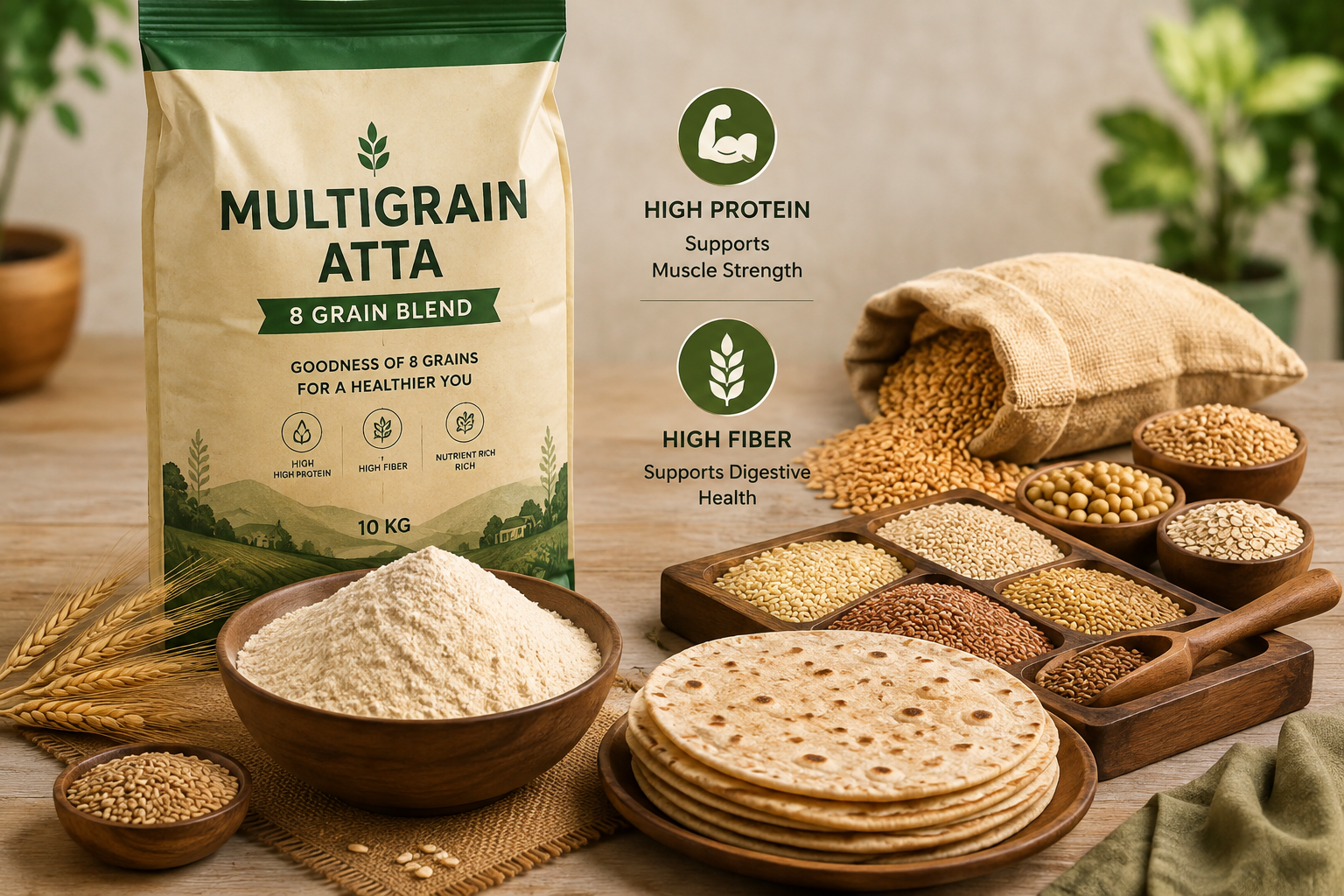
India has a well-documented nutrition problem, but it's actually two problems wearing the same clothes. The first is protein deficiency — studies consistently show that a majority of Indian households, particularly vegetarian ones, consume less protein than recommended daily intake guidelines suggest is necessary for good health. The second is dietary fibre deficiency — urban Indian diets, built increasingly around refined grains, processed foods, and convenience eating, are chronically low in the kind of fibre that gut health, blood sugar management, and cardiovascular function depend on.
These two deficiencies are usually treated as separate nutritional conversations — protein on one side, fibre on the other. What makes multigrain atta a particularly useful dietary intervention is that a well-formulated eight-grain blend addresses both gaps simultaneously, through the same daily staple that Indian households are already eating multiple times a day.
India's protein deficiency is both widespread and underacknowledged. A 2020 survey found that over 70% of Indian households consume less protein than recommended — and this isn't a problem confined to low-income households. Urban, middle-class, vegetarian families regularly fall short of adequate protein intake because the meal structure that dominates Indian cooking — rice or roti with dal and vegetables — provides carbohydrate efficiently while protein often plays a secondary role.
The challenge for vegetarian households is that plant-based protein sources require larger portions or more deliberate combining than animal proteins to meet daily requirements. Dal provides protein, but the quantities typically eaten at a meal don't always reach the contribution needed. Paneer and dairy help, but aren't present in every meal. The result is a daily protein shortfall that accumulates silently — contributing to slower muscle recovery, reduced immune function, hair and skin issues, and the kind of persistent low energy that's easy to attribute to stress or inadequate sleep rather than nutritional inadequacy.
India's dietary fibre problem is largely a consequence of the shift from traditional whole grain cooking to commercially milled refined flour. Refined wheat flour — the foundation of most commercial atta products — has had its bran and germ removed during milling. What remains after refining is primarily starch. The fibre that was in the original grain — soluble fibre that supports gut bacteria, insoluble fibre that supports bowel regularity, resistant starch that moderates blood sugar response — is gone.
This refinement-driven fibre deficit has compounding consequences. Gut microbiome diversity, which depends on consistent prebiotic fibre intake, declines in low-fibre diets — contributing to the digestive irregularity, bloating, and immune dysregulation that are increasingly common in urban Indian adults. Blood sugar management becomes harder without fibre to slow glucose absorption. Cardiovascular risk factors worsen as soluble fibre intake decreases. And appetite regulation becomes less effective without fibre's contribution to satiety.
The value of a well-formulated eight-grain multigrain blend is that each grain type contributes something specific, and the combination covers both the protein gap and the fibre gap through a single flour.
The protein contribution comes primarily from the legume-based additions in the blend — soybean and chickpea, both of which carry significantly higher protein content than wheat and contribute a more complete amino acid profile when combined with grain proteins. The protein content of a quality multigrain atta — typically 18-20 grams per 100 grams — represents a meaningful improvement over standard whole wheat atta's 10-12 grams. Across three to four rotis eaten daily, this difference accumulates into a significant daily protein contribution that requires no additional dishes or ingredients.
The fibre contribution comes from multiple directions — the retained bran of whole grain wheat, the insoluble fibre of millets like jowar and bajra, the soluble fibre of oats, and the resistant starch from chickpea. This multi-type fibre contribution is more comprehensive than any single grain provides, and it supports digestive health, blood sugar moderation, and gut microbiome diversity simultaneously.
Most nutritional interventions for protein deficiency and fibre deficiency address them separately — a protein supplement on one side, a fibre supplement or specific high-fibre food on the other. This two-product approach has a compliance problem: it requires forming two new habits rather than one, and it adds cost and complexity to the daily routine.
Addressing both through the same daily staple — the flour that already appears in multiple meals every day — requires no new habit formation. The household doesn't need to remember to take a protein supplement. It doesn't need to add a fibre supplement or specifically plan high-fibre meals. The flour itself delivers the improvement, automatically, at every meal where roti appears.
This is the practical advantage that multigrain atta 10 kg provides over the supplement-based approach to the same nutritional goals. It works through compliance that doesn't require willpower — because the habit is already established. The only change is what the flour contains.
The dual nutrition gap argument for multigrain atta only holds if the flour is used consistently — not as an occasional supplement to regular wheat flour, but as the primary daily flour. A small pack purchased occasionally doesn't produce the consistent protein and fibre improvement that daily use does. It gets used for a week, runs out, defaults back to regular atta, and the cumulative effect never accumulates.
A 10 kg pack is the format that enables consistent use. It's enough flour that the household stops treating it as a specialty purchase and starts treating it as the default. The nutritional benefit compounds across consistent daily use in ways that intermittent use never achieves.
10on10foods has formulated its multigrain atta 10 kg blend around genuine eight-grain nutritional depth — each grain contributing something specific to the protein and fibre profile rather than appearing on the label for marketing value alone.
Most Indian households are addressing their protein deficiency and their fibre deficiency imperfectly, with supplements and specific foods that require deliberate effort to use consistently. Multigrain atta offers a different approach — both gaps addressed simultaneously, through a product that replaces something already in daily use, requiring no new behaviour beyond the flour choice itself.