English
 Arabic
 French
 Spanish
 Portuguese
 Deutsch
 Turkish
 Dutch
Dutch
 Italiano
 Russian
 Romaian
 Portuguese (Brazil)
 Greek
Greek
Lip Augmentation in Jeddah: A Complete Understanding of Lip Enhancement Procedures
Health |
2026-08-07 19:10:04
 Advertise With Us
 About Us
 Terms And Conditions
 Datenschutzbestimmungen
Alle anzeigen
Datenschutzbestimmungen
Alle anzeigen

Upgrade auf Pro
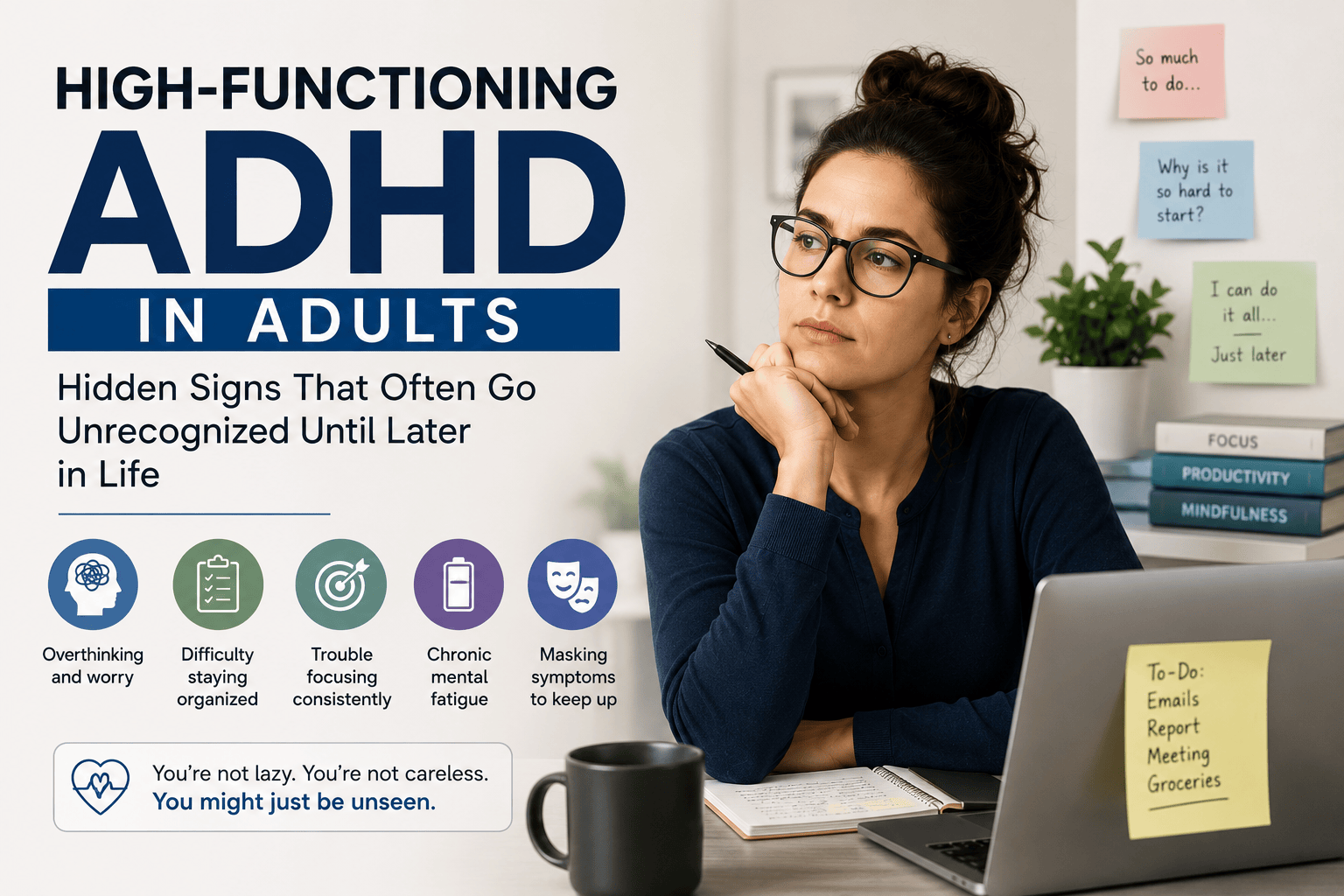
Did you know that many adults live for decades with undiagnosed ADHD simply because they were never the "disruptive kid" teachers worried about? Research suggests that a significant number of adults with attention-deficit/hyperactivity disorder go unrecognized well into adulthood — often because they learned, early and quietly, how to compensate.
High-functioning ADHD in adults describes a pattern where someone manages to hold down a career, maintain relationships, and appear organized on the outside, while privately battling constant mental overload, last-minute scrambling, and an exhausting internal effort just to keep up appearances. Because the outward signs are subtle, this presentation of ADHD is frequently missed by both the individuals experiencing it and the professionals they encounter.
If you've ever wondered whether your chronic overwhelm, forgetfulness, or restless mind is "just how you are" or something more, this guide is meant to offer clarity — not a diagnosis, but a starting point for understanding.
Why high-functioning ADHD often goes unnoticed for years, even decades
The subtle signs that differ from the more commonly recognized ADHD symptoms
How masking and compensation strategies can hide underlying struggles
Evidence-based approaches that can help adults manage symptoms more effectively
The term itself can create confusion. It suggests that someone is doing fine, when in reality, many adults with this presentation are working significantly harder than their peers just to maintain the same level of output. A person might submit projects on time while quietly staying up until 2 a.m. the night before, or maintain a tidy home by cramming all their organizing into a single exhausting weekend.
Many individuals with high-functioning ADHD develop elaborate coping systems — color-coded calendars, constant reminders, over-preparation — not because they're naturally organized, but because they've learned that without these systems, things fall apart quickly.
Actionable Takeaway: If you rely heavily on external systems just to function at a baseline level, and abandoning those systems for even a few days causes noticeable disruption, that pattern is worth exploring with a professional rather than dismissing as a personality quirk.
Unlike more widely recognized presentations of ADHD, high-functioning ADHD in adults doesn't always look like visible hyperactivity or obvious disorganization. Instead, it often shows up as:
Chronic mental fatigue from constantly self-monitoring and self-correcting
Difficulty starting tasks despite knowing exactly what needs to be done
Time blindness — consistently underestimating how long things take
Emotional sensitivity to criticism or perceived failure
A pattern of overcommitting, followed by burnout
Feeling "lazy" or "not good enough" despite objectively strong achievements
This last point tends to carry significant emotional weight. Many adults internalize years of unmet expectations — their own and others' — long before they ever consider that ADHD might be part of the picture.
Actionable Takeaway: Instead of asking "am I lazy?" try asking "what makes starting this task harder for me than it seems to be for others?" That reframe alone can open the door to more productive self-understanding.
Masking refers to the conscious or unconscious effort to hide symptoms in order to meet social or professional expectations. For adults with high-functioning ADHD, masking might look like:
Rehearsing conversations in advance to avoid appearing scattered
Forcing eye contact and stillness during meetings despite internal restlessness
Overpreparing to compensate for fear of forgetting something important
While masking can help someone get through a workday or social event, it often comes at a steep cost — chronic stress, anxiety, and a persistent sense of exhaustion that doesn't match how "put together" a person appears from the outside.
|
Feature |
Commonly Recognized ADHD |
High-Functioning ADHD |
|
Visibility |
Symptoms often visible to others (fidgeting, interrupting, missed deadlines) |
Symptoms often hidden through compensation and masking |
|
Academic/work performance |
May struggle openly with performance |
Often high-achieving, but at significant internal cost |
|
When typically identified |
Frequently identified in childhood |
Often identified in adulthood, sometimes after years of struggle |
|
Coping style |
May rely on external accommodations |
Often relies on self-created systems and overpreparation |
|
Emotional impact |
Can include frustration, low self-esteem |
Often includes chronic exhaustion, imposter feelings, burnout |
David, a 38-year-old software engineer, had always been described as "brilliant but scattered." He excelled at work but routinely stayed late finishing tasks he'd technically had days to complete. At home, he forgot appointments, misplaced important documents, and felt a persistent hum of anxiety that he could never quite explain.
It wasn't until his daughter was evaluated for ADHD that David began recognizing pieces of his own childhood in her diagnosis. He pursued an evaluation of his own and began working with a therapist using a combination of CBT and structured coaching techniques.
David didn't experience an overnight shift. Building new systems took trial and error, and some old habits were slow to change. But over time, he found that understanding why he struggled — rather than assuming he simply lacked discipline — allowed him to build strategies that actually worked with his brain instead of against it.
CBT can help adults with ADHD identify unhelpful thought patterns, such as chronic self-criticism, and build more structured approaches to planning and task initiation.
Individual therapy paired with ADHD-specific coaching often focuses on practical skill-building — time management, prioritization, and breaking large tasks into manageable steps — alongside emotional processing of years of misunderstood struggle.
ADHD symptoms can sometimes strain relationships, particularly around forgetfulness, follow-through, or emotional regulation. Couples or family therapy can help partners and family members understand the condition and develop communication strategies that reduce frustration on both sides.
For many adults, simply having a consistent, nonjudgmental space to process years of self-doubt can be an important part of treatment, separate from skill-building work.
Treatment often depends on individual needs, and for some adults, a psychiatric evaluation to discuss medication options may be a valuable part of a comprehensive treatment plan alongside therapy.
Actionable Takeaway: If you're considering an evaluation, look for a licensed provider experienced specifically in adult ADHD, since presentations in adulthood can differ significantly from childhood criteria.
Early signs worth paying attention to:
Persistent difficulty managing daily responsibilities despite genuine effort
A pattern of high achievement paired with private exhaustion or overwhelm
Ongoing feelings of underperforming despite objective success
Signs that suggest it may be time to seek an evaluation soon:
Symptoms are affecting your job performance, relationships, or self-esteem
You're relying on unsustainable coping strategies (excessive caffeine, chronic overwork, avoidance)
Emotional exhaustion is beginning to affect your mental health more broadly
If you're experiencing significant distress, hopelessness, or thoughts of self-harm alongside these struggles, please contact the 988 Suicide & Crisis Lifeline (call or text 988) or seek immediate emergency care. Living with unrecognized ADHD for years can understandably take a toll, and support is available.
External structure — calendars, alarms, and visual reminders reduce reliance on memory alone
Body doubling — working alongside another person, even virtually, can improve task initiation
Movement breaks — regular physical activity can support focus and emotional regulation
Simplified routines — reducing daily decisions can conserve mental energy for higher-priority tasks
Self-compassion practices — actively challenging years of internalized self-criticism is often as important as any organizational system
Adults, parents, and couples in Charlotte, Raleigh, Ballantyne, Pineville, SouthPark, and throughout North Carolina have access to both in-person and telehealth evaluation and therapy options for ADHD. Telehealth services in particular can make ongoing support more manageable for adults balancing demanding careers and family responsibilities.
Myth: If you're successful, you can't have ADHD. Many adults with ADHD achieve significant success — often at a much higher personal cost than others realize.
Myth: ADHD is just an excuse for poor discipline. ADHD involves differences in brain-based executive functioning, not a lack of willpower or character.
Myth: Only children need ADHD support. Many adults benefit significantly from evaluation and treatment, sometimes decades after symptoms first appeared.
Can adults be diagnosed with ADHD for the first time later in life?
Yes. Many adults are diagnosed for the first time after recognizing patterns that were previously overlooked or misattributed to stress or personality.
Is high-functioning ADHD an official diagnosis?
Not formally — it's a descriptive term used to explain presentations where symptoms are less visibly disruptive, though the underlying diagnosis remains ADHD.
What's the difference between ADHD and anxiety?
While the two can overlap and even co-occur, ADHD centers on attention and executive functioning differences, whereas anxiety centers on excessive worry and fear-based thinking.
Do all adults with high-functioning ADHD need medication?
Not necessarily. Some adults manage symptoms effectively with therapy and structured strategies alone, while others benefit from medication as part of a broader treatment plan.
How can I find out if I have high-functioning ADHD?
A comprehensive evaluation by a licensed mental health professional experienced in adult ADHD is the most reliable way to understand your symptoms and next steps.
Living with unrecognized ADHD often means spending years quietly wondering why ordinary tasks feel so much harder than they seem to for everyone else. Recognizing high-functioning ADHD in adulthood isn't about assigning blame to the years spent struggling — it's about finally having language for an experience that may have felt confusing or isolating for a long time.
With the right support, many adults find that understanding their brain — rather than fighting against it — opens the door to strategies that genuinely work, along with a good deal more self-compassion along the way.
If any part of this feels familiar, consider reaching out to a licensed mental health professional in your area or through telehealth to explore what support could look like for you.