English
 Arabic
 French
 Spanish
 Portuguese
 Deutsch
 Turkish
 Dutch
Dutch
 Italiano
 Russian
 Romaian
 Portuguese (Brazil)
 Greek
Greek
(A Story by) The Spare by Elodie Hart
Dance |
2026-06-19 09:18:45
 Advertise With Us
 About Us
 Terms And Conditions
 Política de privacidade
Ver todos
Política de privacidade
Ver todos

Atualizar para Plus
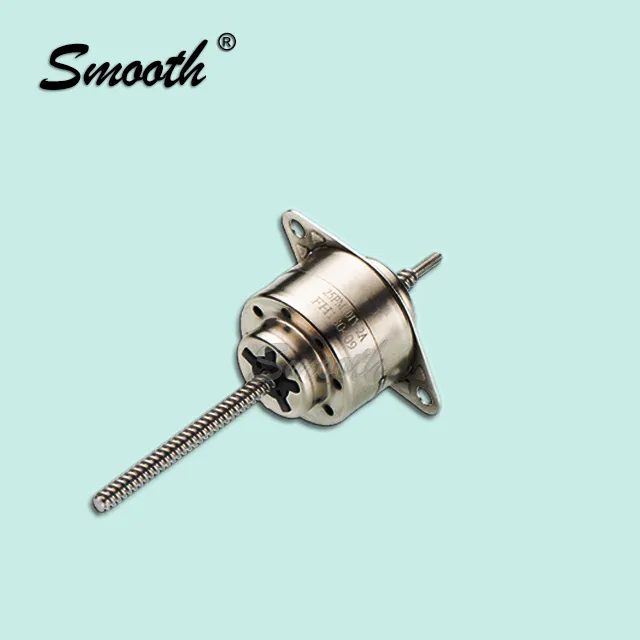
Textile manufacturing and commercial printing share a demand for precise, consistent motion that many other industries would find surprising given how different the two fields otherwise appear. Fabric handling, thread tensioning, and print registration all depend on motion components capable of extremely fine, repeatable movement, which is exactly why a linear stepper motor has become such a common presence across both industries, quietly powering equipment that most people never think about until a print job comes out misaligned or a fabric roll jams partway through production.
Textile production lines rely on carefully controlled fabric feed rates to maintain consistent tension throughout weaving, knitting, or finishing processes. Even small variations in feed speed can introduce visible defects like puckering or uneven stretching across the finished material. Stepper-driven feed mechanisms provide the fine, incremental control needed to maintain this consistency across long production runs, helping mills avoid the costly waste associated with fabric defects that only become apparent after significant yardage has already been processed.
Automated embroidery machines depend on extremely precise needle and hoop positioning to reproduce complex patterns accurately across thousands of stitches per design. Any drift in positioning compounds visibly across a finished embroidered piece, particularly on intricate designs with fine detail work. Stepper-based positioning gives embroidery equipment the repeatable accuracy needed to maintain pattern fidelity from the first stitch to the last, a capability that has become increasingly important as embroidery designs have grown more detailed and commercially demanding over recent years.
Commercial printing equipment, whether producing labels, packaging, or textile prints, depends heavily on precise print head positioning to maintain color registration across multiple passes. Misalignment between color layers produces visibly blurred or shifted printed images that are immediately noticeable to customers and quality inspectors alike. Stepper-driven print head positioning systems offer the fine, repeatable control needed to keep multiple color layers precisely aligned, even at the high speeds modern commercial printing equipment increasingly demands.
Automated cutting systems used in both textile and printing applications rely on accurate linear motion to guide blades or laser cutting heads along precise paths. Inconsistent motion here results in wasted material and inconsistent finished part dimensions, both of which directly affect a manufacturer's bottom line. Reliable stepper motor actuators provide the consistent, repeatable travel these cutting systems depend on to minimize waste and maintain tight dimensional tolerances across high-volume production runs.
Both textile mills and commercial print shops frequently run equipment continuously across multiple shifts to meet production deadlines, placing significant duty cycle demands on the underlying motion components. Actuators built with appropriate thermal management and wear-resistant components hold up well under this kind of sustained operation, helping facilities avoid the unplanned downtime that comes from components failing prematurely under continuous, high-cycle use.
Engineers designing new equipment for textile or printing applications researching a linear stepper motor platform often find that the same fundamental technology adapts easily across both industries, despite their otherwise very different production processes. This shared underlying reliability continues to make stepper-driven motion a practical, cost-effective foundation for precision automation across two industries that depend heavily on consistent, defect-free output to remain competitive.