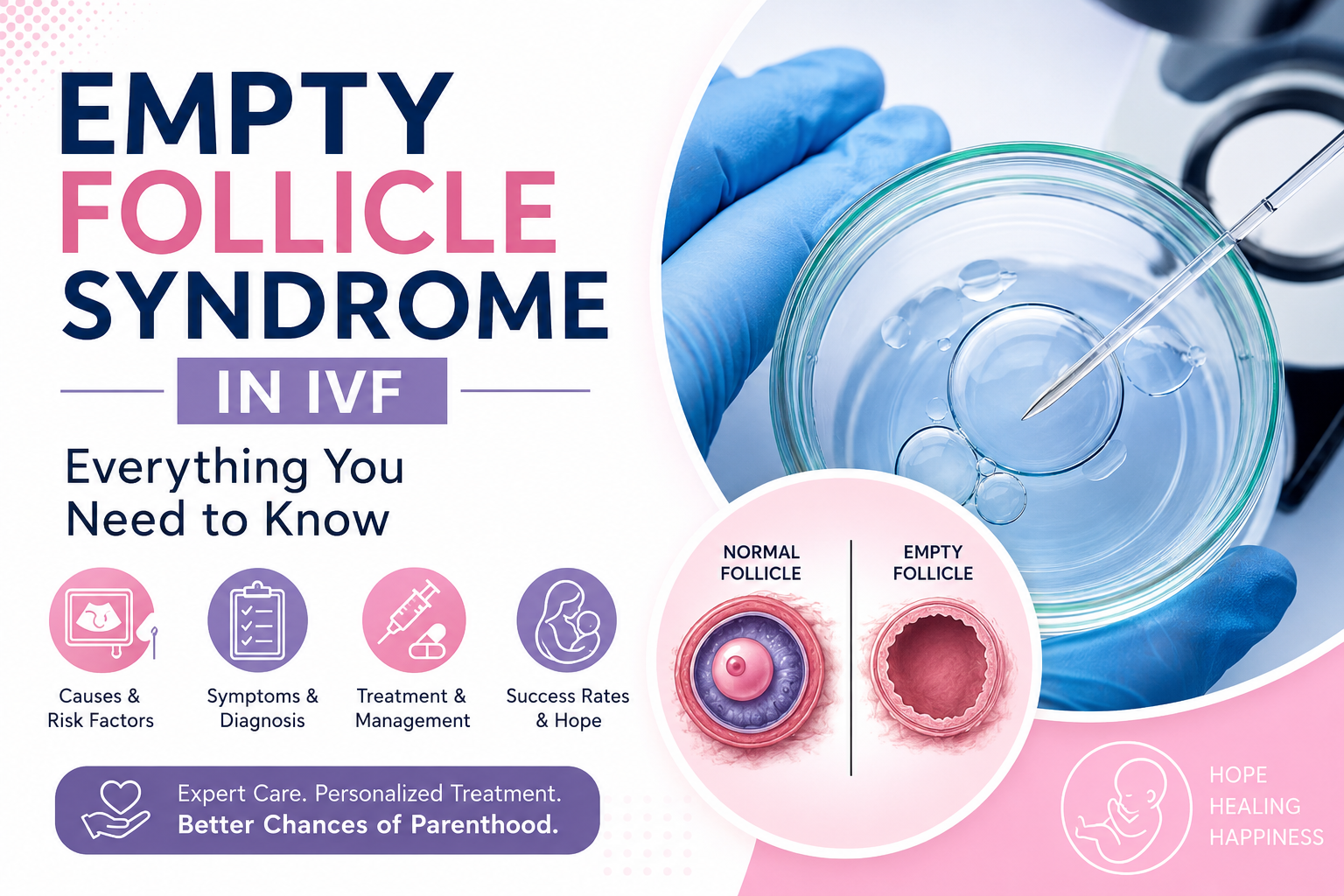
1. What Is Empty Follicle Syndrome (EFS)?
Empty Follicle Syndrome (EFS) is a rare complication that can occur during In Vitro Fertilization (IVF) treatment. In this condition, mature ovarian follicles appear healthy on an ultrasound scan, but no eggs are retrieved during the egg collection procedure, even after careful aspiration.
Under normal circumstances, each mature follicle contains an egg that can be collected for fertilization. However, in EFS, the follicles appear fully developed, yet no oocytes (eggs) are found.
Although this can be emotionally distressing, it's important to remember that EFS affects less than 1% of IVF cycles and experiencing it once does not mean future IVF treatments will fail. With the right evaluation and personalized treatment, many women go on to have successful pregnancies.
2. How Does Egg Retrieval Normally Work?
To understand Empty Follicle Syndrome, it helps to know how the egg retrieval process works during IVF.
Step 1: Ovarian Stimulation
Hormonal medications are given to stimulate the ovaries to produce multiple mature follicles instead of the single egg released during a natural menstrual cycle.
Step 2: Follicle Monitoring
Your fertility specialist monitors follicle growth using ultrasound scans and blood tests to ensure the eggs are developing properly.
Step 3: Trigger Injection
Once the follicles reach the right size, a trigger injection (usually hCG or a GnRH agonist) is administered. This final injection helps mature the eggs so they are ready for retrieval.
Step 4: Egg Retrieval
Approximately 34–36 hours after the trigger injection, the eggs are collected using an ultrasound-guided needle under mild sedation.
In most IVF cycles, mature follicles contain healthy eggs. However, in Empty Follicle Syndrome, the follicles appear normal, but no eggs are retrieved.
3. Types of Empty Follicle Syndrome
Doctors classify Empty Follicle Syndrome into two main types.
Genuine Empty Follicle Syndrome (GEFS)
This is the rarer form of EFS. In Genuine EFS:
- The trigger injection is administered correctly.
- Hormone levels are within the expected range.
- Egg retrieval is performed at the correct time.
- Despite all of this, no eggs are retrieved.
The exact cause of Genuine EFS is still not fully understood, and researchers continue to investigate why it occurs.
False Empty Follicle Syndrome (FEFS)
False EFS is more common and is usually caused by problems related to the trigger injection.
Possible reasons include:
- Incorrect timing of the trigger injection
- Improper injection technique
- Medication storage issues
- Poor absorption of the medication
- Rare manufacturing defects
Unlike Genuine EFS, False EFS can often be corrected, allowing successful egg retrieval in future IVF cycles.
4. How Common Is Empty Follicle Syndrome?
The good news is that Empty Follicle Syndrome is extremely rare.
Studies suggest that:
- The overall incidence is approximately 0.2% to 1% of IVF cycles.
- Genuine EFS is much less common than False EFS.
- Most fertility clinics encounter only a handful of cases over several years.
With experienced fertility specialists, careful monitoring, and proper medication management, the risk remains very low.
5. What Causes Empty Follicle Syndrome?
There isn't a single cause of Empty Follicle Syndrome. Instead, several factors may contribute.
Incorrect Trigger Injection
The trigger injection plays a crucial role in preparing eggs for retrieval.
If the injection is:
- Given too early or too late
- Administered incorrectly
- Missed completely
- Ineffective due to medication issues
the eggs may not mature properly, resulting in Empty Follicle Syndrome.
Hormonal Imbalances
Abnormal hormone levels can interfere with the final stages of egg maturation.
After an unsuccessful egg retrieval, doctors often check:
- hCG levels
- LH (Luteinizing Hormone) levels
- Estradiol levels
These tests help determine whether hormonal factors contributed to the condition.
Poor Ovarian Response
Some women naturally produce follicles that do not contain healthy eggs.
This is more likely in women with:
- Low ovarian reserve
- Advanced maternal age
- A history of poor IVF response
Genetic Factors
Although rare, certain genetic abnormalities affecting follicle development may contribute to Genuine Empty Follicle Syndrome.
Research in this area is still ongoing.
Laboratory Factors
In rare situations, laboratory-related issues may contribute to unsuccessful egg retrieval.
Reputable IVF laboratories follow strict quality-control procedures to minimize this possibility.
6. Risk Factors for Empty Follicle Syndrome
While EFS can happen unexpectedly, certain factors may increase the risk.
These include:
- Advanced maternal age
- Reduced ovarian reserve
- Low AMH levels
- Previous IVF failure
- Poor ovarian response
- A history of Empty Follicle Syndrome
- Hormonal disorders
However, having one or more of these risk factors does not mean you will definitely experience EFS.
7. Symptoms and Diagnosis
One of the unique aspects of Empty Follicle Syndrome is that it usually has no warning signs before egg retrieval.
Most women experience:
- Normal follicle development
- Healthy ultrasound findings
- Expected hormone levels
- A normal ovarian response to stimulation
The condition is usually diagnosed only during the egg retrieval procedure, when no eggs are found despite multiple mature follicles.
Additional Evaluation
After diagnosis, your fertility specialist may recommend:
- Blood tests to measure hCG levels
- Reviewing the timing of the trigger injection
- A detailed ultrasound assessment
- Laboratory evaluation
- A review of your medical and IVF history
These investigations help determine whether the condition is Genuine EFS or False EFS.
8. Can Empty Follicle Syndrome Affect IVF Success?
Although receiving an EFS diagnosis can be disappointing, it does not mean your IVF journey is over.
Many women achieve successful pregnancies after:
- Changing the ovarian stimulation protocol
- Adjusting the timing of the trigger injection
- Using a different trigger medication
- Undergoing another IVF cycle with closer monitoring
One unsuccessful egg retrieval does not predict future IVF failure.
9. Treatment Options for Empty Follicle Syndrome
Treatment depends on the underlying cause identified by your fertility specialist.
Repeat Trigger Injection
If False EFS is suspected, doctors may administer another trigger injection and schedule a second egg retrieval.
Many patients have successfully retrieved eggs using this approach.
Modified IVF Protocol
Your doctor may recommend changes such as:
- Different fertility medications
- Dual-trigger protocols
- Higher trigger doses
- Alternative hormone schedules
Dual Trigger Technique
Many fertility specialists now use a combination of:
This approach may improve egg maturation and increase the chances of successful retrieval.
Personalized IVF Treatment
Every woman responds differently to fertility treatment.
An experienced best IVF Doctor in Delhi NCR will carefully review your previous IVF cycle and design a personalized treatment plan to improve your chances of success.
10. Can Empty Follicle Syndrome Be Prevented?
Although Genuine EFS cannot always be prevented, several steps may reduce the risk.
Follow Medication Instructions Carefully
Always remember to:
- Take your injections exactly as instructed.
- Double-check the timing of every dose.
- Store medications correctly.
- Contact your fertility clinic immediately if you are unsure about any step.
Choose an Experienced IVF Center
An experienced fertility team closely monitors:
- Hormone levels
- Follicle growth
- Trigger timing
- Laboratory procedures
This careful monitoring helps reduce the likelihood of complications.
Attend Regular Monitoring Visits
Routine ultrasounds and blood tests allow your doctor to make timely adjustments throughout your IVF cycle.
11. Success Rates After Empty Follicle Syndrome
The encouraging news is that many women go on to achieve successful pregnancies after experiencing EFS.
Studies suggest that:
- Most patients retrieve eggs successfully in future IVF cycles.
- False EFS generally has an excellent prognosis.
- Individualized treatment significantly improves outcomes.
- Pregnancy rates after successful egg retrieval are comparable to many routine IVF cycles.
Early diagnosis, expert evaluation, and personalized treatment are key to improving success.
12. Emotional Impact and Coping Strategies
Experiencing Empty Follicle Syndrome can be emotionally overwhelming.
Many couples feel:
- Disappointment
- Anxiety
- Frustration
- Sadness
- Fear about future IVF treatment
These emotions are completely normal.
Healthy Ways to Cope
You may find it helpful to:
- Talk openly with your fertility specialist.
- Join an infertility support group.
- Practice relaxation techniques such as yoga or meditation.
- Maintain a healthy lifestyle.
- Seek professional counseling if needed.
Remember, one unsuccessful IVF cycle does not define your fertility journey.
13. When Should You Consult an IVF Specialist?
You should consult a fertility specialist if you:
- Have experienced Empty Follicle Syndrome
- Have had repeated IVF failures
- Have a low ovarian reserve
- Have poor ovarian response
- Are over 35 years of age
- Need a personalized fertility treatment plan
Consulting the best IVF Doctor in Delhi NCR can help identify the underlying cause of EFS and provide a tailored treatment strategy to improve your chances of a successful pregnancy.
14. Final Thoughts
Empty Follicle Syndrome is one of the most unexpected complications of IVF, but it is also one of the most misunderstood. While discovering that no eggs were retrieved can be heartbreaking, it does not mean your dream of becoming a parent is over.
Advances in fertility medicine have made it possible to identify potential causes, adjust treatment protocols, and significantly improve outcomes in future IVF cycles. By working closely with an experienced fertility specialist, following medication instructions carefully, and choosing a trusted IVF center, many couples successfully overcome this challenge.
Every IVF journey is unique, and each experience provides valuable information that helps doctors develop a more effective treatment plan. With expert care, patience, and hope, many women who experience Empty Follicle Syndrome go on to retrieve healthy eggs and achieve successful pregnancies.
Frequently Asked Questions (FAQs)
1. What causes Empty Follicle Syndrome in IVF?
Empty Follicle Syndrome is most commonly caused by problems with the trigger injection, hormonal imbalances, poor ovarian response, or, in rare cases, unknown biological factors.
2. Can I get pregnant after Empty Follicle Syndrome?
Yes. Many women successfully conceive in later IVF cycles after receiving personalized treatment adjustments and careful monitoring.
3. Is Empty Follicle Syndrome common?
No. It is a rare IVF complication that affects less than 1% of IVF treatment cycles.
4. Can Empty Follicle Syndrome be prevented?
False Empty Follicle Syndrome can often be prevented through proper trigger injection timing, correct medication use, and close monitoring throughout the IVF cycle.
5. Should I change my fertility specialist after experiencing Empty Follicle Syndrome?
Not necessarily. However, if you have experienced repeated IVF failures or would like a second opinion, consulting the best IVF Doctor in Delhi NCR can help identify the cause and develop the most appropriate treatment strategy for future IVF cycles.
 English
 Arabic
 French
 Spanish
 Portuguese
 Deutsch
 Turkish
 Dutch
Dutch
 Italiano
 Russian
 Romaian
 Portuguese (Brazil)
 Greek
Greek
 Advertise With Us
 About Us
 Terms And Conditions
 Política de Privacidade
Ver Todos
Política de Privacidade
Ver Todos