English
 Arabic
 French
 Spanish
 Portuguese
 Deutsch
 Turkish
 Dutch
Dutch
 Italiano
 Russian
 Romaian
 Portuguese (Brazil)
 Greek
Greek
North America Feed Flavours and Sweeteners Market Growth Analysis, Competitive Landscape, and Future Outlook 2025–2031
Food |
2026-08-21 10:34:55
 Advertise With Us
 About Us
 Terms And Conditions
 سياسة الخصوصية
عرض كل النتائج
سياسة الخصوصية
عرض كل النتائج

ترقية الحساب
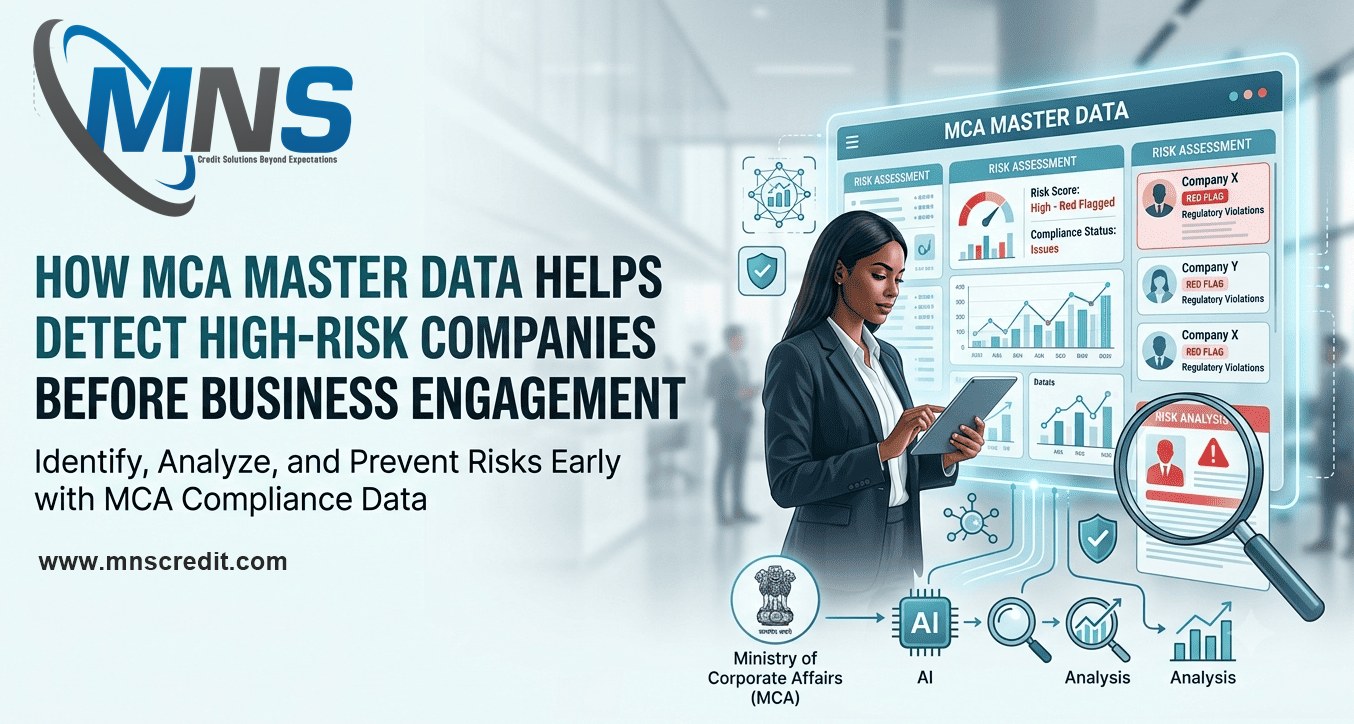
Every commercial relationship carries an invisible question: is the company on the other side of the table actually who it claims to be, and is it financially and legally sound enough to honor its obligations? In India, that question has a reliable first answer sitting inside a government database that far too many businesses check only after something has gone wrong. MCA Master Data, maintained by the Ministry of Corporate Affairs on the MCA21 V3 portal, is the official record of every registered company and LLP in the country. Used correctly, before a contract is signed, before credit is extended, or before a vendor is onboarded, it becomes one of the fastest and cheapest ways to filter out high-risk entities before they ever become a liability.
MCA Master Data is a structured public record tied to a company's Corporate Identification Number (CIN). It includes the legal name and registration date, registered office address, authorized and paid-up capital, classification (private, public, government, Section 8, etc.), current registration status, details of directors and their Director Identification Numbers (DINs), charges registered against company assets, and a history of statutory filings such as annual returns and financial statements. None of this is opinion or estimate. It is the company's own regulatory footprint, recorded because Indian law under the Companies Act, 2013 requires it.
Most businesses still rely on documents the counterparty hands over directly: a PAN card, a GST certificate, an invoice, a business card. These are easy to fabricate or selectively present. A company can look perfectly legitimate on paper while its actual MCA record shows it has been dormant for years, has directors who are disqualified elsewhere, or has already been marked "Under Process of Striking Off." Because MCA Master Data is sourced independently of the counterparty, it removes the incentive and the opportunity to misrepresent basic facts. This is precisely why it is treated as a foundational step in company verification, due diligence, and regulatory compliance work across lending, investment, and vendor onboarding.
A handful of fields do most of the work when it comes to flagging risk:
● Company status — Active, Dormant, Under Liquidation, Strike Off, or Under Process of Striking Off. Anything other than "Active" should stop a transaction until clarified.
● Filing history — Annual returns and financial statements that are consistently late or missing for two or more years often indicate financial distress or an entity that has effectively ceased serious operations.
● Charges (mortgages and pledges) — A large number of open charges relative to company size, or charges that have never been satisfied years after the underlying loan should have matured, can signal heavy leverage or unresolved liabilities.
● Director profile — Directors holding an unusually high number of directorships, or directors flagged as disqualified under Section 164 of the Companies Act, are a recurring pattern in shell company networks.
● Capital structure mismatches — A company with a large authorized capital but negligible paid-up capital, or one that has never increased capital despite claimed growth, warrants a closer look.
● Registered office changes — Frequent shifts in registered office, especially across states, can be an attempt to stay ahead of regulatory or legal action.
1. Confirm identity — Match the legal name and CIN exactly against what the counterparty has provided. Minor spelling variations are sometimes used deliberately to create confusion with a more established company.
2. Check current status — Anything besides "Active" is an immediate escalation point.
3. Review the director list — Cross-check DINs for disqualification status and unusually high directorship counts.
4. Examine charges — Look for unsatisfied charges and compare their value against the company's declared scale of operations.
5. Audit filing consistency — Gaps in annual filings are one of the strongest early indicators of financial or governance trouble.
6. Cross-reference with financial statements — Where available, compare declared turnover and net worth in filings against what the counterparty has represented in negotiations.
Certain patterns show up again and again in companies that later turn out to be high-risk: a status marked struck off or under liquidation while still actively soliciting business; directors linked to multiple financially distressed entities; no annual filing for several consecutive years despite claims of active trading; a registered office that resolves to a shared virtual address used by dozens of unrelated companies; and paid-up capital so minimal that it cannot plausibly support the scale of business being proposed. None of these facts alone is proof of fraud, but together they build a risk profile that deserves further scrutiny before money or goodwill changes hands.
MCA Master Data is the starting point, not the finish line. It confirms legal existence and surfaces compliance red flags, but it does not capture litigation history, adverse media, banking conduct, or the qualitative business reputation that a structured investigation reveals. This is where a professional due diligence report adds value — combining verified MCA data with litigation checks, credit history, and on-ground verification to give decision-makers a fuller, risk-scored view rather than a single data point.
For companies trading with counterparties in the Middle East or elsewhere, the same discipline applies using local equivalents — commercial registry checks under CBUAE and DIFC/ADGM frameworks, along with FATF and MENAFATF-aligned screening. The principle stays constant across jurisdictions: verify the entity independently of what it tells you, and treat any gap between registry data and business claims as a reason to investigate further, not a reason to move faster.
The businesses that get the most value from MCA Master Data are the ones that turn it into policy rather than judgment call. That means defining, in writing, which status codes automatically pause an onboarding decision, how many open charges trigger escalation to a senior reviewer, and how often an existing counterparty's status is re-checked after the initial approval. Without this structure, screening tends to happen inconsistently — thoroughly for large, high-visibility deals and barely at all for smaller, routine ones, even though smaller counterparties are statistically where dormant, struck-off, and shell-company risk concentrates most heavily. A written policy also protects the organization internally: when a deal later goes wrong, having documented that MCA screening was performed to a consistent standard is far stronger than being able to say it was "checked informally."
In many organizations, MCA verification ends up split across procurement, finance, and legal, with each assuming another team has already done it. The more reliable model assigns clear ownership — typically to a compliance or risk function — with a defined turnaround time, so that sales and procurement teams aren't tempted to bypass the check under deal pressure. Larger organizations increasingly automate the first pass of this screening, using it to flag exceptions for human review rather than requiring a manual look at every counterparty regardless of risk level.
High-risk companies rarely announce themselves. They look, on the surface, like any other counterparty — until the payment defaults, the contract is disputed, or the vendor disappears mid-project. MCA Master Data gives Indian businesses, lenders, and procurement teams an independent, government-sourced way to catch these risks before engagement rather than after loss. Built into a standard onboarding checklist and paired with a structured due diligence process, it turns a five-minute registry check into one of the most cost-effective risk controls a business can have. For organizations that engage with dozens or hundreds of counterparties a year, that habit — checked consistently, every time, and owned clearly by one function — is what separates businesses that absorb occasional losses quietly from those that never see them coming at all.