English
 Arabic
 French
 Spanish
 Portuguese
 Deutsch
 Turkish
 Dutch
Dutch
 Italiano
 Russian
 Romaian
 Portuguese (Brazil)
 Greek
Greek
Why Local SEO Services Matter for Law Firms
Other |
2026-08-13 07:38:15
 Advertise With Us
 About Us
 Terms And Conditions
 Πολιτική Ιδιωτικότητας
δες τα όλα
Πολιτική Ιδιωτικότητας
δες τα όλα

Upgrade to Pro
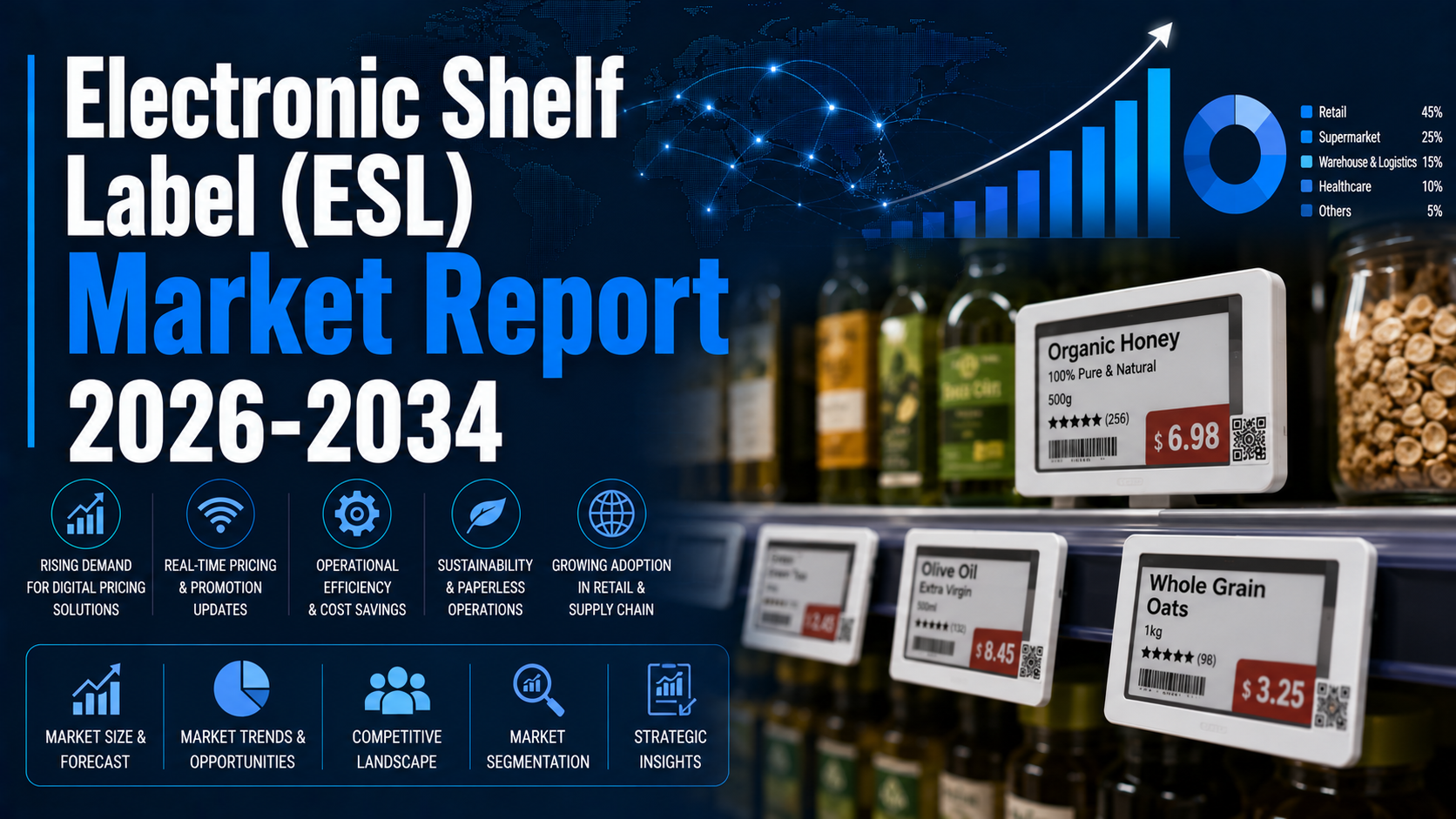
The global electronic shelf label market size reached USD 1,372.1 Million in 2025. Looking forward, IMARC Group expects the market to reach USD 4,713.6 Million by 2034, exhibiting a growth rate (CAGR) of 14.26% during 2026-2034. Europe currently leads the electronic shelf label market, supported by a mature and highly competitive retail sector across countries such as Germany, France, and the United Kingdom.
This detailed analysis primarily encompasses industry size, business trends, market share, key growth factors, and regional evaluation. The report offers a comprehensive overview and integrates research findings, market assessments, and data from multiple sources. It also includes pivotal market dynamics such as drivers and challenges, while highlighting growth opportunities, technological improvements, and innovations across the electronic shelf label market. Besides this, the report provides regional market evaluation along with a competitive landscape analysis.
The market is experiencing robust growth driven by the rising need for retail efficiency, enhancement of consumer shopping experience, growing environmental sustainability, significant technological advancements, and competitive pressure among retailers seeking to modernize their pricing operations.
Growing Demand for Retail Efficiency and Accuracy: Traditional paper price tags are time-consuming to update and prone to errors. Electronic shelf labels enable retailers to instantly update prices across stores, reducing labor costs associated with manual price changes and minimizing pricing errors that affect consumer trust.
Enhancement of Consumer Shopping Experience: Electronic shelf labels provide consumers with real-time pricing information and can display additional product details such as nutritional facts or reviews, fostering transparency and helping retailers differentiate their shopping environment.
Environmental Sustainability Focus: Electronic shelf labels are reusable and consume minimal power compared to the constant printing and disposal required for traditional paper tags, aligning with retailers' efforts to reduce their environmental footprint.
Competitive Differentiation Through Dynamic Pricing: Retailers are adopting electronic shelf labels to offer a modern, tech-savvy shopping experience and respond swiftly to market trends and competitor pricing actions, using the technology as a tool for agility.
Download a sample copy of the report: https://www.imarcgroup.com/electronic-shelf-label-market/requestsample
SES-imagotag is focusing on developing energy-efficient and cost-effective label solutions aligned with sustainability trends, Pricer AB is expanding its global footprint in the Asia Pacific region, and Altierre Corporation is emphasizing IoT integration for data-driven pricing and inventory management.
Breakup by Type:
LCD represents the largest segment, valued for vibrant colors, high contrast, good visibility, and responsiveness to real-time updates, despite higher power consumption than E-paper alternatives.
Breakup by Component:
Hardware accounts for the largest market share, comprising the electronic shelf labels themselves along with the associated infrastructure required for their operation.
Breakup by Technology:
Radiofrequency represents the leading segment due to its wireless range, reliability, and longer battery life, allowing labels to be updated even from a distance in large retail spaces.
Breakup by Application:
Supermarkets and hypermarkets represent the leading application segment, as electronic shelf labels simplify pricing and promotion management across the vast range of product categories these formats carry.
Breakup by Region:
Europe accounts for the largest electronic shelf label market share, followed by North America, where large retail chains and tech-savvy consumers, particularly in the United States, have prompted robust adoption for real-time pricing updates and promotions.
The electronic shelf label market presents strong opportunities as retailers continue shifting from manual pricing operations toward centralized, software-driven price management. Sectors beyond core retail, including healthcare and logistics, offer expansion potential as these industries adopt digital labeling for inventory accuracy and error reduction. Asia Pacific stands out as a particularly promising growth region, with rising modern retail formats and improving manufacturing affordability encouraging even smaller retailers to adopt the technology.
Integration between electronic shelf labels and IoT or AI-enabled retail systems, as pursued by players such as Altierre Corporation, points toward further opportunity in data-driven pricing and inventory management. Meanwhile, the sustainability advantages of E-paper based labels, particularly their minimal power consumption and reduction of paper waste, align with the environmental objectives of retailers across Europe and North America, reinforcing long-term demand for reusable, energy-efficient shelf labeling solutions.