English
 Arabic
 French
 Spanish
 Portuguese
 Deutsch
 Turkish
 Dutch
Dutch
 Italiano
 Russian
 Romaian
 Portuguese (Brazil)
 Greek
Greek
Best Multivitamin in Pakistan | Best Multivitamin for Men
Fitness |
2026-04-24 11:38:38
 Advertise With Us
 About Us
 Terms And Conditions
 Πολιτική Ιδιωτικότητας
δες τα όλα
Πολιτική Ιδιωτικότητας
δες τα όλα

Upgrade to Pro
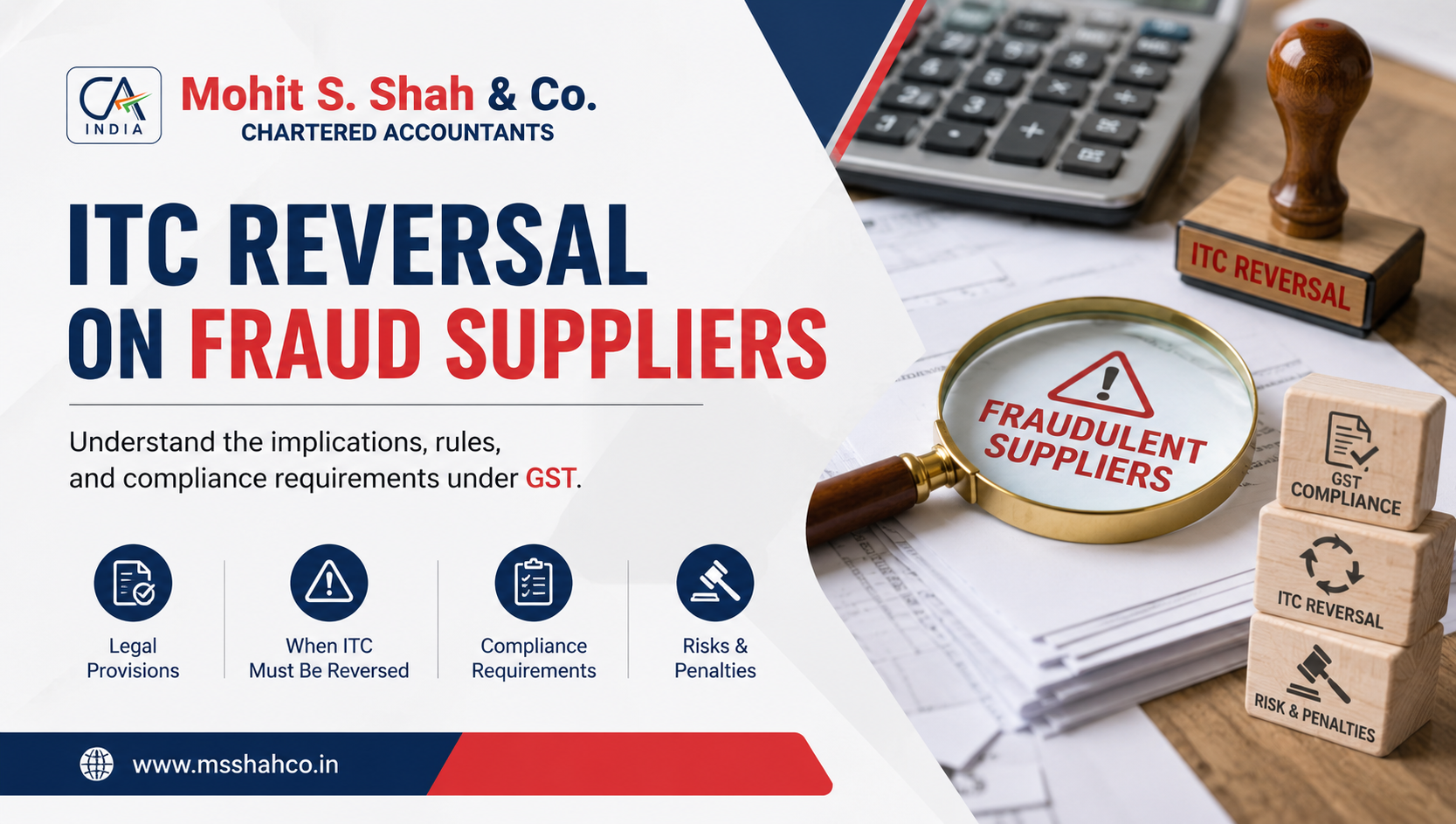
Input Tax Credit (ITC) is one of the biggest advantages available under the Goods and Services Tax (GST) regime. It allows businesses to reduce their tax liability by claiming credit for the GST paid on purchases. However, one issue that has become increasingly common is ITC Reversal on Fraud Suppliers. Many genuine taxpayers receive GST notices because their suppliers are later found to be fake, non-compliant, or involved in fraudulent transactions.
The question every business owner asks is: Can a genuine buyer lose ITC because of the supplier's fraud?
With GST authorities increasing scrutiny over fake invoicing and bogus GST registrations, businesses must understand the legal framework, judicial developments, and practical safeguards related to ITC Reversal on Fraud Suppliers. Recent policy discussions have also explored protecting bona fide buyers from supplier defaults, reflecting the evolving nature of GST compliance.
In this guide, Mohit S. Shah & Co. explains everything businesses need to know about ITC Reversal on Fraud Suppliers and how to minimize compliance risks.
Input Tax Credit (ITC) refers to the GST paid on purchases of goods or services that can be adjusted against the GST payable on outward supplies.
For example:
This mechanism prevents cascading taxation and reduces the overall tax burden on businesses.
ITC Reversal on Fraud Suppliers occurs when GST authorities deny or reverse ITC claimed by a recipient because the supplier has been found involved in fraudulent activities.
Examples include:
In many cases, the purchasing business has no knowledge of these fraudulent activities but still receives GST notices questioning the legitimacy of the ITC claimed.
GST authorities are actively identifying fake invoice networks and fraudulent suppliers to curb tax evasion.
Common reasons include:
Several large fake ITC rackets involving bogus invoices have been uncovered in recent years, resulting in stricter enforcement.
Section 16 lays down the eligibility conditions for claiming ITC.
Generally, a taxpayer must:
Failure to satisfy these conditions may result in ITC reversal.
GST authorities may issue notices under:
Applicable where tax is unpaid without fraud.
Applicable where fraud, suppression, or wilful misstatement is alleged.
These proceedings may involve:
The burden generally lies on the taxpayer claiming ITC to demonstrate eligibility through proper records and evidence.
This remains one of the most debated GST issues.
Many businesses argue:
Despite this, GST authorities may still question ITC if suppliers later turn out to be fraudulent.
Indian courts have repeatedly emphasized that bona fide purchasers should not automatically be denied ITC solely because of supplier defaults, provided they can establish genuine transactions with sufficient evidence.
Businesses frequently receive notices for:
To defend against ITC Reversal on Fraud Suppliers, businesses should maintain:
Proper documentation significantly improves the chances of defending ITC claims.
Businesses should conduct proper vendor verification before claiming ITC.
Always verify GSTIN from the GST portal.
Ensure the supplier regularly files:
Confirm invoices appear in GSTR-2B before claiming ITC.
Check:
Keep supplier KYC documents including:
Businesses should implement strong internal GST controls.
Match:
every month.
Create risk categories:
Include contractual clauses requiring:
Conduct periodic GST health checks to identify risks early.
If you receive a notice regarding ITC Reversal on Fraud Suppliers:
Timely and well-supported responses often help resolve disputes more effectively.
If authorities conclude that ITC has been wrongly claimed, consequences may include:
Where fraudulent intent is established, enforcement action can be significantly more severe.
Given the increasing complexity of GST litigation, businesses should seek professional assistance for:
Professional representation helps businesses safeguard legitimate tax credits while ensuring compliance.
Mohit S. Shah & Co. offers comprehensive GST advisory and litigation support for businesses across industries.
Our services include:
Our experienced professionals assist clients in protecting their rightful Input Tax Credit while ensuring complete GST compliance.
The issue of ITC Reversal on Fraud Suppliers has become one of the most significant challenges under the GST regime. While the government continues its crackdown on fake invoicing and fraudulent suppliers, genuine businesses should not suffer for transactions carried out in good faith. Maintaining robust documentation, conducting vendor due diligence, reconciling GST records regularly, and responding promptly to notices are essential to protecting your ITC. Courts have increasingly recognized the need to safeguard bona fide taxpayers where genuine transactions can be established, and ongoing policy discussions also indicate a move toward greater protection for compliant buyers.
If your business has received a GST notice regarding ITC Reversal on Fraud Suppliers or you need expert guidance on GST compliance and litigation, Mohit S. Shah & Co. is here to help.
📍 Office No. 26, 2nd Floor, Anant Building, 217, Shamaldas Gandhi Marg, Princess Street, Marine Lines (East), Mumbai – 400 002
📞 +91-9821462283