English
 Arabic
 French
 Spanish
 Portuguese
 Deutsch
 Turkish
 Dutch
Dutch
 Italiano
 Russian
 Romaian
 Portuguese (Brazil)
 Greek
Greek
Fat Melting Injection in Dubai Body Shaping Solution Guide
Health |
2026-06-19 09:05:05
 Advertise With Us
 About Us
 Terms And Conditions
 Política de Privacidade
Ver Todos
Política de Privacidade
Ver Todos

Atualize para o Pro
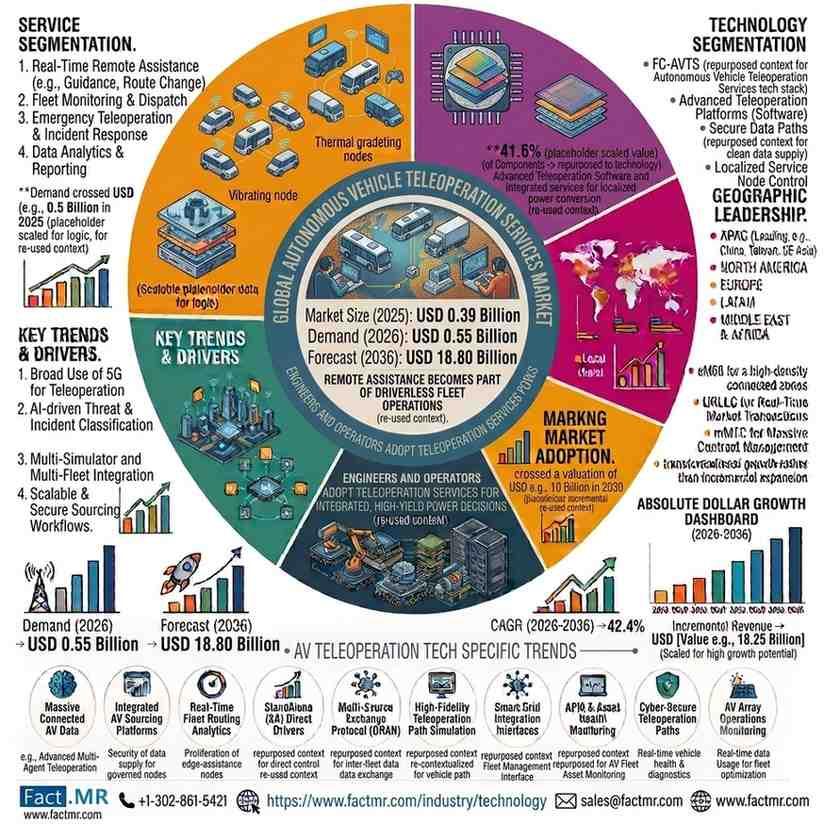
According to an in-depth research report published by Fact.MR, The global autonomous vehicle teleoperation services market is projected to grow from USD 0.55 billion in 2026 to USD 18.80 billion by the end of 2036, expanding at an extraordinary compound annual growth rate (CAGR) of 42.4% over the forecast period (2026–2036).
Get detailed market forecasts, competitive benchmarking, and pricing trends: https://www.factmr.com/connectus/sample?flag=S&rep_id=15279
this steep growth trajectory is driven by the rapid commercialization of robotaxis, expanding driverless logistics fleets, and the imperative for real-time human intervention in edge-case driving scenarios. Autonomous vehicle (AV) operators are increasingly deploying teleoperation platforms to deliver continuous remote monitoring, real-time remote driving, and fallback assistance to guarantee operational safety and regulatory compliance across urban transportation networks.
Key Market Highlights at a Glance
Why Is the Autonomous Vehicle Teleoperation Services Market Growing?
The adoption of autonomous vehicle teleoperation services is accelerating rapidly due to the physical realities of autonomous driving in complex environments. While Level 4 and Level 5 autonomous systems handle standard driving tasks, unpredictable road blockages, extreme weather, and novel construction zones require real-time human assistance to resolve stall states and maintain fleet efficiency.
Primary Demand Drivers
Which Connectivity Type Leads the Autonomous Vehicle Teleoperation Services Market?
Cellular Networks Command Over Half of Global Market Share
The cellular networks segment holds the dominant position in the autonomous vehicle teleoperation services market, capturing 52.0% of global revenue. The rollout of commercial 5G Standalone (SA) networks and continuous coverage enhancements along urban thoroughfares supply the ultra-low latency and elevated throughput necessary to transmit synchronized multi-angle video feeds from moving vehicles to remote operations centers.
Cellular teleoperation allows fleet operators to maintain persistent data links across dense urban canyons. As public telecommunication providers optimize automotive network slicing, latency drops below 20 milliseconds, granting remote human operators high-fidelity control over distant vehicles.
Which Delivery Model Commands the Highest Market Value?
Managed Service Models Capture 44.0% Market Share
The managed service delivery model serves as the primary operational approach in the global market, representing 44.0% of total revenue. Autonomous vehicle developers and fleet operators increasingly outsource teleoperation logistics to specialized third-party providers capable of supplying full-stack monitoring centers, trained operators, regulatory compliance oversight, and cybersecurity architecture.
Early commercial deployments favor managed teleoperation offerings because they eliminate the immense capital expenditure of building proprietary physical monitoring command centers and training dedicated remote operator workforces.
Which Vehicle Type Drives the Dominant Usage?
Robotaxis Generate 41.0% of Market Demand
Robotaxis constitute the leading vehicle type segment in the market, accounting for 41.0% of total global demand. Passenger safety demands, unpredictable passenger interactions, and navigating congested downtown traffic make remote assistance services indispensable for commercial ride-hailing operators.
Market Dynamics: Drivers, Restraints, and Key Trends
Key Market Drivers
The continuous push toward commercializing Level 4 autonomous vehicle fleets without onboard safety drivers represents the central driver for teleoperation services. Teleoperation provides the essential safety backstop required by transportation authorities, enabling driverless fleets to scale efficiently across major metropolitan cities.
Key Market Restraints
Network signal degradation, variable packet loss, and latency spikes in dead zones represent significant technical restraints for market expansion. Ensuring absolute fail-safe protocols and robust cybersecurity protection against potential signal hijacking across public cellular networks requires continuous, capital-intensive engineering investments.
Key Industry Trends
A key industry trend is the convergence of AI-assisted remote guidance with human control. Rather than requiring continuous direct remote driving, modern teleoperation platforms utilize AI microservices to propose tactical path clearance routines, allowing a single human operator to supervise up to 50 autonomous vehicles simultaneously.
Regional Outlook: Germany Leads Global Growth
North America and Western Europe currently lead commercial teleoperation deployments due to early commercial robotaxi launches and progressive legal frameworks, while East Asia accelerates infrastructure buildouts across connected mobility hubs.
Country-Level Growth Stories
Competitive Landscape
The autonomous vehicle teleoperation services market features leading mobility software developers, specialized remote assistance technology providers, and autonomous driving technology pioneers. Companies are focusing on real-time video compression, ultra-low latency streaming protocols, advanced human-machine interfaces, and enterprise cybersecurity compliance.
Industry participants are actively partnering with telecommunications providers and cloud software hyperscalers to lower data streaming latencies and ensure high-availability remote supervision.
Read the Comprehensive Industry Report: https://www.factmr.com/report/autonomous-vehicle-teleoperation-services-market
Frequently Asked Questions
What is the projected market size of the global autonomous vehicle teleoperation services market by 2036?
The global autonomous vehicle teleoperation services market is projected to reach a valuation of USD 18.80 billion by the end of 2036.
What is the estimated market size of the autonomous vehicle teleoperation services market in 2026?
The global autonomous vehicle teleoperation services market is estimated at USD 0.55 billion in 2026, up from USD 0.39 billion in 2025.
What is the expected growth rate (CAGR) of the autonomous vehicle teleoperation services market?
The global autonomous vehicle teleoperation services market is expected to grow at a Compound Annual Growth Rate (CAGR) of 42.4% between 2026 and 2036.
Which connectivity technology holds the leading share in the autonomous vehicle teleoperation services market?
Cellular networks hold the leading share in the autonomous vehicle teleoperation services market, accounting for 52.0% of total market revenue.
Which vehicle type accounts for the largest share in the autonomous vehicle teleoperation services market?
Robotaxis represent the largest vehicle type segment in the autonomous vehicle teleoperation services market, generating 41.0% of global demand.
Which country is the fastest-growing market for autonomous vehicle teleoperation services?
Germany is the fastest-growing country in the autonomous vehicle teleoperation services market, expanding at a projected CAGR of 49.5% through 2036.
Who are the key technology providers in the autonomous vehicle teleoperation services market?
Key players in the autonomous vehicle teleoperation services market include Ottopia, Vay, FERNRIDE, TIER IV, Applied Intuition, and Waymo.
To View Related Report:
Autonomous Stadium Retail Market: https://www.factmr.com/report/autonomous-stadium-retail-market
Autonomous Sorting for Flexible Plastic Waste Market: https://www.factmr.com/report/autonomous-sorting-for-flexible-plastic-waste-market
Autonomous Valet Parking (AVP) Scenario Test Systems Market: https://www.factmr.com/report/autonomous-valet-parking-avp-scenario-test-systems-market
Autonomous Mobile Robots Market: https://www.factmr.com/report/1402/autonomous-mobile-robots-market
To View More Report:
Lightning Protection Technologies (LPT) Market: https://www.openpr.com/news/4582478/lightning-protection-technologies-market-to-reach-usd-5-2
3D Concrete Printing Market: https://www.openpr.com/news/4582497/3d-concrete-printing-market-to-surpass-usd-55-5-billion-by-2036-as