English
 Arabic
 French
 Spanish
 Portuguese
 Deutsch
 Turkish
 Dutch
Dutch
 Italiano
 Russian
 Romaian
 Portuguese (Brazil)
 Greek
Greek
Trending Read Rolls and Rivalry by Kristy Boyce
Travel |
2026-06-24 06:57:41
 Advertise With Us
 About Us
 Terms And Conditions
 Политика конфиденциальности
Смотреть все
Политика конфиденциальности
Смотреть все

Обновить до Про
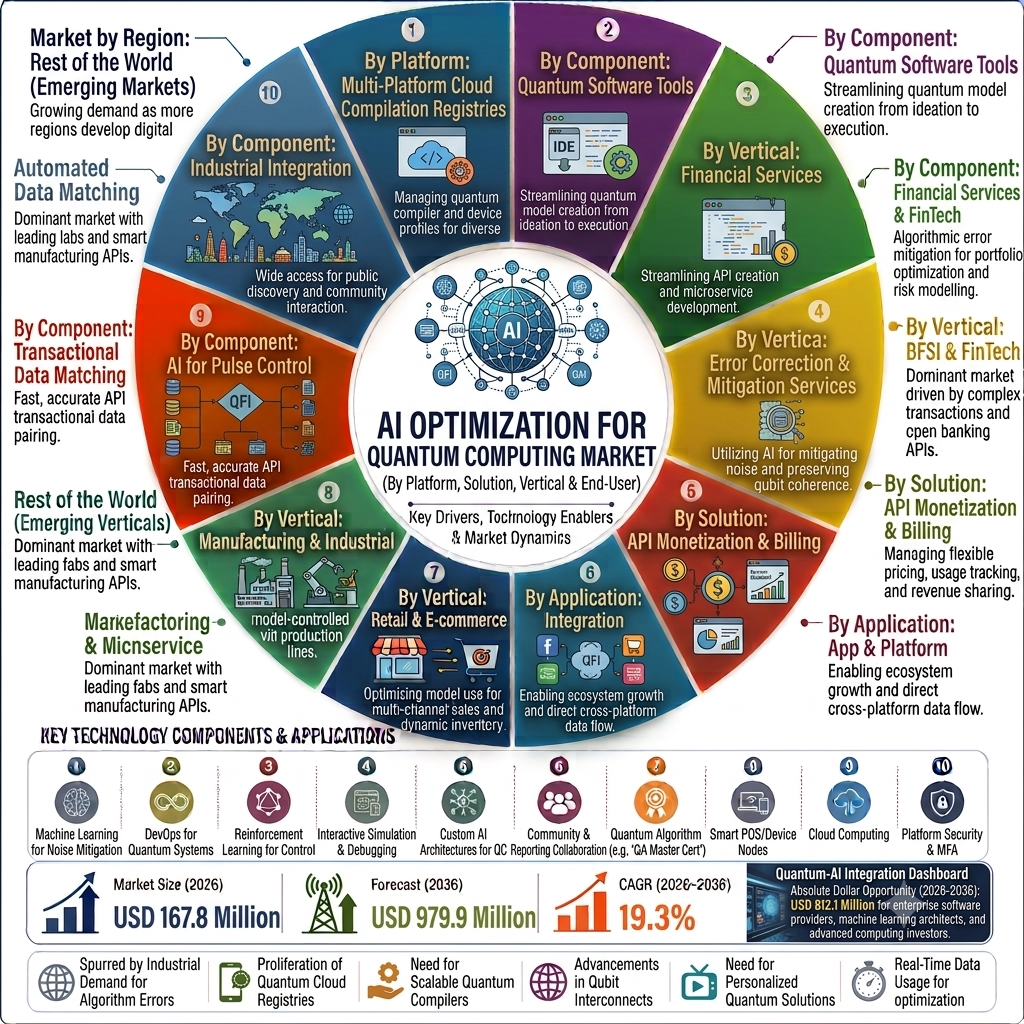
According to a comprehensive global industry assessment released by Fact.MR, the global AI optimization for quantum computing market reached an explicit valuation of USD 140.7 million in 2025.
Get detailed market forecasts, competitive benchmarking, and pricing trends: https://www.factmr.com/connectus/sample?flag=S&rep_id=15503
Driven by the critical industrial demand for algorithmic error mitigation and multi-platform cloud compilation registries, the market is projected to reach USD 167.8 million in 2026. Looking forward to the conclusion of the ten-year analysis window, the industry is forecast to secure an absolute market valuation of USD 979.9 million by 2036. This expansion reflects a compound annual growth rate (CAGR) of 19.3% between 2026 and 2036, delivering an absolute dollar opportunity of USD 812.1 million for enterprise software providers, machine learning architects, and advanced computing investors.
"Physical quantum processors remain highly sensitive to thermal and electromagnetic variations," says Shambhu Nath Jha, Senior Analyst at Fact.MR. "Enterprise research groups are realizing that manual hardware calibration creates an expensive operational bottleneck. The market is aggressively pivoting toward intelligent, software-defined compilation layers that dynamically shield processing circuits from environmental degradation."
The underlying technical architecture of advanced processing relies heavily on intermediate synthesis tools that decouple mathematical algorithms from physical hardware limitations. The software component segment is estimated to account for a 31.7% share of the overall market in 2026. This leading share position is sustained by intense enterprise demand for reusable compilation, transpilation, and synthesis layers capable of executing across diverse hardware formats. While bespoke consulting remains important for early-stage conceptual development, standalone optimization software delivers the scalable, repeatable execution routines needed as processing environments expand.
Immediate developer access to scarce, multi-million-dollar quantum processing arrays depends completely on centralized, highly virtualized delivery platforms. Cloud deployment is projected to account for a 44.5% share of the global market in 2026. This deployment architecture dominates the landscape because web-accessible portals eliminate the need for localized cryogenic hardware setups, allowing distributed research groups to immediately send optimized instruction sets to remote quantum mainframes. On-premise installations remain limited to highly restricted government labs, whereas public and hybrid cloud models provide the transactional agility required by commercial enterprise developers.
The primary driver accelerating the global market is the rising deployment of AI-guided circuit compilation, which contributes an estimated 2.4% positive impact to the industry's compound annual growth. Additionally, automated calibration and error suppression technologies provide a 2.0% positive impact on the global CAGR by replacing slow manual tuning with real-time neural network adjustments. These technical developments allow organizations to execute longer, more complex processing routines before environmental noise corrupts the calculated results.
The primary restraint limiting broader commercial deployment is weak benchmark comparability across disparate hardware families, which creates a 1.4% negative impact on the overall market CAGR. Furthermore, hardware-specific optimization overhead contributes an 1.1% negative drag on growth because optimization models trained on one processor architecture rarely transfer cleanly to alternative systems. This lack of architectural standardization forces enterprise procurement teams to perform tedious custom validation procedures for every unique hardware target.
The most significant trend defining the current market is the emergence of unified error-correction optimization layers that sit directly between classical control systems and quantum hardware. Modern enterprise platform engineering groups are prioritizing cross-platform benchmarking services to evaluate algorithmic efficiency across different processing centers. Additionally, software providers are designing their machine learning models to support hybrid quantum-classical orchestration, ensuring smooth data handoffs between cloud data centers and local systems.
The systemic requirement for optimized, high-performance computing infrastructure is generating rapid compound growth rates across emerging Asian technology hubs and established Western software centers.
India is expected to record a 21.1% CAGR between 2026 and 2036, positioning the country as the fastest-growing national market globally. This rapid expansion is heavily supported by government-backed National Quantum Mission research hubs and a massive, expanding base of enterprise software engineers.
China is projected to post a 20.4% CAGR during the ten-year forecast horizon. High growth is driven by dedicated quantum-AI consortia and state-aligned industrial software application programs focused on supply chain optimization.
Australia is anticipated to expand at a 19.1% CAGR over the assessment timeframe. Market development is propelled by rising corporate experimentation with automated optimization tools and deep academic research partnerships.
The United Kingdom is estimated to register an 18.8% CAGR across the 2026 to 2036 period. Market momentum is sustained by active venture capital allocations for deep-tech software startups and collaborative cloud computing initiatives.
The United States is forecast to sustain strong market volume, backed by a mature cluster of advanced computing hardware manufacturers and aggressive algorithmic research programs across private enterprise networks.
The competitive environment within the AI optimization for quantum computing sector is consolidating around specialized software providers that abstract away lower-level hardware friction.
Competitive dynamics indicate that hardware accessibility alone is no longer a sustainable differentiator. Modern software vendors are heavily prioritizing automated multi-platform compilation capabilities, real-time error mitigation pipelines, and seamless cloud provisioning APIs. This software focus enables enterprise research teams to maximize their algorithmic accuracy while shielding development workflows from underlying hardware architectural shifts.
Read the Comprehensive Industry Report: https://www.factmr.com/report/ai-optimization-for-quantum-computing-market
The global AI optimization for quantum computing market is projected to reach an absolute market valuation of USD 979.9 million by the year 2036.
The AI optimization for quantum computing market is forecast to record a compound annual growth rate (CAGR) of 19.3% from 2026 to 2036.
The software component holds the largest market position, capturing a 31.7% share of the overall industry in 2026.
The cloud deployment model dominates the industry, accounting for a 44.5% share of global deployment choices in 2026.
India is recorded as the fastest-growing national market, expanding at a projected 21.1% CAGR between 2026 and 2036.
The key companies profiled in the report include Classiq Technologies, Q-CTRL, IBM, Quantinuum, D-Wave Quantum Inc., Riverlane, and NVIDIA.
To View Related Report:
Bioinformatics Market: https://www.factmr.com/report/bioinformatics-market
Field Force Automation Market: https://www.factmr.com/report/field-force-automation-market
Law Enforcement Software Market: https://www.factmr.com/report/law-enforcement-software-market
Demand for Energy Harvesting System in UK: https://www.factmr.com/report/united-kingdom-energy-harvesting-system
To View More Report:
iBeacon and Bluetooth Beacon Market: https://www.openpr.com/news/4577704/ibeacon-and-bluetooth-beacon-market-set-to-reach-usd-287-4
Voice Over LTE (VoLTE) and Voice Over Wi-Fi Market: https://www.openpr.com/news/4577742/voice-over-lte-volte-and-voice-over-wi-fi-vowi-fi-market