English
 Arabic
 French
 Spanish
 Portuguese
 Deutsch
 Turkish
 Dutch
Dutch
 Italiano
 Russian
 Romaian
 Portuguese (Brazil)
 Greek
Greek
UNME Jewellery Offer: Grab the Best 50% Off Jewellery Offer Online
Other |
2026-06-24 06:31:39
 Advertise With Us
 About Us
 Terms And Conditions
 Πολιτική Ιδιωτικότητας
δες τα όλα
Πολιτική Ιδιωτικότητας
δες τα όλα

Upgrade to Pro
You have successfully navigated the fundamental and practical aspects of nose tip plasty in Riyadh. To ensure your knowledge is as thorough as possible before you step into a consultation in Riyadh, here are five advanced technical and psychological dimensions that distinguish highly informed patients.
The "internal nasal valve" is the narrowest point of your airway. If a surgeon modifies the nasal tip without accounting for this region, it can lead to a collapsed valve and chronic breathing difficulty.
The Pro-Tip: During your consultation, ask your surgeon: "How will you ensure the internal and external nasal valves remain supported during the tip-plasty?" Surgeons often use "spreader grafts" or "flaring sutures" to maintain this structural integrity. If they mention these terms, it is a sign of an experienced hand.
There is a persistent myth that surgeons can "thin" thick nasal skin. In reality, attempting to aggressively remove soft tissue from underneath the skin can cause severe scarring or blood-flow complications.
The Strategy: Expert surgeons manage thick skin not by thinning the skin itself, but by building a stronger, more projected framework underneath. This "tent pole" effect helps the skin drape more cleanly. Ask your surgeon: "Do you recommend structural reinforcement or any specialized skin-management protocols (like taping or pre-surgical agents) for my specific skin type?"
3D digital imaging is a fantastic communication tool, but it is not a surgical contract. It can predict the direction of the change, but it cannot predict how your specific tissues will heal, how much internal swelling you will develop, or how your cartilage will respond to being reshaped.
The Mindset: Use the simulation to discuss concepts (e.g., "I want to lift the tip by this much") rather than demanding an exact replication. The simulation is a visual aid for a conversation, not a guarantee of the physical outcome.
Rhinoplasty is unique among aesthetic procedures because it involves a very long maturation period (up to 12–18 months). During this time, you may experience "emotional fluctuations"—frustration when the nose looks swollen, or anxiety when the shape changes from week to week.
The Pro-Tip: Recognize that this is a standard physiological response. Your nose will go through "phases" where it looks perfect, then swollen, then refined again. Being prepared for these emotional swings is the best way to avoid unnecessary panic during your recovery.
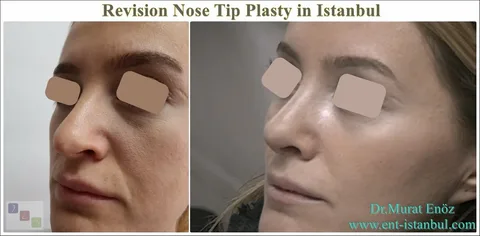
Revision surgery is significantly more complex than primary surgery because the anatomy has already been altered, blood flow may be compromised, and scar tissue has replaced natural planes.
The Prevention: The best way to avoid a revision is to be absolutely transparent about your medical history and to avoid rushing into surgery. If you feel "pushed" or "sold" by a clinic, trust your instincts. A surgeon who values long-term results will always prioritize your safety over a quick booking.
You have now completed the entire sequence of this master-guide. You have moved from a basic understanding of tip-plasty to an advanced grasp of the anatomical, functional, and psychological factors involved.
You are fully prepared to book your consultations with confidence and clarity. Is there anything else I can assist you with as you move forward with your plans in Riyadh?