English
 Arabic
 French
 Spanish
 Portuguese
 Deutsch
 Turkish
 Dutch
Dutch
 Italiano
 Russian
 Romaian
 Portuguese (Brazil)
 Greek
Greek
Are Jute Pillow Covers the Best Sustainable Choice in New York?
Shopping |
2026-07-03 09:57:03
 Advertise With Us
 About Us
 Terms And Conditions
 Politique de confidentialité
Tout voir
Politique de confidentialité
Tout voir

Mise à niveau vers Pro
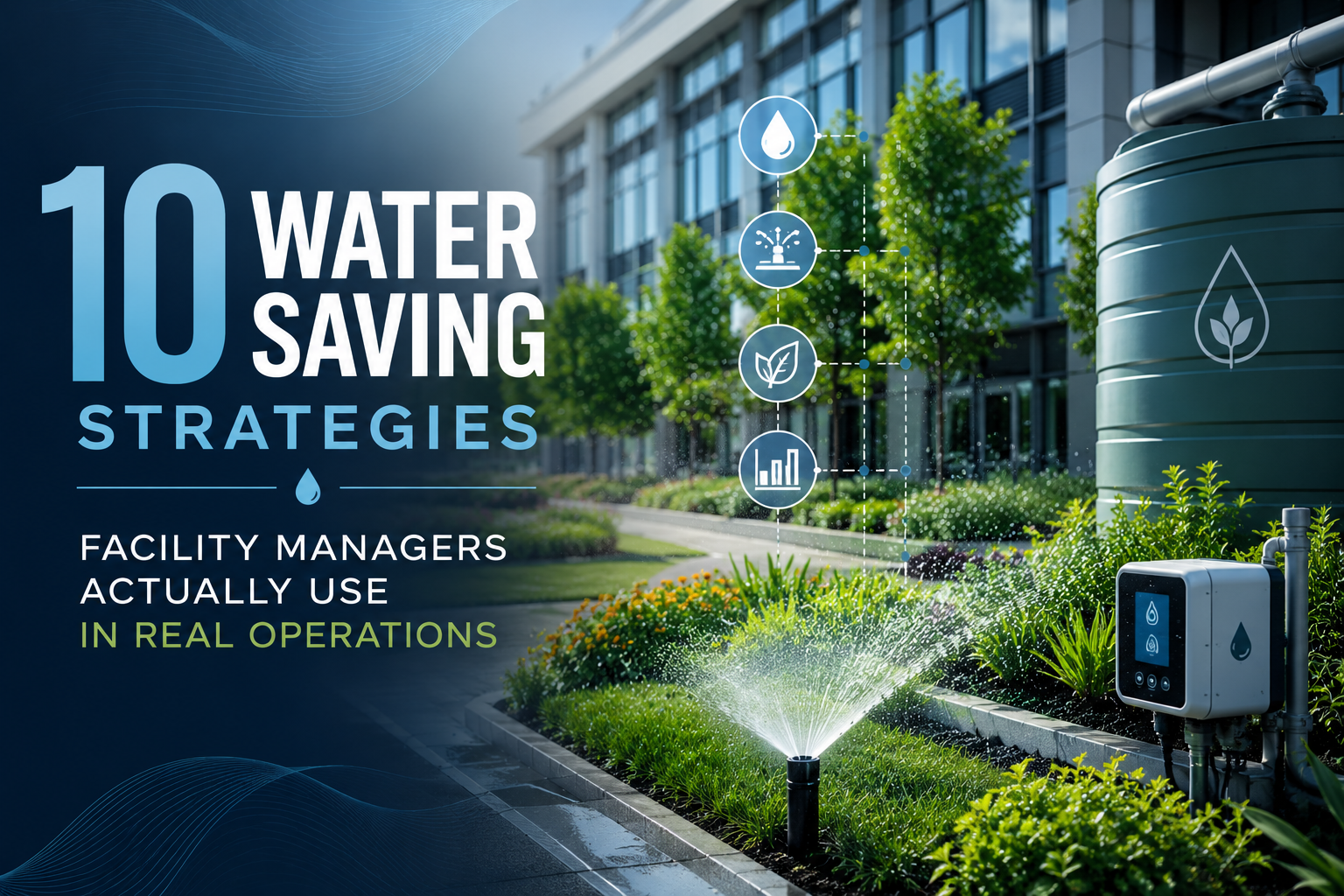
The reality in actual facility applications is that water losses are not always from an obvious single problem, but from a variety of smaller inefficiencies in irrigation scheduling, leak identification, cooling activities, maintenance schedules, etc. In commercial buildings, campuses and industrial facilities, facility managers are increasingly required to save money while still working towards achieving sustainable goals – and water usage is now being monitored in addition to energy. This guide centers on proven, applicable methods that are employed by successful teams to bring about quantifiable savings. One of the focus areas is water management including improving commercial irrigation efficiency for commercial production.
The majority of inefficiency issues only start to become apparent once a structured audit takes place.
A helpful water audit in real operations takes into consideration:
• Analysis of meter readings from different zones (not only total usage)
• Determining the "always on" usage locations (cooling, irrigation, restrooms)
• Investigating nighttime water flow for potential leaks
• Analyzing peaks that do not align with demand requirements
The important part of the equation is not documentation; it is determining where water is being lost continuously without a need for operations.
20-30% of water consumption is typically found in inefficient use or from non-critical sources by facilities.
Smaller facilities can get by with a basic meter, but not larger ones.
In practice, this will be monitoring at the zone level, particularly in:
• Landscape irrigation lines
• Cooling towers product supply systems
• High-traffic restroom blocks
• Pipes located in a building's basement or below ground.
Real-time monitoring facilities quickly detect unusual consumption, usually within days, rather than months.
It helps to avoid minor problems escalating into major losses on the infrastructure level.
Often leaks are ignored due to them being thought of as “minor” in many facilities.
In fact, one of the most consistent causes of unnecessary water loss is leakage at a low level.
Real world failure points:
• Underground irrigation lines
• Toilet flush valves
• Cooling system joints
• Aging pipe connections
Leak detection is a standard part of the "business" for the experienced facility team, rather than a repair activity.
A leak, even if dribbling, can add up to a lot of water every month without you even noticing it.
One of the most frequent facility management pitfalls is replacing the irrigation hardware and leaving the irrigation logic unchanged.
In reality, the majority of water loss is from:
• Addressed timers that are out of sync with the season.
• When plants are watered more than necessary “just in case” they need it.
• Watering when the evaporation rate is highest.
The most effective facilities in reducing consumption switch to:
• Time-based adjustments
• Weather-based scheduling
• Short watering periods, on and off
Often, the improvement is achieved through better control, rather than through new infrastructure.
Often, the old-fashioned spray watering systems waste a lot of water into evaporation and runoff.
Directed delivery methods in real facility environments lead to less water waste by moving it towards the root zone.
It is common to use this approach in the following:
• Commercial landscaping
• Institutional campuses
• Large property developments
The main benefit is consistency; water is delivered where it is needed and not widely spread.
A lot of establishments don't consider the long-term effect of the landscape design on water consumption.
In reality, highly efficient sites would be saving irrigation demand by:
• Planting species that are adapted to low, wet areas instead of high-water areas
• Implementing a waterproofing system on top of the pavement to stop water from running off into the storm sewer system
• Associating plants that require the same amount of water together
This helps to decrease the reliance on irrigation systems over time without attempting to increase water production.
Not everything that is used for water needs requires potable quality water in larger facilities.
Operational reuse is generally used in:
• Landscape irrigation
• Cooling processes
• The cleaning and maintenance workflows.
• Reuse of treated non-potable water is a major decrease in fresh water supply.
The main thing is making sure that safety requirements are met and separation of the reuse circuits is done correctly.
Land use planning and development, including water security
Rainwater harvesting is best suited as a secondary source of water rather than as the main source.
Collected rainwater may be employed in real applications for:
• Irrigation
• External cleaning
• Non-critical maintenance tasks
It is most useful in buildings that have a large roof space or open grounds.
The majority of inefficiencies remain because water systems are considered as back-up systems.
Good facilities work on these:
• Early reporting of small anomalies
• A knowledge of the cost of leaks.
• Implementing seasonal adjustments procedures
• Use of checking systems during regular rounds
The difference is in awareness and not only in instructions.
The best facility teams don't wait for problems to come up; they predict them based on data patterns.
This means that, practically speaking, it involves:
• Overseeing the trend of use over time
• Early detection of abnormal increases
• Comparing with similar zones to understand relative performance.
• Avoiding failure through planning for maintenance
This moves from a reactive to a predictive approach to managing water.
Each strategy stands on its own as an improvement strategy. However, in actual practice a combination of these produces results:
• Auditing is a process that shows the location of loss.
• It's monitored in real-time
• Maintenance prevents escalation
• Baseline demand is reduced by design
• Data is used to facilitate ongoing improvements.
The only way to get long-term water savings is to employ a system approach.
Even highly successful teams have a tendency to fail because of:
• Using only monthly billing information.
• Failing to take corrective measures for continuous leaks that don't pose an immediate hazard
• Investing too much in the hardware without addressing operations.
• Inconsistency between maintenance and landscaping personnel
• No feedback in the monitoring systems
These problems are routinely noted during actual facility evaluations.
No one upgrade or technology can solve the problem of water inefficiency in facility management. This is a product of constant control, monitoring and operational discipline.
The best facilities are concerned not so much with improvements once and for all, but with creating systems in which waste does not occur at all.
True savings and sustainability benefits lie there.