English
 Arabic
 French
 Spanish
 Portuguese
 Deutsch
 Turkish
 Dutch
Dutch
 Italiano
 Russian
 Romaian
 Portuguese (Brazil)
 Greek
Greek
Hair Transplant Advantages for Long Term Hair Growth
Health |
2026-03-25 06:22:28
 Advertise With Us
 About Us
 Terms And Conditions
 Politique de confidentialité
Tout voir
Politique de confidentialité
Tout voir

Mise à niveau vers Pro
In practice, what this translates to is that a supplier might get a Form 483 after an inspection, submit an inadequate CAPA response, get a formal warning letter and then be placed on Import Alert 66-40, and even if it takes 3-6 months to be placed on the alert, your buying team might not be alerted at any point. Often the first sign you will notice is anything from the US border that slows down your shipment.
This is no longer a possibility, but a reality. The number of both 483 violations and warning letters are at five-year highs. The FDA issued a total of 135 warning letters in Q1 2026. Over 62% of FDA drug quality inspections for FY2024 occurred at foreign manufacturing facilities, which also provide APIs, excipients, and intermediates to pharmaceutical purchasers globally. In 2024, over 70% of the critical GMP inspection findings worldwide were directly related to issues with data integrity and poor quality systems.
Every pharma manufacturing company sources raw materials from third-party suppliers; your compliance risk is your supplier's compliance. The question is why isn't this important. But whether you have a qualification process that will capture it.
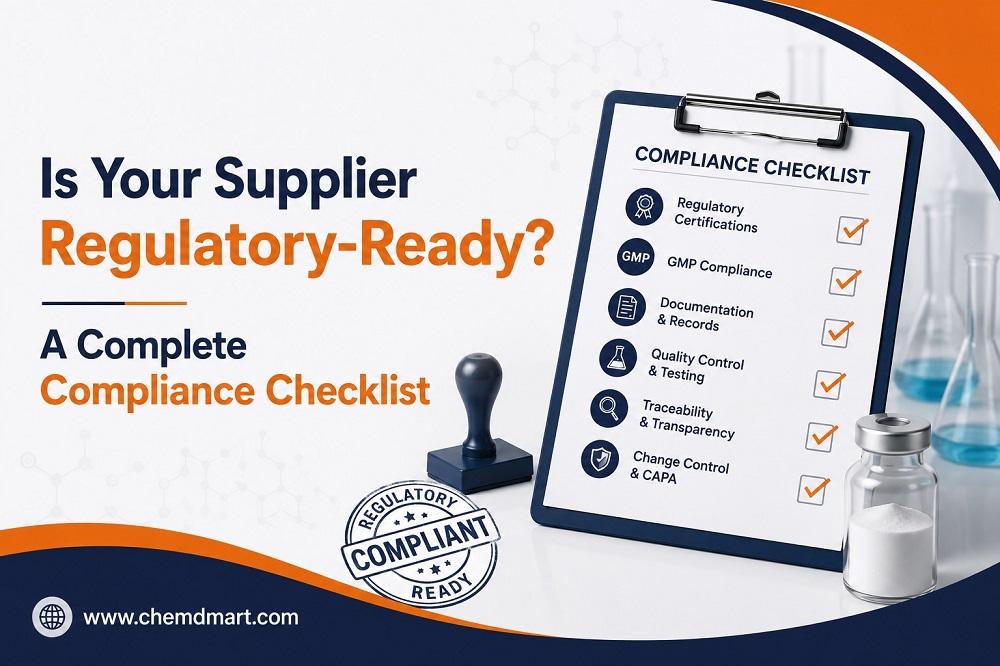
This is a hands-on resource to determine if your pharma raw material suppliers are regulatory ready, paper ready, or ready for inspection.
It doesn't mean having a GMP certificate on the wall.
A regulatory-ready pharma raw material supplier is a company that has a quality system and documentation that complies with what regulators are looking at – not only during audit, but daily. The difference is in whether a supplier is prepared for an inspection or if they're not.
That is important because the FDA's message in 2025 and 2026 was quite clear, that they want to see well-controlled operations, and not companies that have to pull racks of papers together when the inspector arrives. Regulators aren't interested in cosmetic changes. They aren't just checking to see how your supplier's quality system performs in a book, but how it performs in action.
Regulatory readiness includes five related dimensions:
| Pillar | What It Covers | Key Regulatory Reference |
| GMP Compliance | Manufacturing controls, facility standards, validated processes | FDA 21 CFR Parts 210/211; ICH Q7; EU GMP Annex 1 |
| Documentation & Records | Batch records, SOPs, deviation logs — complete and contemporaneous | FDA 21 CFR 211.22; PIC/S PE008 |
| Data Integrity | ALCOA/ALCOA+ compliance, audit trail controls, electronic records | FDA 21 CFR Part 11; MHRA Data Integrity Guidance |
| Quality Management System | CAPA, change control, internal audits | ICH Q10; FDA 21 CFR 211.22(d) |
| Regulatory Filing Status | Current DMF/CEP, no active warning letters or import alerts | FDA DMF database; EMA EUDRAGMDP; FDA IA 66-40 |
It is possible to have a valid GMP certificate and not pass pillars three and four. That is what regulators have found, and that is the reason that a certificate is not a qualification process.
Check 1: Ensure GMP Certification Verified from Public Database and Not Just Certificate
It is possible to have an out-of-date GMP certificate. It could be a copy of an expired certificate. In a few extreme instances, it has been known to be forgery. The public databases cannot lie.
Always independently verify any claim of a certificate:
A regulatory ready supplier would actively provide the number of the GMP certificate and its issuing body and would expect you to validate this. There's a hesitation in giving that number as a reference, and that's a clue.
For each verified supplier, their current certifications such as WHO-GMP, US-FDA, EDQM, EU-GMP, CDSCO, ISO are shown directly on supplier's company profile on ChemDmart. This is a helpful preliminary screening tool, but it does not stand in for database verification. Use it to narrow it down and then check it.
Check 2: Search the FDA Warning Letter Database and Import Alert 66-40 List
This check is completed in 5 minutes. It's too late to wait for any new supplier — or for any existing supplier — to renew any contract.
Companies can be found in the FDA Warning Letter database (fda.gov). Look back at the previous 18 months — which is about the amount of time between an FDA inspection and the impact it can have on enforcement.
Please also review the FDA Import Alert 66-40 Database. Upon being entered there, all shipments from this supplier are automatically detained at the US border and there is no grace period for the shipments which are already on the way.
The following two cases are real examples of 2025–2026 cases to show the importance of this check:
In January 2026, Chemspec Chemicals Private Limited (India) received a warning letter from FDA for failing to maintain batch records for all manufactured products, and for retroactively filling in batch records after the products had been made.
Chemspec Chemicals Private Limited (India) was issued with a warning letter in January 2026 due to FDA's observation of the company manufacturing products without batch records, and destroying the original CGMP documents as well as filling in production records after the fact. Based on these results, FDA determined the firm's APIs are adulterated. Importation of goods could be denied in future.
Linghai ZhanWang Biotechnology (China) – Import Alert 66-40 – Inadequate component testing (Methanol Testing of ethanol not performed).
Presumably both suppliers had been added to an approved vendor list. Both could have been identified in a five minute database check prior to the first purchase order.
Check 3: Confirm Status of DMF or CEP Filing for Regulated Market APIs
For suppliers that sell their APIs into the U.S. market, a Drug Master File (DMF) must be on file with the FDA. The DMF number is searchable by the public. If a supplier states that he has FDA approval for an API but cannot produce a verifiable DMF number, then it is a false claim — and it would take less than two minutes to confirm it.
The equivalent in the EU is a Certificate of Suitability (CEP) issued by EDQM, which can be accessed on the EMA's EUDRAGMDP database. The MHRA has an equivalent Active Substance Master File (ASMF) for post-Brexit UK supply.
Check 4: Review the Quality Management System
Failure to follow written quality unit procedures (21 CFR 211.22(d)) was the most cited violation in FY2024, with 184 citations. For four consecutive years, it has been the leader. Discrepancy investigation (21 CFR 211.192) did not receive enough attention, being mentioned 116 times.
Such observations are not accidental. These are fundamental failures of the QMS at facilities that are already approved vendors.
To evaluate a supplier's QMS, consider:
A supplier who is "ready to open the door" to the regulatory requirements will be willing to provide a general overview of their QMS. A supplier whose quality system deserves extra scrutiny is one who treats all quality documentation as confidential.
Check 5: Assess Data Integrity – ALCOA Framework
Over 70% of findings in GMP inspections worldwide in 2024 have been linked to data integrity problems. From 2017 to 2022, there have been more than 160 Warning Letters from FDA due to data integrity failures according to GMP and 21 CFR Part 11. The rate has been increasing since then.
The ALCOA framework is used to determine if records can be trusted, based on the supplier. ALCOA+ adds: Complete, Consistent, Enduring and Available.
To the supplier assessment questions, this translates to:
| ALCOA Principle | What to Ask the Supplier |
| Attributable | Is every record linked to an individual login or signature? Who has system access? |
| Legible | Are electronic records protected from alteration? Are paper records in permanent ink? |
| Contemporaneous | Are batch entries made in real time, or filled in at end of shift? |
| Original | Is raw data retained, or only transcribed summaries? |
| Accurate | How are OOS results handled — documented or deleted? |
| + Complete | Are all instrument runs retained, including failed ones? |
| + Consistent | Are there unexplained inconsistencies between batch records across different periods? |
A supplier that can respond to all these questions with clarity and with documented policies and real-life examples has built data integrity into their operations. If they are looking skeptical or defensive, then they have not.
(Check 6): Request the Site Master File
The Site Master File (SMF) is a formal document that describes the manufacturer's GMP-relevant activities in detail, including site organisation, quality system, personnel, premises, equipment, production activities, quality control activities and self-inspection programme.
It is mandatory as part of EU GMP regulatory requirements and cited in PIC/S PE008. It is reviewed by regulators to learn about a facility prior to inspection. If your supplier does not have an up-to-date SMF, then they are not working up to the required standard for a regulated market supplier, and are unlikely to meet EU or WHO standards at an inspection.
A supplier with a comprehensive and up-to-date SMF – is a supplier who is considering Regulatory Readiness as a continuous process, rather than an event to prepare for.
Check 7: Confirmation of Change Control/Customer Notification Procedures
A change to a manufacturing process, a starting material or a production site by a supplier without informing the buyer in advance can invalidate your regulatory dossiers, lead to revalidation and thus pose compliance risk, all the way up to the marketing authorisation of your product.
Ask suppliers directly:
If there's no formal process in place for your supplier to alert its customers, or the change control process is internal only, then you're running regulatory risk on every product dossier containing a reference to your supplier's site.
Check 8: Review Inspection History and CAPA Closure Record
The best measure of regulatory readiness that you can get is past inspection results. Most inspections will have FDA Form 483 observations posted online; reviewing a supplier's most recent 483 and their response to it, will provide straight information on any compliance issues.
What matters:
Companies with poor 483 responses are more than 50% likely to receive a formal warning letter, according to research. Then comes a warning letter that can result in consent decrees, an import alert or an injunction. It's impossible to do due diligence on procurement without knowing where a supplier fits in that progression before ordering.
Having knowledge of the checklist is one thing, but knowing that is another. Having a verified start point is one other.
The supplier network of ChemDmart includes 5,000+ verified pharma and chemical suppliers from 50+ countries, with each company's regulatory information listed as part of its profile. These are some of the trusted suppliers of pharma materials available on the platform:
| Supplier | Key Certifications | Specialisation |
| Supriya Lifescience Ltd | US-FDA, EDQM | Antihistamines, anesthetics, CNS APIs — 86+ countries |
| Cipla Ltd | US-FDA, EU-GMP, WHO-GMP | Respiratory, antiviral, anti-infective APIs |
| Zydus Lifesciences Ltd | US-FDA, WHO-GMP | Lifestyle and chronic disease APIs |
| Glenmark Pharmaceuticals Ltd | US-FDA, EU-GMP | Oncology, dermatology APIs |
| IPCA Laboratories Ltd | US-FDA, EU-GMP | Cardiovascular, anti-malarial, anti-inflammatory APIs |
| Aarti Pharmalabs Ltd | US-FDA, EU-GMP, WHO-GMP | APIs and intermediates across 6 approved facilities |
| Sun Pharmaceutical Industries | US-FDA, EU-GMP | Generic and specialty APIs, 100+ countries |
These companies have complete company profiles on ChemDmart including product portfolio, manufacturing locations, certification information, and direct contact details. The filter for certification on the platform narrows down your search from the first search result with a US-FDA, WHO-GMP, EDQM or EU-GMP filter, than by starting your shortlist from an open directory.
This is not an alternative to the above eight point checklist. It is that starting point that makes running that checklist quicker and more focused.
There is no checklist for removing all regulatory risk. Suppliers change. Inspections bring to light problems that did not have a visible presence during the qualification process. Regulatory frameworks evolve.
However, the eight points above are the most frequent and most avoidable points of failure that repeatedly appear in FDA warning letters, import alerts, and leave pharma buyers open to risk they are unaware of.
You can begin your sourcing process on a trusted site, such as ChemDmart, run each new supplier through this check list, and document the entire experience, which produces an audit-proof qualification log — and a supply chain that extends beyond mere trust.