English
 Arabic
 French
 Spanish
 Portuguese
 Deutsch
 Turkish
 Dutch
Dutch
 Italiano
 Russian
 Romaian
 Portuguese (Brazil)
 Greek
Greek
Best Wall EV Charger India - A Smart Choice for Faster and Safer EV Charging | ORBLR Drivtech
Other |
2026-07-10 13:04:00
 Advertise With Us
 About Us
 Terms And Conditions
 Política de privacidade
Ver todos
Política de privacidade
Ver todos

Atualizar para Plus
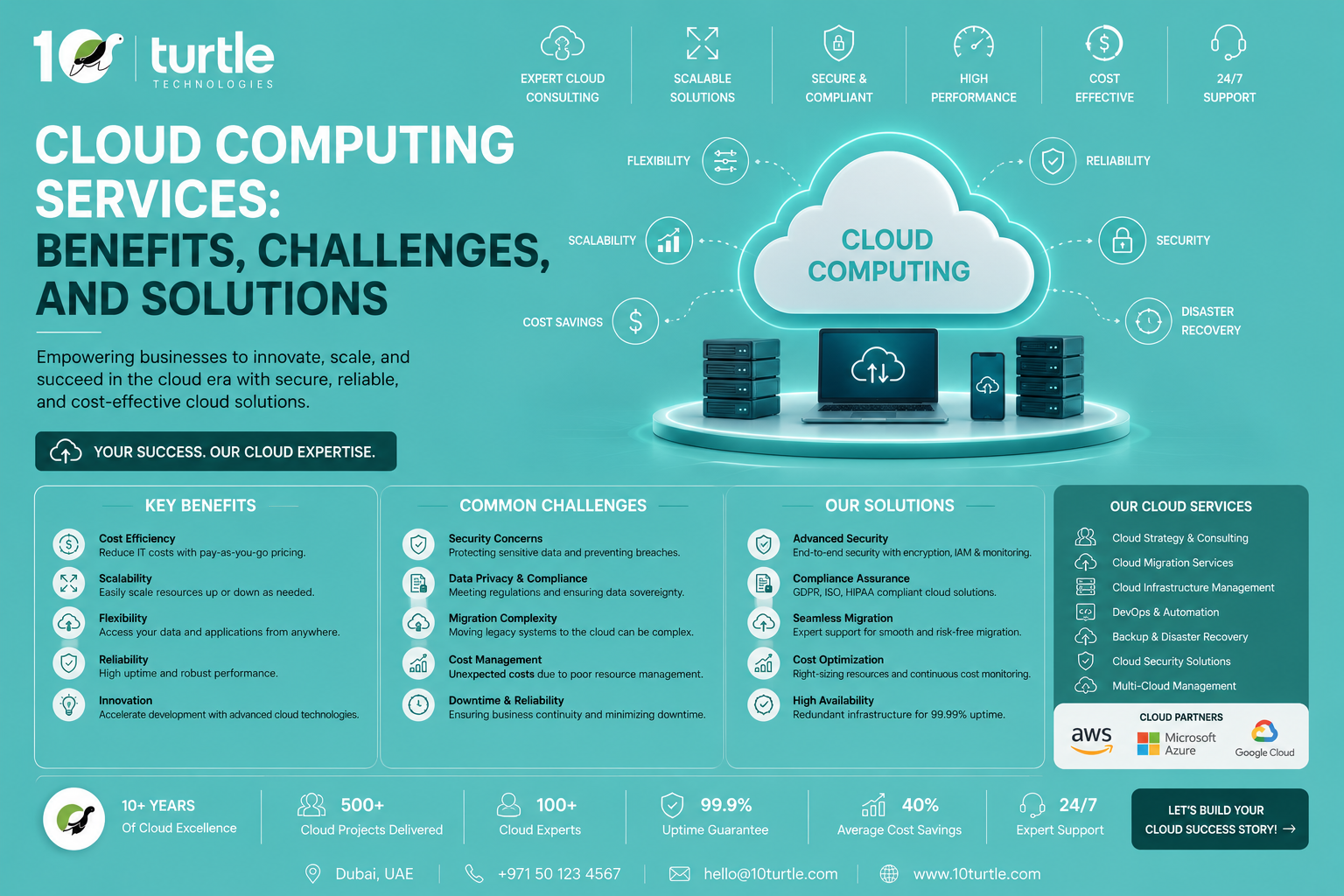
Every business today, from a small Dubai startup to a large Abu Dhabi bank, is moving its data online. Cloud computing services have become the backbone of this shift, letting companies store, process, and access information without owning physical servers. This blog explains the real benefits of cloud adoption, the practical challenges businesses face, and workable solutions with a special look at how the UAE is turning into a regional cloud hub.
In simple words, cloud computing means renting computing power, storage, and software over the internet instead of buying and maintaining your own hardware. Instead of a server room in your office, your data lives in a secure data center run by a provider like AWS, Microsoft Azure, Google Cloud, or Oracle. You pay only for what you use, and you can scale up or down whenever your business needs change. This model covers three main service types: Infrastructure as a Service (IaaS), Platform as a Service (PaaS), and Software as a Service (SaaS).
Cost savings top the list. Companies no longer need heavy upfront investment in servers, cooling systems, or IT staff to manage them. Monthly subscription pricing turns a fixed capital expense into a flexible operating cost.
Scalability and flexibility come next. A retail business in Sharjah can add extra server capacity during a big sale weekend and scale back afterward, paying only for what was actually used.
Remote access and collaboration have become essential since hybrid work became normal. Teams spread across Dubai, Riyadh, or London can work on the same files in real time, using nothing more than an internet connection.
Disaster recovery and reliability are stronger with cloud setups, since data is backed up automatically across multiple locations, reducing the risk of permanent loss from hardware failure or local outages.
Faster innovation is another advantage. Developers can spin up new applications, test AI models, or launch a product feature in days instead of months, because the underlying infrastructure is already available on demand.
The UAE is one of the most active cloud markets in the Middle East right now. According to recent industry research, the country's cloud computing sector is expected to grow at a compound annual rate well above 20% through the early 2030s, with estimates placing 2026 market value anywhere between USD 7 billion and USD 16 billion depending on the methodology used, and several forecasts projecting the market to cross USD 50–60 billion within the next decade.
This growth is not accidental. The UAE government's cloud-first policies push federal and local entities toward digital platforms, and sovereign cloud frameworks require providers to keep sensitive data within the country's borders. Abu Dhabi currently leads regional adoption, followed closely by Dubai, while the Northern Emirates are catching up quickly. Government and public sector projects, banking, and healthcare remain the biggest spenders, and IaaS is the most widely used service model, largely because organizations want flexible storage and computing power without owning hardware.
Major moves are reshaping the landscape too. Global players like AWS, Microsoft, Oracle, and Core42 (formed from the G42 group) have committed billions of dirhams to new data centers, and initiatives such as the AWS-e& Sovereign Launchpad now give regulated sectors healthcare, finance, education, oil and gas a compliant path to cloud and AI adoption. Telecom operators like du and stc are also repositioning themselves as cloud platform brokers rather than just connectivity providers.
Despite all these advantages, cloud adoption is not without friction.
Data security and privacy risks remain the top concern for most organizations. Cyberattacks targeting cloud environments have risen sharply across the region in recent years, and any breach can expose sensitive customer or financial records.
Compliance and data residency rules add another layer of complexity. UAE data protection regulations require certain categories of information to stay within national borders, which forces companies to choose providers carefully rather than defaulting to whichever hyperscaler is cheapest.
Downtime and internet dependency can disrupt operations, since a cloud-based business is only as reliable as its connection. A poor network link can bring productivity to a halt.
Vendor lock-in is a quieter but real problem. Once a company builds its systems deeply around one provider's tools, switching later becomes expensive and technically painful.
Skill shortages also slow things down. Many organizations, especially smaller ones, don't have staff trained to manage cloud security, cost optimization, or multi-cloud environments properly.
Choosing a provider with local data centers and clear compliance certifications solves much of the residency problem instantly; this is exactly why sovereign cloud offerings have gained traction across Abu Dhabi and Dubai. Layered security practices, including encryption, multi-factor authentication, and regular audits, cut down breach risks significantly. For downtime concerns, a hybrid cloud approach, keeping critical systems on private infrastructure while using the public cloud for flexible workloads, offers a practical middle ground. Businesses worried about lock-in can adopt a multi-cloud strategy from the start, spreading workloads across two or more providers. Finally, investing in staff training or partnering with a managed cloud services firm closes the skills gap without requiring a large in-house IT department.
Cloud computing is no longer optional for businesses that want to stay competitive, and this is especially true in the UAE, where government policy, infrastructure investment, and enterprise demand are all pulling in the same direction. The benefits of cost efficiency, scalability, and faster innovation are real, but so are the challenges around security and compliance. Companies that pick the right provider, follow data residency rules, and train their teams properly will get the most out of this shift.
1. What are cloud computing services in simple terms?
They are internet-based services that let businesses use storage, servers, databases, and software without owning physical hardware, paying only for what they consume.
2. Why is cloud computing important for businesses in the UAE?
UAE government cloud-first mandates, sovereign data frameworks, and rapid digital transformation across banking, healthcare, and government sectors make cloud adoption almost essential for staying compliant and competitive.
3. What is the biggest challenge in cloud adoption?
Data security and regulatory compliance, particularly around data residency, are consistently cited as the top concerns by organizations in the region.
4. Which cloud service model is most popular in the UAE?
Infrastructure as a Service (IaaS) currently holds the largest revenue share, driven by demand for flexible computing, storage, and networking resources.
5. Is cloud computing safe for storing sensitive financial or healthcare data?
Yes, when paired with proper encryption, access controls, and a provider that offers local sovereign cloud options compliant with UAE data protection law.