English
 Arabic
 French
 Spanish
 Portuguese
 Deutsch
 Turkish
 Dutch
Dutch
 Italiano
 Russian
 Romaian
 Portuguese (Brazil)
 Greek
Greek
Lab Grown vs Real Diamond Engagement Rings Under 3000 Dollars – Complete Buying Guide
Other |
2026-06-23 09:43:57
 Advertise With Us
 About Us
 Terms And Conditions
 سياسة الخصوصية
عرض كل النتائج
سياسة الخصوصية
عرض كل النتائج

ترقية الحساب
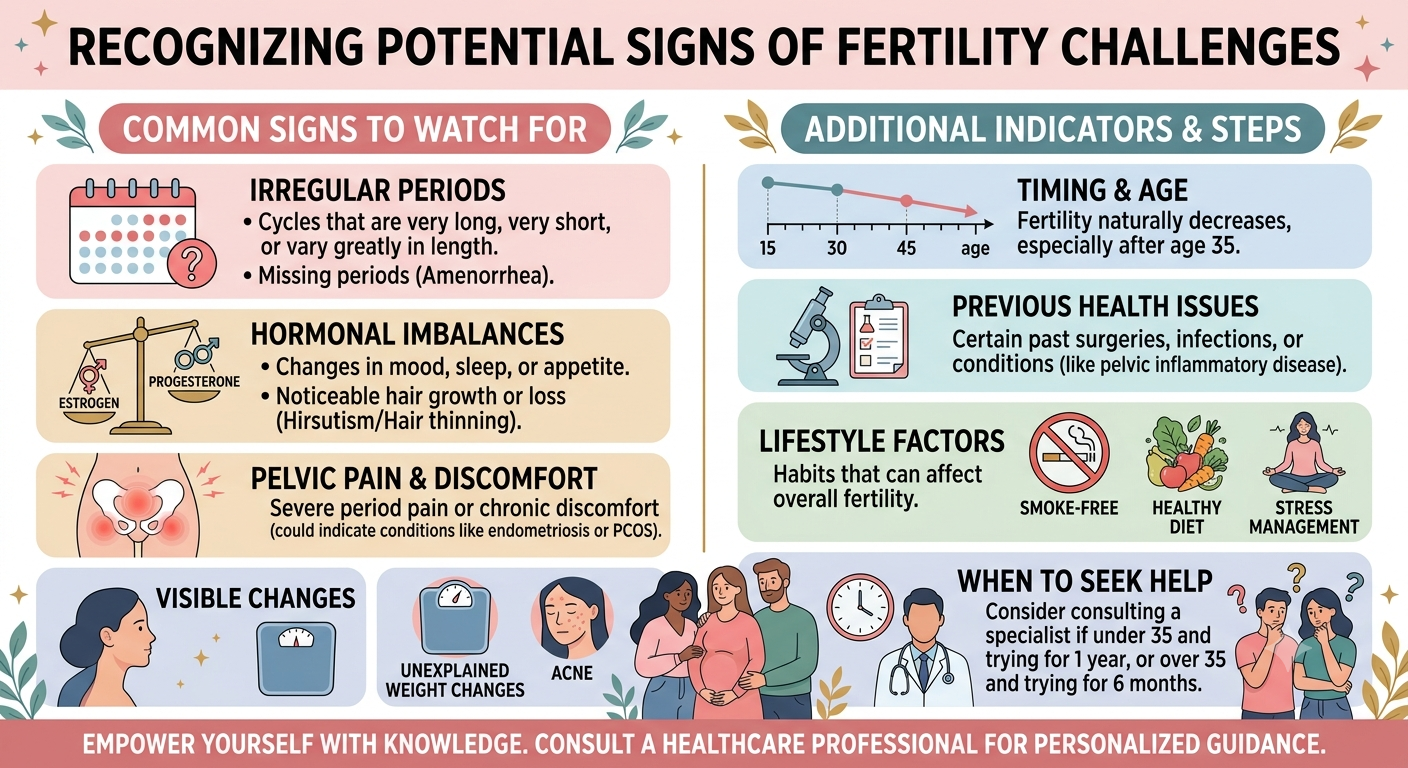
Let’s be real for a second. Most of us don't think about our reproductive health until something goes sideways. You miss a period, and you panic. You get two periods in one month, and you Google yourself into a rabbit hole. But what about the slower, quieter signs? The acne that won’t clear up, the fatigue that hits you like a truck at 3 PM, or the sudden weight gain that makes your jeans feel like a torture device.
We talk to women every day who chalk these things up to "stress" or "getting older." And sure, sometimes that’s all it is. But often, these are the earliest whispers of a hormonal imbalance that could eventually turn into fertility challenges. The goal here isn't to scare you; it’s to give you a roadmap so you know when to stop ignoring your body and start asking the right questions.
Forget tracking your steps for a minute. If you want to know what’s really going on inside, look at your calendar. Your menstrual cycle is a vital sign. A regular cycle anywhere between 21 and 35 days tells us that your hormones are talking to each other the way they should.
When that rhythm goes off, it’s the first red flag. I’m talking about cycles that stretch to 40 days, or ones that show up every 18 days. Maybe you’re skipping months entirely. Maybe the bleeding is so heavy you’re setting alarms to change your pad, or so light that a panty liner does the job for two days.
If you aren’t ovulating regularly (a condition called anovulation), your body isn’t releasing an egg. And without an egg, conception is impossible. It’s that simple. So, if your period is consistently playing hide and seek, you’re not just "irregular"—your body is telling you ovulation isn’t happening.
Irregular periods are just the tip of the iceberg. Beneath the surface, you’ve got estrogen, progesterone, thyroid hormones, and prolactin all trying to maintain a delicate balance. When one of them spikes or drops, it creates a domino effect.
Here is where it gets personal. Do you have persistent acne on your jawline? Are you noticing extra hair on your upper lip or chin? Is your hair thinning on top but you’re losing it in clumps in the shower? These aren’t cosmetic issues; they are clinical signs. They often point to elevated androgens (male hormones) or insulin resistance, which are hallmark features of PCOS.
Then there’s the weight issue. If you’re eating reasonably well and exercising, but the scale won’t budge or worse, it keeps climbing—that’s often tied to thyroid dysfunction or insulin resistance. These conditions directly interfere with the hormones needed to sustain a pregnancy.
When we see these symptoms, we usually look for three main culprits.
First, PCOS (Polycystic Ovary Syndrome). It’s incredibly common and often presents with irregular periods, acne, and weight gain.
Second, Thyroid disorders. Both an underactive and overactive thyroid can stop ovulation dead in its tracks.
Third, Elevated Prolactin. This is the hormone that produces breast milk, and if it’s high when you aren’t breastfeeding, it can shut down your reproductive hormones.
The important thing to note is that these aren't isolated. A woman with thyroid issues often has irregular cycles and fatigue. A woman with PCOS often has acne and a stubborn weight. It’s all connected.
Let’s address the elephant in the room: the anxiety. Many women delay seeing a doctor because they are terrified of hearing bad news, or they worry they’re being dramatic. "It’s only been six months," they say. Or, "I’ll just lose weight first."
But here’s the thing early intervention changes the game. If we catch a thyroid issue early, it can often be managed with medication that restores regular ovulation quickly. If we catch PCOS early, lifestyle changes and medication can help you ovulate. Waiting doesn’t make the problem go away; it just narrows your options.
Don't wait until you're actively trying to conceive if you have these symptoms. If your periods are erratic, your skin is breaking out, and you feel off go now.
However, if you are trying, the guidelines are clear: if you’re under 35 and have been trying for a year, or over 35 and trying for six months, it’s time to get evaluated. Also, if you have a history of severe pelvic pain, endometriosis, or miscarriages, don’t wait for the clock to run out.
When you finally go in, expect a thorough check-up. They’ll likely draw blood to check your FSH, LH, AMH (to check your egg reserve), and thyroid panel. A pelvic ultrasound will look for cysts or fibroids. It sounds like a lot, but each test gives us a piece of the puzzle.
If you are in South Delhi, Malviya Nagar is a hub for reproductive care. When you are searching for a gynecologist in Malviya Nagar Delhi, look for someone who doesn’t rush you. The best gynecologist in Malviya Nagar Delhi isn’t just the one with the most degrees; it’s the one who sits down with you, explains your bloodwork in plain English, and lets you ask the "silly" questions without making you feel stupid.
Look, ignoring these signs is a gamble. Getting checked doesn’t guarantee a perfect journey, but it guarantees you stop walking in the dark. That’s a step worth taking.