English
 Arabic
 French
 Spanish
 Portuguese
 Deutsch
 Turkish
 Dutch
Dutch
 Italiano
 Russian
 Romaian
 Portuguese (Brazil)
 Greek
Greek
Port & Industrial Tire Market Growth Fueled by Expanding Global Trade
Literature |
2026-06-09 11:48:18
 Advertise With Us
 About Us
 Terms And Conditions
 Privacy Policy
Mostra tutti i risultati
Privacy Policy
Mostra tutti i risultati

Passa a Pro
So, let me tell you about something that's been coming up more and more in my consultations lately. Students looking to study Engineering in UK for Indian Students are starting to ask about TEDI-London. And honestly? I think that's a smart move.
TEDI-London stands for The Engineering and Design Institute London. It's a relatively new institution, established in 2018 with support from King's College London, the University of New South Wales in Australia, and Arizona State University in the US. That's a pretty impressive consortium of universities backing a single institute.
What makes TEDI really interesting is that it's not trying to be a traditional engineering school. It's something different entirely. The curriculum is project-based, industry-focused, and designed around the actual skills that employers are looking for. They're offering three undergraduate programmes: Design Engineering, Mechanical Engineering, and Software Engineering.
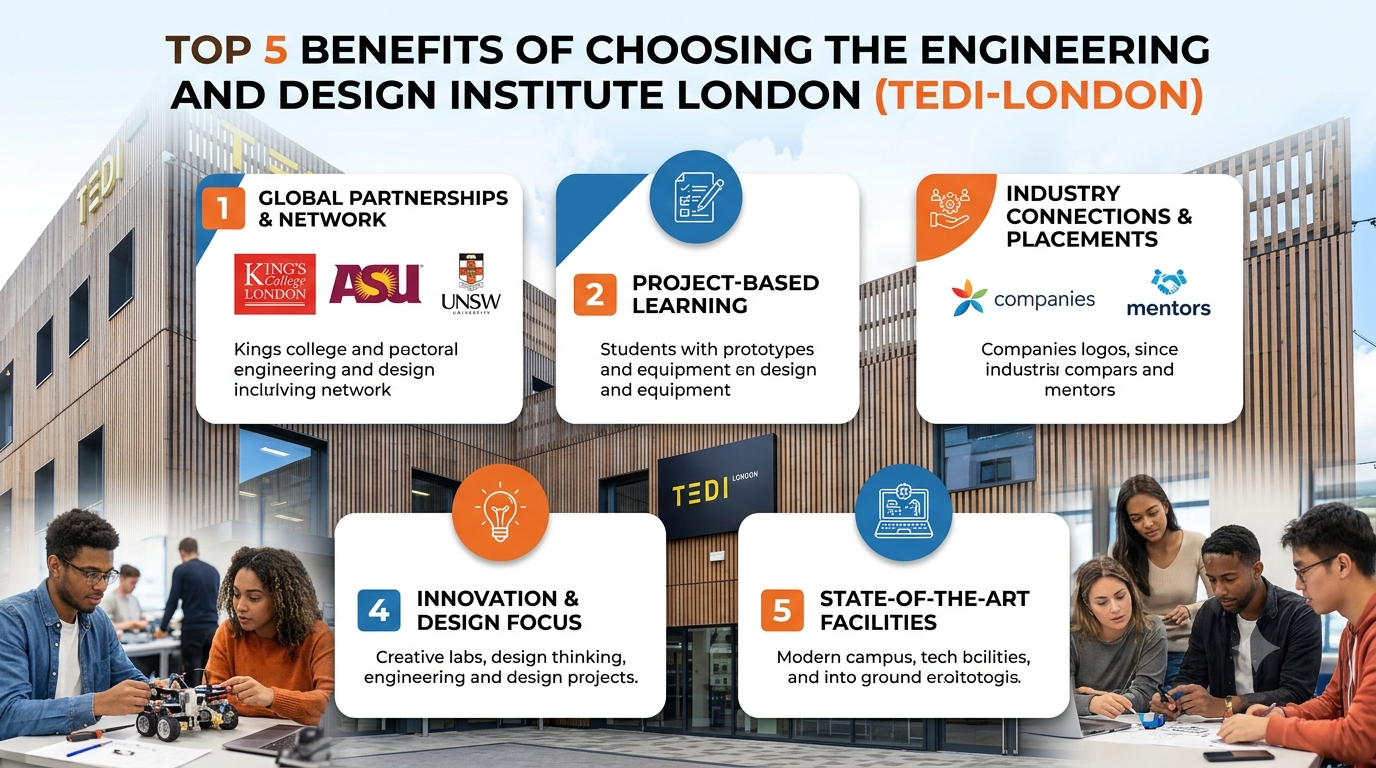
Let me walk you through five benefits that I think make TEDI genuinely worth considering.
This is the biggest differentiator, and it's why I keep recommending TEDI to students who actually want to practice engineering, not just study it. From your very first week, you'll be working on real projects set by industry partners.
The curriculum is designed around a "spiral curriculum" model where core concepts are revisited repeatedly, with increasing complexity each time. You'll start by taking apart robots, building products, and designing solutions to problems in the first year. By the time you graduate, you're ready to take on professional challenges from day one in the workplace.
Students consistently tell me that this approach makes them much more prepared than traditional engineering graduates. You're not memorising formulas—you're applying them to actual problems. And that's what employers actually want.
The numbers back this up. TEDI-London reports that 90% of students say they feel their practical skills are employable. That's not just a feel-good statistic—that's evidence that the approach works.
Here’s something that kind of sets TEDI apart: the programmes are co-created and co-delivered with employers, and it feels more like a joint effort than a “we’ll have a talk and that’s it” situation. Companies like Arup, Atkins, and Transport for London are not just an occasional guest lecturing moment, they’re baked right into the learning pathway.
The focus on industry integration helps ensure that you get real practical experience and you build a professional network, one that you’ll likely find useful long after graduation. Work-based learning is a core feature, and work placements are an integral part of the programme too. So you’re not only learning about engineering, you’re learning how to make engineering, in a kind of lived, working context.
I've seen students graduate with job offers already lined up because the companies they worked with during their studies want to keep them. That's the power of this approach.
The programmes are kind of multidisciplinary, so it’s not like you’re only learning mechanical engineering or software engineering in total isolation. Instead, you start seeing how these disciplines rub off on each other, and how they’re used together to work through those tricky complex problems.
The institute also has this fairly strong entrepreneurial focus. TEDI was created because there was this clear need to address the engineering skills gap, and to build, or grow, the next generation of engineers. The curriculum is set up on three big pillars: Design, Engineering, and Entrepreneurship. And honestly that combo isn’t that common in the more traditional engineering programmes.
You’re not only learning how to be an engineer, you’re also being trained to think like an innovator, to notice opportunities sooner, and to turn ideas into something real. That entrepreneurial kind of mindset is getting more and more valuable in today’s economy. Because in a lot of cases, engineers are expected to understand not just the technical part, but also the business side.
TEDI-London is based in Canada Water, which is Zone 2 in London. The campus is equipped with state-of-the-art facilities, including a 250-square-metre workshop with 3D printers, laser cutters, and a 5-axis machine tool. There's also an electronics lab, a design studio, and a computing hub.
Being based in London is itself a benefit. You're in one of the world's great cities, surrounded by engineering and tech companies. The location gives you access to internships, networking opportunities, and the kind of professional environment that you simply don't get in a smaller city.
The campus won awards. It was shortlisted for the New London Architecture Awards 2020 and the Dezeen Awards 2020. That tells you something about the quality of the environment you'll be studying in.
This kind of thing matters a lot for Indian students, genuinely. TEDI feels much more affordable than a lot of the other engineering programmes you’ll see around London. UK students usually pay about £9,250 per year, and international students are more like £20,500 annually. For Indian students it roughly comes to around ₹22.6 lakhs per year, which is honestly a big relief compared to many alternatives.
Then there’s entry requirements, which are also more reachable. Most of the time you’ll need A-level grades like ABB, or an International Baccalaureate score of 32 points , but you’re expected to include maths and physics in that mix. If you don’t quite match the direct entry route, there are foundation programmes too , so you can still get in through that pathway.
TEDI also uses contextual admissions. So they take your personal circumstances into account, along with your academic results. It’s a bit of a different way of viewing potential, and it makes the whole place feel more open to a broader group of students, even those who didn’t have the most privileged schooling background, or the smoothest prep time.
And support is there as well. Scholarships, bursaries, and different financial support packages are available. There’s also the King’s Scholarship for standout students, which can help a lot if you’re aiming to reduce the financial pressure early on.
I always like to look at student reviews, and the feedback on TEDI is genuinely positive. One student described it as "a fantastic, unique place to study engineering," noting the "brilliant industry projects" and "great collaboration with students of other fields."
The 90% student satisfaction rate , the strong industry partnerships, project based curriculum and affordable fees all kinda point to one thing: TEDI is doing something right
If you’re thinking about going with The Engineering and Design Institute London as your study destination, I’d really suggest linking up with study in UK consultants who can help you with the application flow, the visa stuff and scholarship opportunities. The correct guidance at the right moment can really make a big difference, you know
No matter what you decide, just be sure you’re picking a programme that matches where you actually want to end up, not only what sounds good on paper. That’s honestly the advice I give every student, and it hasn’t once steered anyone wrong.
Before you apply, there are some things you should know. The first-year core modules are common across all programmes, which means you can switch between Design Engineering, Mechanical Engineering, and Software Engineering during your first year.
English language proficiency is required. The standard requirement is IELTS 6.0 overall with no element below 5.5, but this can vary. For undergraduate programmes, you typically need GCSEs, A-Levels, or equivalent qualifications.
The application deadline for 2027 entry is likely to be in January 2026, so you need to plan ahead.
TEDI-London is not a traditional engineering school. It's not trying to be. It's a modern, project-based, industry-focused institution that's designed to produce engineers who are ready to work from day one.
If you're looking to study Engineering in UK for Indian Students at a place that prioritises practical skills over theory, industry connections over ivory towers, and project work over lectures, TEDI deserves serious consideration.
The 90% student satisfaction rate , the strong industry partnerships, project based curriculum and affordable fees all kinda point to one thing: TEDI is doing something right
If you’re thinking about going with The Engineering and Design Institute London as your study destination, I’d really suggest linking up with study in UK consultants who can help you with the application flow, the visa stuff and scholarship opportunities. The correct guidance at the right moment can really make a big difference, you know
No matter what you decide, just be sure you’re picking a programme that matches where you actually want to end up, not only what sounds good on paper. That’s honestly the advice I give every student, and it hasn’t once steered anyone wrong.