English
 Arabic
 French
 Spanish
 Portuguese
 Deutsch
 Turkish
 Dutch
Dutch
 Italiano
 Russian
 Romaian
 Portuguese (Brazil)
 Greek
Greek
Fast and Secure Karachi VPS Hosting for WordPress Websites
Other |
2026-05-15 08:03:52
 Advertise With Us
 About Us
 Terms And Conditions
 Privacy Policy
TOON ALLES
Privacy Policy
TOON ALLES

Upgrade to Pro
ReelShort pulled in roughly $1.2 billion in gross consumer spending in 2025, up 119% from the year before. DramaBox more than doubled its own revenue over the same period, crossing $276 million. TikTok just launched its own microdrama app to get a piece of this. A team of Hollywood veterans backed by Reddit's co-founder, Kris Jenner, and Kim Kardashian raised $14 million to build a competitor.
If you're reading this, you've probably already noticed all of that, and you're past the point of asking whether vertical drama is a real category. The question you actually need answered is narrower and harder: how much money does it take to build something in this space without either underfunding it into irrelevance or overspending on the wrong things first?
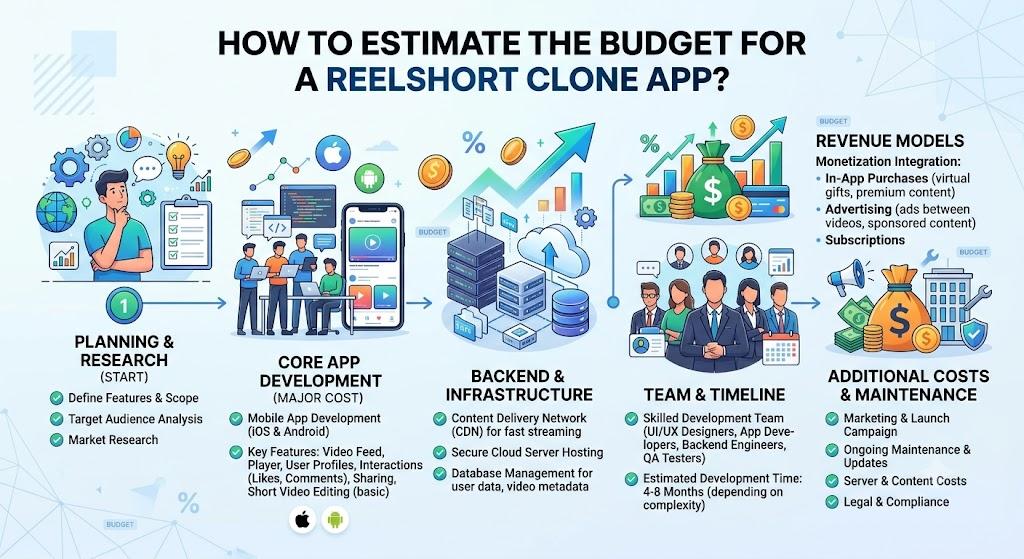
Most guides answer that question with a single number, usually somewhere between $15,000 and $300,000+, which tells you almost nothing useful. The honest answer is that estimating a ReelShort clone budget isn't a pricing exercise — it's a sequencing exercise. You're not buying one product. You're funding three interdependent businesses simultaneously: a technology platform, a content studio, and a user acquisition machine. Get the order and proportions wrong, and you can spend the "right" total amount and still fail.
This article walks through exactly how to build that estimate yourself, with the actual numbers behind every decision.
Here's the trap almost every founder falls into when researching this topic: they search "ReelShort clone development cost," find a number, and treat that number as the budget for the whole venture. It isn't. It's the budget for one of three things you need to fund, and usually not even the most expensive one.
Look at how the platforms that actually matter in this space allocate their resources. ReelShort, owned by Crazy Maple Studio, didn't win by having marginally better app engineering than competitors — its parent company had spent years building Chapters and Kiss, two interactive fiction platforms, generating an IP library and a publishing operation before ReelShort ever existed as an app. DramaBox, the #2 player globally with 44 million monthly active users in early 2025, beating Hulu and Paramount+ in that metric, built its position the same way: heavy investment in original short drama production, not just a polished player. Together with NetShort, these two platforms captured more than half of total market revenue by mid-2025, in a field of over 200 active competing apps.
That last statistic is the one that should reshape your entire approach to budgeting. Two hundred apps exist. Two or three of them control the market. The difference between the winners and the other 197 was never primarily the quality of their video player. It was the depth of their content pipeline and the precision of their user acquisition spend, sitting on top of technology that was good enough — not necessarily best-in-class.
So before you build a line-item budget, internalize this reframe: you are not estimating "what does it cost to build an app like ReelShort Clone." You are estimating "what does it cost to build the three things that determine whether your platform survives past month three" — and technology is only one of them.
The single highest-leverage move in this entire process happens before you contact a single development agency. Split your total available budget conceptually into three pools — technology, content, and user acquisition — and decide roughly what percentage goes to each before you start collecting quotes.
This matters because development agencies will happily consume 100% of your budget if you let them. They quote based on the scope you give them, not based on what's left over for the rest of your business. Founders who go to a development agency first, get a quote, and then figure out what's left for content and marketing consistently end up with beautifully engineered platforms and nothing compelling to watch on them, and no money left to tell anyone they exist.
A reasonable starting allocation for a first-time entrant looks like roughly 30 to 35% of total budget on technology, 35 to 40% on content, and 25 to 30% on user acquisition and launch marketing. These proportions shift depending on your strategy — a platform leaning heavily on licensed content needs less in the content pool, while a platform betting on original IP needs more — but the discipline of deciding the split before you start spending is what separates founders who run out of money mid-build from founders who launch with a complete, functioning business.
With your technology pool defined, here's how to estimate it accurately rather than accepting whatever number the first agency quotes you.
Start with platform strategy, because it's the single biggest lever on cost. Cross-platform frameworks like React Native or Flutter let you deploy to both iOS and Android from one codebase, typically cutting development cost by 30 to 40% compared to building separate native apps. For a launch-stage clone, this is almost always the right call — the performance difference is negligible for the core use case of video browsing and playback, and most successful platforms in this category, including early-stage DramaBox and ReelShort builds, didn't need native-level optimization to compete.
Next, map your feature set against what actually drives the ReelShort experience, not a generic streaming app checklist. The video player needs adaptive bitrate streaming engineered specifically for near-zero latency between episode transitions — this alone runs $15,000 to $35,000 depending on whether you integrate a managed service like Mux or Cloudflare Stream versus building custom infrastructure. The coin economy — wallet management, server-side unlock validation, fraud prevention, and integration with both Apple's and Google's separate in-app purchase systems — runs $25,000 to $50,000, and this is consistently the most underestimated line item in cheap quotes. The admin CMS your content team will live in daily, supporting the kind of continuous publishing cadence that lets a platform release dozens of episodes weekly, runs $15,000 to $45,000.
Layer in discovery and planning at $5,000 to $20,000, UI/UX design at $10,000 to $45,000, backend and API work at $25,000 to $85,000, QA and testing at $8,000 to $28,000, and App Store submission support at $2,000 to $8,000, and you arrive at a complete technology estimate somewhere between $105,000 and $315,000 before adjusting for your development team's geography.
That geography adjustment is significant and deserves its own line in your estimate. The same scope of work costs roughly $100 to $200 per hour with a North American team, $40 to $90 per hour in Eastern Europe, and $20 to $55 per hour in South or Southeast Asia. A $250,000 scope at North American rates might cost $100,000 to $140,000 with an experienced Eastern European team — but the gap between regions isn't free money. Cheaper teams require more active project management from you, and quality variance within any region is wide enough that hourly rate alone is a poor proxy for output quality.
A realistic technology budget range, after accounting for a sensible cross-platform approach and a mid-tier development team, lands between $80,000 for a lean MVP and $250,000 for a fully-featured platform built to scale.
This is where the budgeting exercise diverges sharply from a generic app development cost guide, and it's the step that determines whether your platform has anything worth watching on launch day.
The economics of vertical drama production are publicly documented enough now to estimate with real confidence. Original short drama production in 2025 runs $100,000 to $300,000 per series for a full season of 60 to 90 episodes, typically shot on an extremely compressed 5-to-10-day production schedule. Lead actors are now earning $600 to $1,000 daily, with top performers commanding $10,000 weekly, while day players start around $250 — the industry has professionalized fast enough that the cost structure is real and predictable, not improvised.
You don't need ReelShort's pace — the platform is reportedly aiming to produce 400 shows in 2026 — but you do need enough content to give a new visitor a reason to stay past their first session. A credible minimum launch library sits at 8 to 12 series across 2 to 3 genres, with romance and romantasy (billionaire CEO sagas, contract marriages, secret heiress plots) still dominating audience demand, though thriller content is achieving roughly 40% higher retention than traditional romance, which is worth factoring into your genre mix if retention is your priority metric.
There are three realistic paths to building that library, and your budget estimate should pick one deliberately rather than drifting into it.
Licensing existing short drama content from established studios is the fastest and cheapest entry point, with fees varying by exclusivity and territory. The tradeoff is real: licensed content is rarely exclusive, meaning the same series might already be available on a competing platform, which limits your ability to differentiate. This path can get a launch library assembled for $20,000 to $80,000, though pricing for premium or exclusive licenses runs considerably higher.
Commissioning original productions is the path that builds a defensible asset rather than rented content, at $100,000 to $300,000 per series. This is the strategy that gave ReelShort and DramaBox their structural advantage — DramaBox initially purchased the rights to Chinese short dramas and translated them for international distribution, but later shifted heavily toward producing a large number of original short dramas once the model proved out, because owned IP compounds in value while licensed content doesn't.
AI-assisted production is the newest and fastest-growing path, with companies citing AI tools as helping lower barriers to entry and cutting production costs by a meaningful multiple compared to traditional shoots. DramaWave, which climbed to the #2 spot globally in monthly active users by April 2025, has bet heavily on AI-assisted production as part of its growth strategy. An AI-assisted series can realistically be produced for $50,000 to $100,000, though audience reception to AI-generated versus live-action content still varies meaningfully by genre and market.
For a first launch, the practical content budget that balances cost against credibility sits between $150,000 and $500,000 — usually a hybrid of a licensed base library plus one or two original or AI-assisted productions that give the platform something genuinely its own.
The third pool is the one most technically-minded founders treat as an afterthought, and it's the one with the clearest data trail showing exactly how much it actually costs to do right.
Paid advertising has been the dominant growth driver across every major platform in this category. DramaWave's rise to the #2 global spot was built on paid advertising accounting for over 80% of its downloads between September and December 2024, with Unity serving as its primary in-app advertising platform. Meta remains the largest single ad channel for international short-drama platforms, though spending is shifting increasingly toward TikTok and regional networks.
The financial case for this spend is grounded in real, region-specific revenue data, which is useful for estimating your own return before you commit a marketing budget. The average revenue per download in North America for ReelShort and DramaBox runs around six times higher than in other regions — roughly $4.70 per download in the North American short drama market between August 2023 and June 2024, against a global average of about $2.00. If your launch market is the US or another high-willingness-to-pay region, your user acquisition spend has a meaningfully better payback ratio than launching in a lower-ARPU market first, which should directly influence both your launch geography and your initial UA budget sizing.
A realistic launch-phase user acquisition budget, sized to acquire a meaningful first cohort of paying users in a high-ARPU market, runs $50,000 to $200,000 for the first three to six months, scaling from there based on what your actual cost-per-install and conversion data tells you once campaigns are live.
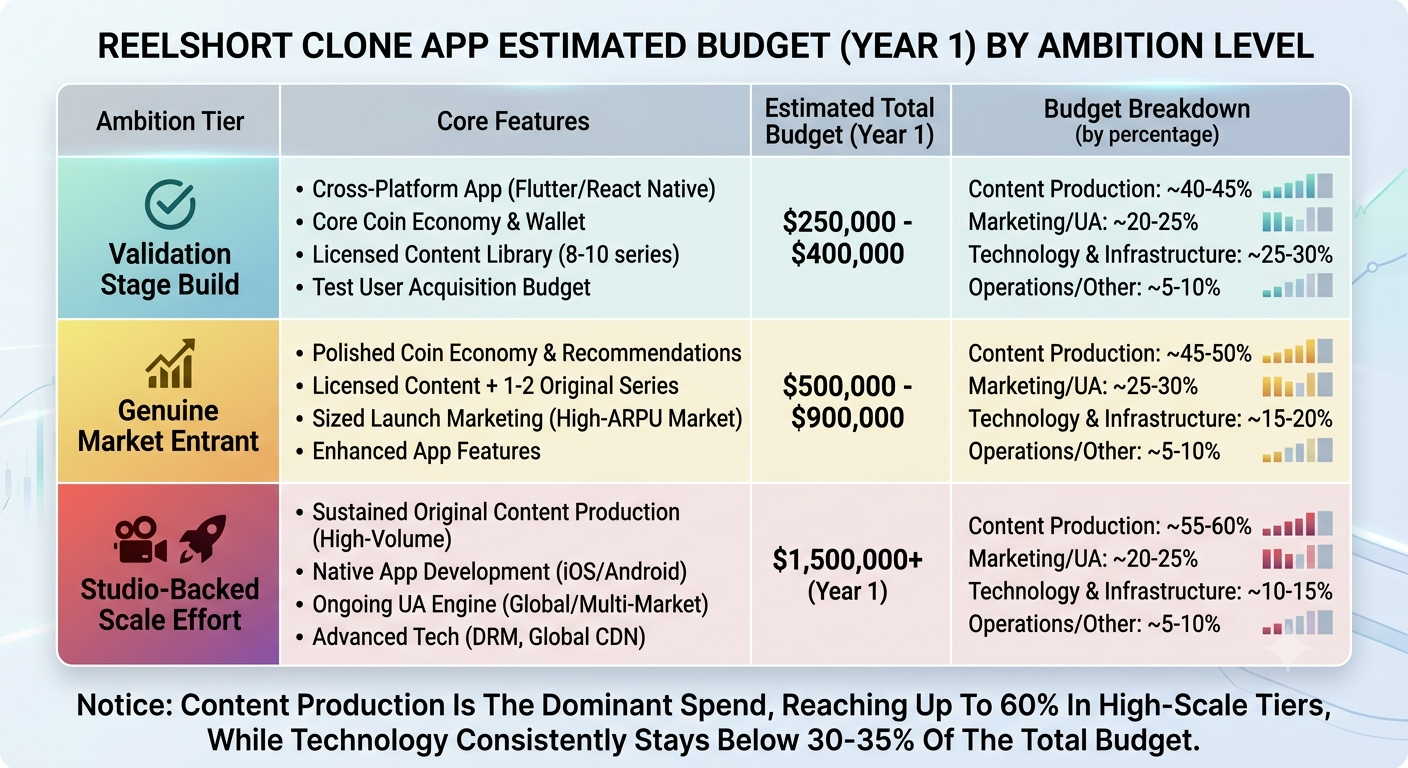
With all three pools estimated, here's what a complete, honest budget looks like at three different ambition levels.
A validation-stage build — cross-platform app with core coin economy features, a licensed launch library of 8 to 10 series, and a modest test budget for user acquisition — totals roughly $250,000 to $400,000. This is the right scope for a founder who wants to prove the model works in a real market before committing further capital, treating the first six months as a controlled experiment rather than a full market entry.
A genuine market entrant — a growth-ready platform with a polished coin economy and recommendation logic, a content library mixing licensed series with one or two original productions, and a real launch marketing push sized to a high-ARPU market — totals roughly $500,000 to $900,000. This is the level where you can credibly position the platform as a competitor rather than an experiment.
A studio-backed effort aiming at the scale DramaBox or ReelShort operate at today, with sustained original content production, native app development where it's justified by traffic, and an ongoing user acquisition engine rather than a one-time launch push, runs well past $1,500,000 in year one, with content as the largest and fastest-growing line item rather than technology.
Notice what's consistent across all three tiers: technology never represents more than 30 to 35% of the total in any of them. The clearest signal that a founder's budget estimate is wrong is when the technology line item dominates the total spend. That ratio inversion is the single most common reason ambitious clone projects launch with a beautiful app and no audience.
A handful of patterns recur often enough across failed and underperforming attempts in this category that they're worth naming directly.
Treating the cheapest development quote as the responsible choice is the most common one. A $20,000 to $30,000 build, the range many white-label vendors advertise for a "ReelShort clone," typically delivers a coin economy with exploitable validation gaps and a CMS your team can't actually operate without a developer on call. The rebuild that inevitably follows costs more than building it correctly the first time.
Sequencing technology and content as separate, disconnected workstreams is the second. Original content production timelines run a minimum of 6 to 12 weeks from commission to delivery. Founders who wait until the app is finished before starting content production end up with a polished, empty platform and a launch date that quietly slips by months.
Pricing coin packages on gross revenue rather than net is the third, and it's a pure arithmetic error with real consequences. Apple and Google both take 15 to 30% of every in-app purchase. A $9.99 coin pack nets roughly $7.00, not $9.99 — and if your entire revenue model and unit economics are built on the gross figure, the business doesn't actually work the way your spreadsheet says it does.
And ignoring regional revenue data when sizing the user acquisition budget is the fourth. Spending the same per-user acquisition budget in a market with $2.00 average revenue per download as you would in a market with $4.70 average revenue per download is leaving money on the table in one case and overspending relative to expected return in the other. Size acquisition spend to the specific market you're launching in, not a blended global average.
Run your estimate through these five questions before you commit capital.
Does your technology line item represent less than 35% of total budget? If it's higher, you are likely underfunding content and acquisition relative to what made the market leaders successful.
Have you priced a minimum credible content library — 8 to 12 series — into your estimate, separately from your technology budget, with its own dedicated line item rather than treated as a development deliverable?
Does your coin pricing strategy account for the 15 to 30% App Store commission, with package prices set against net revenue rather than gross?
Is your user acquisition budget sized to your actual launch market's revenue-per-download data, rather than a generic industry average that may not reflect where you're launching?
And finally — does your total estimate include at least three to six months of runway after launch, before any revenue is expected to meaningfully offset spend? Most platforms in this category, including the ones now generating hundreds of millions in revenue, took meaningful time after launch to find traction. Budgeting as if revenue starts covering costs from week one is the fastest way to run out of money just as the platform starts working.
A credible validation-stage launch — not a prototype, but a real platform with a functioning coin economy, a licensed content library deep enough to retain users past their first session, and a test budget for user acquisition in a real market — realistically starts around $250,000 when you account for technology, content, and marketing together. Anyone quoting a complete, competitive platform for under $50,000 is pricing the app alone, not the business.
Because content is the actual product, and the technology is the delivery mechanism. ReelShort and DramaBox both built their market positions on deep, often original content libraries — DramaBox shifted heavily into original production specifically because owned IP creates a durable advantage that licensed content can't match. A platform with excellent engineering and a thin content library loses users after their first session, while a platform with adequate engineering and genuinely compelling content can still build a real audience. Budget accordingly.
For most first-time entrants, a hybrid is the practical answer: a licensed base library to get to market faster and cheaper, paired with one or two original or AI-assisted productions to build something genuinely differentiated. Licensing alone leaves you vulnerable to having the exact same content available on a competing app, which weakens your platform's pitch to a new user trying to decide which app to download.
For a launch targeting a high-ARPU market like North America, where average revenue per download has historically run around $4.70 against a global average closer to $2.00, a reasonable three-to-six-month launch acquisition budget runs $50,000 to $200,000, scaling based on real cost-per-install and conversion data once your first campaigns are live. Treating marketing as an afterthought after the technology budget is spent is one of the most common reasons technically solid platforms never find an audience.
The market has over 200 active apps globally, and the top two or three platforms capture more than half of total revenue — which sounds discouraging until you account for the fact that the category as a whole is still growing rapidly, with global in-app revenue reaching roughly $700 million in a single quarter and nearly 4x higher than the same quarter a year earlier. The opportunity isn't necessarily in displacing ReelShort or DramaBox outright. It's in genre gaps, underserved geographic markets, or content styles the dominant platforms haven't prioritized — entering with a clear differentiation strategy rather than a direct feature-for-feature clone.
Most entrants in this category are not profitable in year one. Even ReelShort, generating roughly $1.2 billion in gross revenue in 2025, is reportedly still burning cash on marketing faster than viewers burn through episodes, prioritizing growth and market share over near-term margin. A realistic profitability timeline for a new entrant is 18 to 30 months, assuming the content resonates with a real audience, user acquisition becomes efficient over time, and the coin economy converts at rates competitive with established platforms. Budgeting as though the platform needs to be profitable within the first six months sets an expectation the entire category hasn't met yet, including the companies currently leading it.
A quote that covers only the app, with no discussion of content strategy, App Store commission impact on your pricing model, or how the technology choices affect your ongoing user acquisition costs. A development partner who understands this space will ask about your content pipeline and monetization model before quoting a number, because the right technical architecture genuinely depends on those answers. An agency that quotes a price purely off a feature list, without asking what your content and marketing plan looks like, is treating your business like a generic app project — which is exactly the mistake that produces platforms with great engineering and no audience.