English
 Arabic
 French
 Spanish
 Portuguese
 Deutsch
 Turkish
 Dutch
Dutch
 Italiano
 Russian
 Romaian
 Portuguese (Brazil)
 Greek
Greek
Trending on BookTok Villa Coco by Andrew Sean Greer
Sports |
2026-06-23 04:19:08
 Advertise With Us
 About Us
 Terms And Conditions
 Privacy Policy
Mostra tutti i risultati
Privacy Policy
Mostra tutti i risultati

Passa a Pro
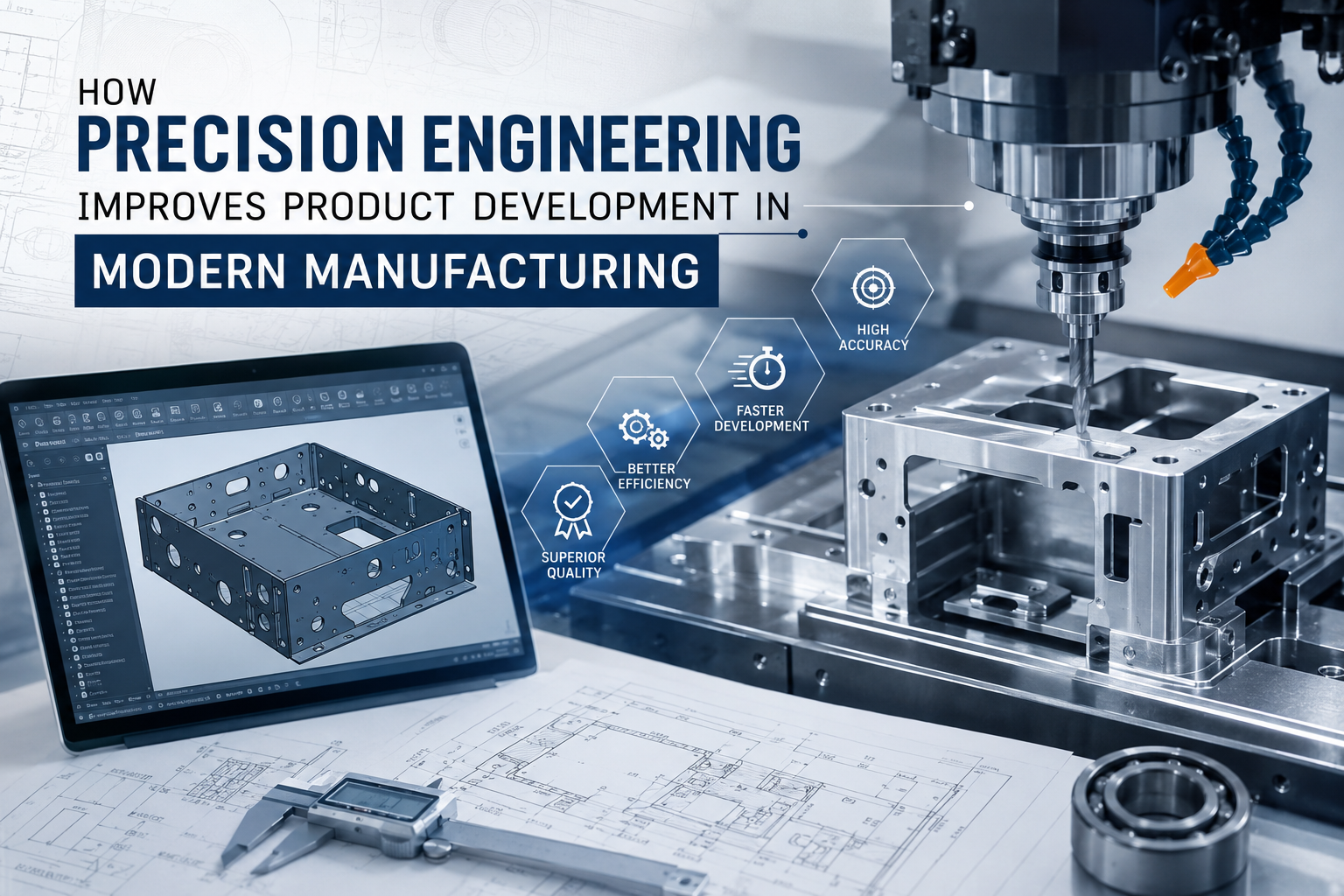
In today's competitive manufacturing landscape, product quality, efficiency, and innovation determine business success. Companies across industries—including automotive, aerospace, electronics, medical devices, and industrial equipment—are increasingly relying on precision engineering to develop products that meet strict quality standards while reducing production costs.
Precision engineering combines advanced manufacturing technologies, digital design tools, and tight tolerance control to create highly accurate components. As manufacturers embrace Industry 4.0 and digital transformation, precision engineering has become the foundation of faster product development and improved manufacturing outcomes. CAD technologies, digital simulation, and Design for Manufacturing and Assembly (DFMA) have significantly accelerated product innovation while minimizing costly design errors.
Precision engineering refers to the design and manufacturing of products with extremely tight dimensional tolerances and exceptional repeatability. It ensures that every component is produced consistently, allowing products to function exactly as intended.
This approach typically integrates:
These technologies enable manufacturers to create reliable products while reducing waste and improving production efficiency.
Every successful product starts with an accurate design. Engineers use advanced CAD software to build detailed digital models before production begins. Digital prototypes allow teams to identify design flaws, verify dimensions, and optimize functionality without manufacturing physical prototypes.
Accurate digital modeling reduces engineering changes later in the product lifecycle, saving both time and money. CAD has become a core technology for improving engineering productivity and manufacturing communication.
Modern manufacturers are under constant pressure to reduce time-to-market. Precision engineering enables rapid product iterations through simulation, virtual testing, and automated manufacturing workflows.
Instead of relying solely on multiple physical prototypes, engineering teams can validate designs digitally before fabrication begins. This streamlined approach shortens development timelines while maintaining high quality standards.
Manufacturing efficiency depends heavily on how well a product is designed for production. Precision engineering minimizes:
Design methodologies such as DFMA help engineers simplify components and improve manufacturability, resulting in lower production costs and higher operational efficiency.
Modern manufacturing begins long before machines start cutting metal. Accurate digital engineering models define every dimension, bend, hole, and assembly requirement.
Professional cad metal design services help manufacturers create production-ready designs that minimize fabrication errors while ensuring compatibility with CNC machines, laser cutters, and sheet metal fabrication processes.
Well-prepared CAD drawings improve collaboration between designers, engineers, and manufacturers, reducing communication errors and accelerating production.
Precision engineering significantly improves product quality through consistent manufacturing processes.
Benefits include:
Industries like aerospace and medical device manufacturing depend on precision engineering because even minor deviations can compromise safety and performance.
Although precision engineering often requires advanced equipment and skilled professionals, it lowers overall production costs by reducing:
Early identification of design issues also prevents expensive engineering changes during production.
Innovation depends on the ability to test new concepts quickly and accurately.
Precision engineering enables manufacturers to:
Advanced CAD platforms and digital engineering workflows allow companies to innovate faster while maintaining manufacturing precision.
Nearly every modern manufacturing sector benefits from precision engineering.
Precision manufacturing improves engine components, transmission systems, safety mechanisms, and electric vehicle parts.
Aircraft manufacturers require exceptionally tight tolerances to ensure safety, reliability, and regulatory compliance.
Precision engineering enables the production of surgical instruments, implants, and diagnostic equipment with extremely high accuracy.
Miniaturized electronic components require consistent manufacturing precision to maintain product performance.
These industries rely on advanced engineering practices to deliver reliable products that meet demanding quality requirements.
Emerging technologies continue to reshape product development.
Key trends include:
These innovations enable manufacturers to improve collaboration, reduce development time, and achieve even greater production accuracy.
Precision engineering has transformed modern manufacturing by enabling companies to develop better products faster and more efficiently. Through accurate digital design, advanced manufacturing technologies, and optimized production processes, manufacturers can reduce costs, improve product quality, and remain competitive in rapidly evolving markets.
As manufacturing continues to embrace automation and digital engineering, precision engineering will remain one of the most important drivers of innovation, reliability, and long-term business success.