English
 Arabic
 French
 Spanish
 Portuguese
 Deutsch
 Turkish
 Dutch
Dutch
 Italiano
 Russian
 Romaian
 Portuguese (Brazil)
 Greek
Greek
Beyond the Billboard: Key Trends in the In-Game Advertising Market
Other |
2026-08-10 07:53:32
 Advertise With Us
 About Us
 Terms And Conditions
 Datenschutzbestimmungen
Alle anzeigen
Datenschutzbestimmungen
Alle anzeigen

Upgrade auf Pro
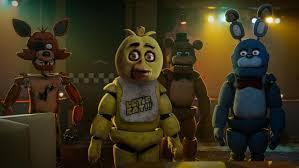
The first time someone recommended Fnaf to me, they smiled and said, "Don't worry. It's just a point-and-click horror game." That description couldn't have been more misleading. I expected a few cheap scares and an hour of entertainment. Instead, I found myself sitting in complete silence, staring at grainy security cameras and hoping nothing would move. Long after I closed the game, I was still thinking about it. Years later, I understand why five nights at freddy's has never disappeared from the horror conversation. It isn't simply scary—it knows exactly how to make players scare themselves.
The magic of Fnaf isn't found in its monsters alone. It's found in the feeling that something is always about to happen.
That feeling never completely goes away.
Even after memorizing enemy patterns, I still hesitate before switching cameras.
Many modern horror games try to shock players every few minutes.
Fnaf takes the opposite approach.
It lets silence become uncomfortable.
You spend most of your time waiting, listening, and questioning your decisions.
Ironically, those quiet moments are often the most frightening.
You're never completely safe.
The tiny office quickly becomes a prison.
Every camera you check leaves another location unwatched.
Every second spent thinking costs valuable electricity.
I've replayed the original game several times, and I still catch myself making rushed decisions whenever the pressure starts building.
After playing dozens of horror titles over the years, I've realized that Fnaf succeeds because it focuses on psychology instead of action.
You don't defeat enemies.
You survive your own mistakes.
At first glance, Freddy Fazbear almost looks harmless.
He's a cartoon mascot.
A smiling bear.
Something children should enjoy.
Then the game slowly changes your perception.
Eventually, seeing him disappear from the stage becomes more terrifying than seeing him standing there.
Very few games completely redefine how players view a character.
The animatronics don't simply chase you.
They force you to make impossible choices.
Do you check Pirate Cove?
Do you watch the hallway?
Should you save power for later?
There is rarely a perfect answer.
That's why every successful night feels earned.
The original Fnaf introduced an unforgettable concept.
Later games expanded it without losing the franchise's identity.
One reason I admire Scott Cawthon is his confidence in the audience.
He rarely explains everything directly.
Instead, tiny clues appear through hidden minigames, newspaper articles, mysterious dialogue, and environmental storytelling.
That approach transformed the franchise into one of gaming's biggest mysteries.
Even players who haven't touched the games in years still enjoy discussing theories.
Every long-running series reaches a point where it must evolve.
For Fnaf, that moment arrived with Security Breach.
Instead of watching cameras from one room, players explored a massive entertainment complex.
The change divided fans.
Personally, I appreciated the experiment.
The original games remain unmatched for suspense, while Security Breach proves the franchise isn't afraid to grow.
Both experiences deserve their place.
Very few horror games inspire this much creativity.
Every week I discover new fan projects, including:
The community has become almost as fascinating as the games themselves.
Without any doubt.
If someone asked me to recommend a horror game that has aged gracefully, Fnaf would be near the top of the list.
The controls are easy to understand.
The objectives are clear.
Yet mastering the game takes patience.
Each failure teaches a lesson.
Each victory feels rewarding.
That design keeps players coming back.
People often reduce Fnaf to its famous jump scare moments.
I think that's unfair.
The scares only work because of everything leading up to them.
The silence.
The uncertainty.
The rising panic.
Without those elements, the jump scares wouldn't be nearly as memorable.
That's what separates Fnaf from many games that rely only on loud noises.
Every time I revisit five nights at freddy's, I notice something new. Sometimes it's a clever gameplay detail. Other times it's a subtle story clue or a small animation I overlooked before. That's the beauty of Fnaf. It rewards attention, patience, and curiosity. The terrifying animatronics, the unforgettable presence of Freddy Fazbear, and the carefully crafted atmosphere continue to make every night feel unpredictable. Even after all these years, the series remains one of the strongest examples of psychological horror in gaming.
If you're searching for a horror experience that values suspense over spectacle, Fnaf is still one of the best places to begin.
Because Fnaf relies on suspense, resource management, and psychological tension rather than constant action, making every playthrough feel stressful.
Many fans believe later entries deepen the lore, while the original game remains the strongest introduction to the series created by Scott Cawthon.
Yes. The mechanics are simple to learn, but mastering Fnaf takes observation, patience, and smart decision-making, making it enjoyable for both new and experienced players.