English
 Arabic
 French
 Spanish
 Portuguese
 Deutsch
 Turkish
 Dutch
Dutch
 Italiano
 Russian
 Romaian
 Portuguese (Brazil)
 Greek
Greek
Achieving a Seamless Finish After Mole Removal in Dubai
Health |
2026-04-24 08:42:18
 Advertise With Us
 About Us
 Terms And Conditions
 Политика конфиденциальности
Смотреть все
Политика конфиденциальности
Смотреть все

Обновить до Про
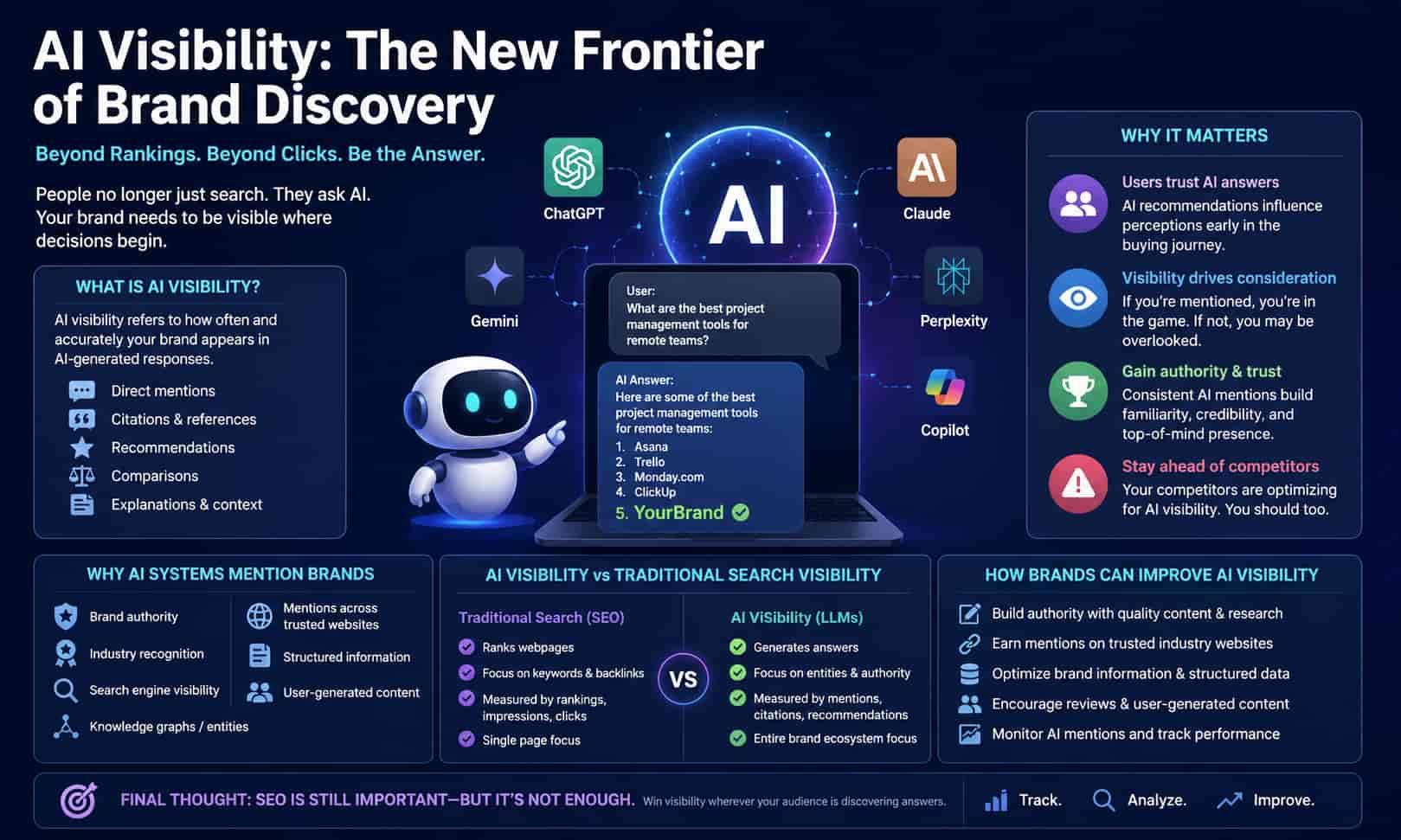
For years, digital marketing teams focused on one primary goal: ranking higher in search engines. If your website appeared on the first page of Google, you were in a strong position to attract visitors, generate leads, and build brand awareness.
That reality is changing.
Today, people increasingly ask questions directly to AI systems like ChatGPT, Gemini, Claude, Perplexity, and Microsoft's Copilot. Instead of browsing through ten blue links, users often receive a single answer that summarizes information from multiple sources.
This is where an AI Visibility Report becomes valuable.
Just as marketers use SEO tools to measure search performance, businesses are now looking at AI brand visibility, brand visibility in AI, and ChatGPT brand mentions to understand their position in this new discovery environment.
In this guide, we'll explore how AI visibility works, why it matters, and what brands can do to improve their presence in AI-generated answers.
When people hear the term AI visibility, they often assume it's simply another version of SEO. In reality, the concept is broader.
AI visibility refers to how frequently and accurately a brand appears in responses generated by AI systems. This includes direct mentions, citations, recommendations, comparisons, and references made by large language models.
Imagine a user asks ChatGPT:
"What are the best project management tools for remote teams?"
If your software company appears in the answer, that's AI visibility.
If the AI explains your product's strengths, references your research, or includes your brand in a comparison, that's also AI visibility.
The key difference is that users may never visit a traditional search results page. Their first interaction happens directly through the AI response.
This makes Brand Visibility in ChatGPT and other AI platforms an increasingly important marketing metric.
The brands that consistently appear in AI-generated answers gain exposure before users ever click a website, read a review, or visit a product page.
Many marketers assume AI tools simply pull information from websites with the highest traffic. The reality is more complicated.
AI models often rely on a combination of factors:
A company that is widely discussed across industry publications may receive more AI mentions than a company that only focuses on publishing content on its own website.
This explains why some businesses with modest search rankings still enjoy strong generative AI visibility.
Consumer behavior is changing faster than many organizations realize.
Ten years ago, someone researching software would search Google, open several websites, compare features, and read reviews.
Today, many users start with AI.
They ask questions such as:
The answers they receive influence perceptions before they ever visit a vendor's website.
This creates a significant opportunity—and a risk.
If your brand appears consistently in AI responses, you gain additional exposure and credibility. If competitors are mentioned while your company is absent, you may lose consideration before the buyer enters the evaluation stage.
Many organizations now treat chatgpt brand visibility as an extension of brand awareness.
The logic is simple. If potential customers increasingly rely on AI assistants for recommendations, then visibility inside those systems becomes part of the buying journey.
One interesting trend is how users perceive AI-generated recommendations.
People don't always treat AI responses as objective facts, but they often view them as useful starting points. When a brand repeatedly appears in answers across different AI platforms, it can create familiarity and trust.
This doesn't guarantee conversions.
However, it often increases the likelihood that a user will research that brand further.
As a result, brand presence in AI answers is becoming a meaningful indicator of digital influence.
Many SEO professionals are asking a reasonable question:
"If I'm already ranking well in Google, won't AI systems naturally mention my brand?"
Sometimes they do.
But not always.
Traditional search engines work primarily by ranking webpages.
Their algorithms evaluate factors such as:
The goal is to determine which pages deserve the highest placement for a specific query.
Success is usually measured through rankings, impressions, traffic, and clicks.
AI systems operate differently.
Rather than presenting a list of webpages, they generate responses by combining information from multiple sources.
In many cases, they evaluate:
As a result, visibility becomes less about a single webpage and more about overall brand authority.
A company may rank well for a keyword but still receive limited AI exposure if the broader web ecosystem doesn't strongly associate that brand with the topic.
Final Thought
I've seen examples where niche companies dominate search results yet rarely appear in AI-generated recommendations.
Meanwhile, larger brands with stronger media coverage, industry recognition, and off-site mentions appear consistently in AI responses.
This happens because AI systems often evaluate broader signals than traditional search engines.
The lesson is straightforward: SEO still matters, but it is no longer the only visibility channel that brands need to monitor.
That is why organizations are increasingly investing in LLM mention analysis, AI mention tracking, and broader brand tracking in LLMs to understand how they appear across AI ecosystems.