English
 Arabic
 French
 Spanish
 Portuguese
 Deutsch
 Turkish
 Dutch
Dutch
 Italiano
 Russian
 Romaian
 Portuguese (Brazil)
 Greek
Greek
Smart Buildings Powered by Integrated Solar Technologies
Networking |
2026-07-28 10:49:26
 Advertise With Us
 About Us
 Terms And Conditions
 Política de Privacidade
Ver Todos
Política de Privacidade
Ver Todos

Atualize para o Pro
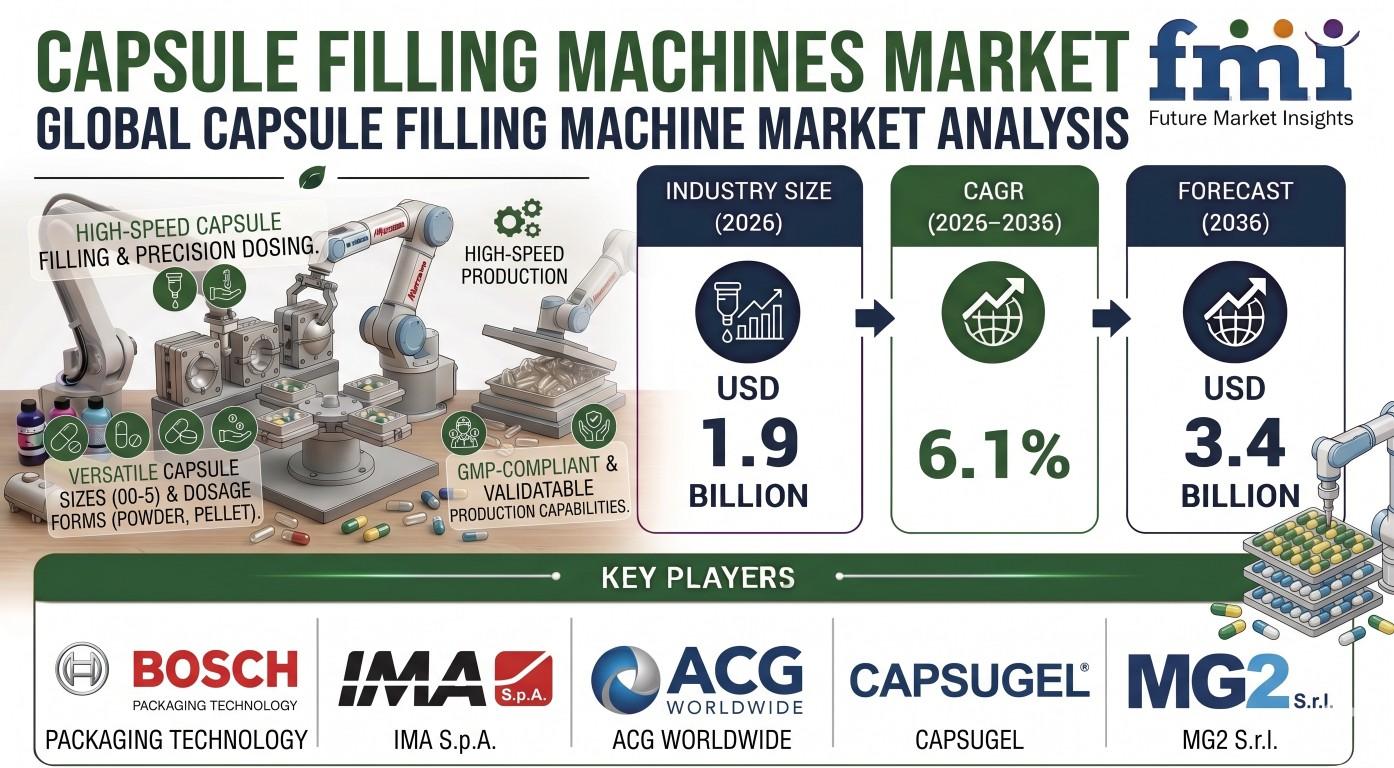
The global Capsule Filling Machines Market is poised for sustained growth as pharmaceutical and nutraceutical manufacturers continue investing in automation, precision dosing, and regulatory-compliant production systems. According to industry projections, the market is expected to expand from USD 1.9 billion in 2026 to USD 3.4 billion by 2036, registering a CAGR of 6.1% during the forecast period. The increasing global demand for encapsulated medicines, dietary supplements, and specialty formulations is reshaping production requirements across manufacturing facilities. Pharmaceutical companies are seeking advanced capsule filling equipment capable of delivering higher throughput, improved dosage accuracy, and enhanced operational efficiency while complying with increasingly stringent quality standards.
Automation has emerged as a defining industry trend, with automatic capsule filling machines expected to account for 58% of market demand in 2026. Simultaneously, low-capacity machines continue to dominate the capacity segment with a 55% market share, reflecting strong adoption among contract manufacturers, regional pharmaceutical producers, research institutions, and emerging nutraceutical brands. As healthcare spending rises and generic drug production expands globally, capsule filling technology is becoming an essential component of modern pharmaceutical manufacturing infrastructure, creating significant opportunities for equipment suppliers focused on innovation, validation support, and digital manufacturing integration.
Capsule filling machines are specialized pharmaceutical processing systems designed to accurately fill hard gelatin and vegetarian capsules with powders, pellets, granules, liquids, and specialized formulations. These systems play a critical role in ensuring dosage consistency, product quality, and manufacturing efficiency across pharmaceutical and nutraceutical production environments. The market is transitioning from traditional manual and semi-automated processes toward highly automated production platforms capable of supporting large-scale manufacturing requirements. Increasing pressure on pharmaceutical companies to improve productivity while maintaining regulatory compliance is accelerating investments in advanced filling technologies. The growing popularity of capsule-based drug delivery systems further supports market expansion. Capsules offer advantages including ease of swallowing, rapid dissolution, improved bioavailability, and enhanced protection for sensitive active ingredients, making them a preferred dosage form across multiple therapeutic categories.
Get Access to the Full Report Sample: Explore detailed forecasts, segment insights, and competitive analysis: https://www.futuremarketinsights.com/reports/sample/rep-gb-5795
Key Growth Drivers
One of the primary drivers behind market growth is the continued expansion of generic pharmaceutical manufacturing. Governments and healthcare providers worldwide are encouraging the use of affordable generic medicines, resulting in increased production volumes and higher demand for efficient capsule filling equipment.
The rapid growth of the nutraceutical industry is creating another significant demand catalyst. Consumers are increasingly adopting dietary supplements, vitamins, herbal products, and functional health formulations, prompting manufacturers to expand encapsulated product portfolios.
Contract Manufacturing Organizations (CMOs) are also playing a pivotal role in market expansion. Pharmaceutical companies increasingly outsource production activities to specialized manufacturers, creating demand for flexible capsule filling systems capable of handling multiple capsule sizes, formulations, and production volumes.
Furthermore, increasing regulatory scrutiny surrounding dosage accuracy, contamination prevention, and quality assurance is encouraging pharmaceutical manufacturers to modernize production lines with automated filling technologies that support validation and traceability requirements.
Technology and Innovation Trends
Technological innovation is transforming capsule filling operations across global pharmaceutical facilities.
Equipment manufacturers are introducing advanced automatic capsule filling systems equipped with digital monitoring capabilities, servo-driven controls, predictive maintenance functionality, and real-time production analytics. These innovations help manufacturers improve operational efficiency while reducing downtime and material waste.
Industry 4.0 integration is becoming increasingly important, enabling capsule filling machines to connect with Manufacturing Execution Systems (MES), Enterprise Resource Planning (ERP) platforms, and digital batch record systems. This integration supports enhanced production visibility and regulatory compliance.
Manufacturers are also focusing on modular machine architectures that facilitate rapid product changeovers and support personalized medicine manufacturing. Flexible machine designs allow producers to switch between capsule sizes, dosage forms, and formulations with minimal disruption.
Another notable trend is the development of integrated filling and sealing systems that improve contamination control while increasing throughput in highly regulated pharmaceutical environments.
Market Challenges and Restraints
Despite positive market fundamentals, several challenges continue to influence equipment adoption.
High capital expenditure requirements remain a significant barrier, particularly for small and mid-sized pharmaceutical manufacturers. Advanced automatic capsule filling systems require substantial investment in equipment, facility modifications, validation processes, and operator training.
Validation and qualification procedures can also be time-consuming and resource-intensive. Pharmaceutical manufacturers must conduct Installation Qualification (IQ), Operational Qualification (OQ), and Performance Qualification (PQ) activities to ensure compliance with regulatory standards.
Additionally, frequent cleaning requirements and product changeovers may increase downtime in facilities producing multiple formulations. These operational challenges can impact productivity and raise overall manufacturing costs.
Price volatility associated with precision machine components, automation technologies, and replacement tooling further adds pressure to procurement budgets, particularly in cost-sensitive emerging markets.
Segment Analysis
Machine Type Analysis
Automatic capsule filling machines are projected to account for 58% of global market demand in 2026, making them the dominant machine category. Their leadership position is supported by superior production efficiency, higher filling accuracy, and reduced reliance on manual labor. These systems are widely deployed in large pharmaceutical manufacturing facilities where consistency, speed, and regulatory compliance are essential. Semi-automatic machines continue to serve medium-scale production environments that require a balance between automation and affordability. Manual systems remain relevant for research laboratories, pilot-scale production, and specialized low-volume applications.
Capacity Analysis
Low-capacity machines, capable of producing up to 25,000 capsules per hour, are expected to capture 55% of market demand in 2026. The segment benefits from strong adoption among emerging pharmaceutical manufacturers, contract production facilities, nutraceutical companies, and research institutions. Their lower investment requirements and operational flexibility make them attractive for smaller batch production and frequent formulation changes. Medium-capacity systems support growing pharmaceutical facilities seeking scalable production solutions, while high-capacity machines above 100,000 capsules per hour are increasingly deployed by multinational pharmaceutical manufacturers focused on mass production.
Regional Analysis
Asia-Pacific continues to emerge as the fastest-growing regional market, supported by expanding pharmaceutical manufacturing capacity and rising healthcare investment. India leads global growth with a projected CAGR of 7.2% through 2036. The country’s position as a leading producer of generic medicines and contract pharmaceutical manufacturing services continues to drive demand for automated capsule filling systems. Growing nutraceutical production further strengthens market expansion. China follows with a CAGR of 6.8%, benefiting from large-scale pharmaceutical production, increasing domestic healthcare demand, and growing exports of pharmaceutical products. The United States is expected to register a CAGR of 5.8%, supported by advanced pharmaceutical manufacturing infrastructure, strong dietary supplement demand, and continued investment in automation technologies. Germany, with a CAGR of 5.5%, remains a key European market driven by precision engineering expertise, pharmaceutical exports, and strict manufacturing quality standards. Brazil is forecast to expand at 6.3%, supported by increasing domestic pharmaceutical production and rising healthcare expenditures across Latin America.
Competitive Landscape
The global capsule filling machines market remains moderately concentrated, with competition centered on technological innovation, validation expertise, automation capabilities, and after-sales service quality. Market participants are increasingly differentiating themselves through advanced digital features, predictive maintenance systems, regulatory support services, and lifecycle equipment management programs. The shift toward fully automated pharmaceutical production environments is encouraging suppliers to develop machines that combine speed, flexibility, compliance, and data integration capabilities. Companies that can provide comprehensive validation support, operator training, spare parts logistics, and global service infrastructure are strengthening their competitive positioning in both mature and emerging markets.
Get Access to the Full Report Sample: Explore detailed forecasts, segment insights, and competitive analysis: https://www.futuremarketinsights.com/reports/sample/rep-gb-5795
Leading Companies Analysis
Several established equipment manufacturers continue to shape the competitive landscape through innovation and global distribution networks.
Major industry participants include:
These companies are investing heavily in automation, machine intelligence, cleanroom-compatible equipment design, and integrated quality monitoring systems to address evolving pharmaceutical manufacturing requirements.
Investment and Strategic Developments
Investment activity is increasingly focused on smart manufacturing technologies, automated dosing systems, and advanced pharmaceutical processing platforms. Equipment suppliers are expanding research efforts in predictive maintenance, AI-driven process optimization, and digital production monitoring to improve machine performance and operational reliability. The growing demand for personalized medicine and specialty pharmaceutical formulations is also encouraging investment in modular and flexible capsule filling technologies capable of supporting small-batch, high-value production. Strategic partnerships between pharmaceutical manufacturers, contract manufacturing organizations, and equipment suppliers are expected to accelerate technology adoption across both developed and emerging markets.
Future Outlook
The Capsule Filling Machines Market is expected to maintain steady growth over the next decade as pharmaceutical manufacturers prioritize productivity, quality assurance, and digital transformation. Automation will continue to reshape production environments, while increasing demand for generic medicines, nutraceutical products, and personalized therapies will expand equipment requirements globally. Manufacturers capable of delivering flexible, highly automated, and validation-ready solutions are likely to benefit most from future market opportunities. Emerging economies, particularly in Asia-Pacific and Latin America, are expected to remain key growth centers as pharmaceutical manufacturing capacity continues to expand.
FMI Custom Research: Strategic Intelligence for Confident Decision-Making
In today's rapidly evolving business environment, leadership teams need more than market data—they need clear, actionable intelligence tailored to their strategic objectives. FMI's Custom Research solutions are designed around the specific business questions organizations need answered, enabling executives to evaluate growth opportunities, validate investments, assess competitive dynamics, and reduce uncertainty before making critical decisions. By combining deep industry expertise, primary research, and proprietary market intelligence, FMI delivers insights that help organizations move from assumptions to evidence-based strategies with greater speed and confidence.
Key Executive Benefits
Business Impact
FMI helps organizations transform market complexity into strategic clarity, enabling leadership teams to identify growth opportunities faster, optimize resource allocation, strengthen competitive positioning, and make high-stakes business decisions with confidence.
To explore how FMI Custom Research can support your strategic priorities, please connect with our team at - sales@futuremarketinsights.com
Conclusion
The global Capsule Filling Machines Market is entering a period of sustained modernization driven by automation, pharmaceutical expansion, and growing demand for encapsulated healthcare products. With market value projected to increase from USD 1.9 billion in 2026 to USD 3.4 billion by 2036 at a CAGR of 6.1%, the industry is benefiting from structural shifts in pharmaceutical manufacturing, regulatory compliance requirements, and nutraceutical production growth. As manufacturers seek greater efficiency, precision, and flexibility, capsule filling technology will continue to play a central role in modern solid-dose production. Equipment suppliers that combine technological innovation, regulatory expertise, and strong service infrastructure will be best positioned to capitalize on the next wave of global pharmaceutical manufacturing investment.
Bread Preservatives Market: https://www.einpresswire.com/article/903536250/bread-preservatives-market-in-usa-to-reach-usd-2-96-billion-by-2036-as-clean-label-demand-reshapes-shelf-life-solutions
Have a Look at Related Research Reports on the Packaging Domain:
Liquid Capsule Filling Machines Market: https://www.futuremarketinsights.com/reports/liquid-capsule-filling-machines-market
Hardgel Liquid Capsule Filling Machines Market: https://www.futuremarketinsights.com/reports/hardgel-liquid-capsule-filling-machines-market
Cup Filling Machines Market: https://www.futuremarketinsights.com/reports/cup-filling-machines-market
Contact Us:
Future Market Insights Inc.
Christiana Corporate, 200 Continental Drive,
Suite 401, Newark, Delaware - 19713, USA
T: +1-347-918-3531
For Sales Enquiries: sales@futuremarketinsights.com
Website: https://www.futuremarketinsights.com
About Future Market Insights (FMI)
Future Market Insights, Inc. (FMI) is an ESOMAR-certified, ISO 9001:2015 market research and consulting organization, trusted by Fortune 500 clients and global enterprises. With operations in the U.S., UK, India, and Dubai, FMI provides data-backed insights and strategic intelligence across 30+ industries and 1200 markets worldwide.