English
 Arabic
 French
 Spanish
 Portuguese
 Deutsch
 Turkish
 Dutch
Dutch
 Italiano
 Russian
 Romaian
 Portuguese (Brazil)
 Greek
Greek
DermaPen Treatment Benefits for Facial Skin Rejuvenation
Health |
2026-08-25 06:02:42
 Advertise With Us
 About Us
 Terms And Conditions
 Privacy Policy
TOON ALLES
Privacy Policy
TOON ALLES

Upgrade to Pro
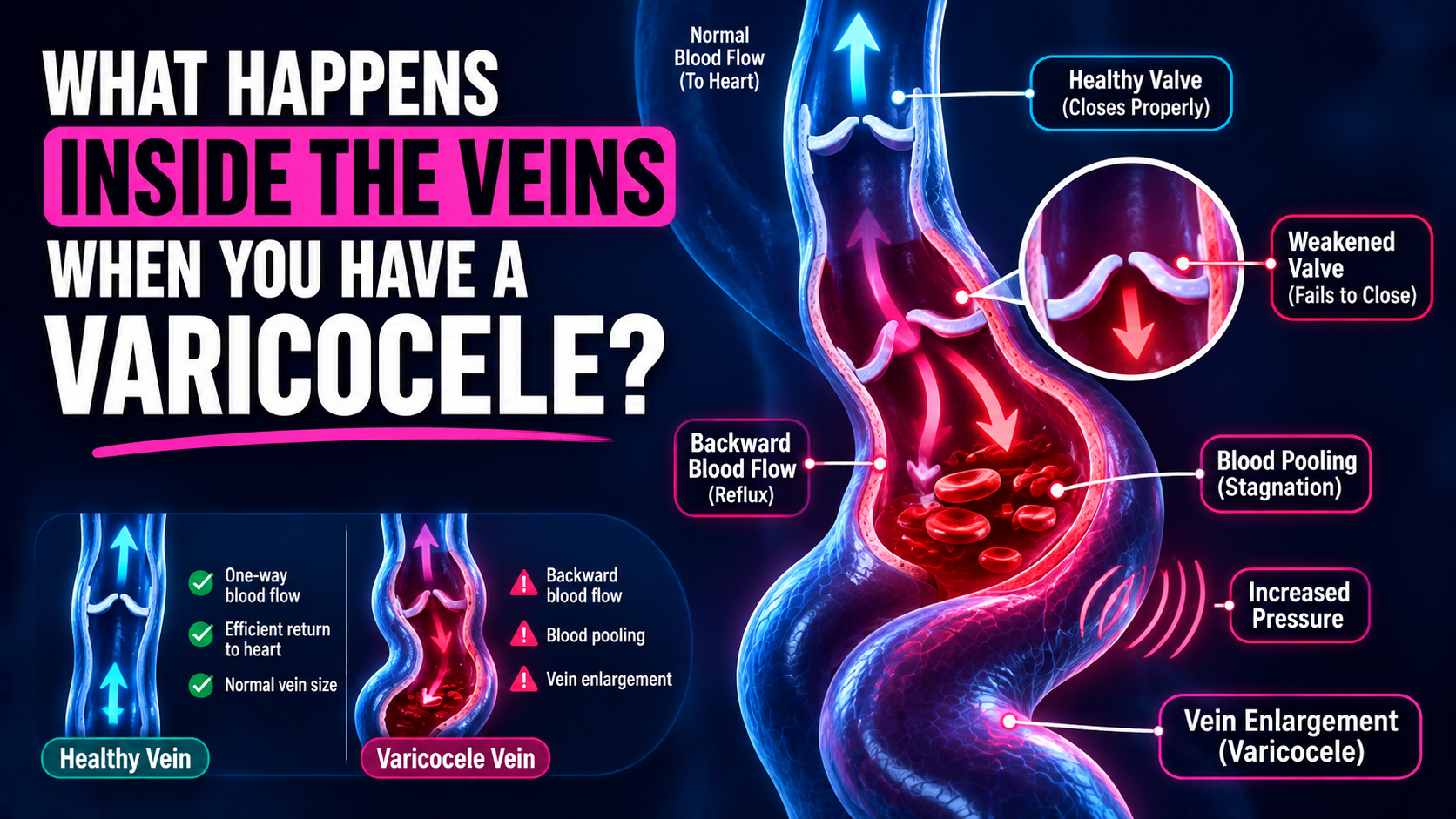
A varicocele develops when blood does not drain efficiently from the veins around the testicle, causing blood to flow backward and pool within the affected veins. This increases venous pressure and gradually causes the veins to become enlarged and sometimes twisted.
For men researching varicocele, understanding what happens inside these veins explains why a varicocele can produce visible veins, scrotal heaviness, discomfort, and, in some men, reproductive concerns.
The testicles receive blood through arteries and return deoxygenated blood through veins.
The testicular veins form a network called the pampiniform plexus, which surrounds the testicular artery within the spermatic cord.
Normally, blood travels:
Testicle → testicular veins → larger abdominal veins → heart
Small valves within the venous system help maintain the appropriate direction of blood flow.
When this system works normally, blood can leave the testicle efficiently despite having to travel upward against gravity.
In a varicocele, the veins responsible for draining the testicle become enlarged because venous blood is not moving normally.
One important mechanism involves venous reflux, where blood flows backward because the valves do not function effectively.
This can lead to:
Backward blood flow
Blood accumulation within the veins
Increased venous pressure
Enlargement of the pampiniform plexus
More prominent or twisted veins
The enlarged veins are what eventually produce the characteristic physical findings of a varicocele.
Veins are flexible blood vessels that can expand when pressure inside them increases.
When blood repeatedly pools within the testicular veins, the veins can gradually become:
Wider
More prominent
Elongated
Twisted
A larger varicocele may become visible beneath the scrotal skin or feel like a soft cluster of cords.
The enlargement is therefore not simply a surface abnormality. It reflects an underlying problem with venous drainage.
Venous reflux means that blood is flowing backward instead of moving efficiently toward its intended drainage pathway.
Normally, venous valves help prevent backward movement.
When the valves are incompetent, gravity can contribute to blood moving downward and accumulating in the veins around the testicle.
The resulting increase in venous pressure can keep the abnormal circulation going.
This is one of the central mechanisms involved in many varicoceles.
Varicoceles are much more commonly found on the left side.
The reason is largely anatomical.
The left testicular vein generally drains into the left renal vein, while the right testicular vein usually drains directly into the inferior vena cava.
Differences in the length and drainage pathway can influence venous pressure and the likelihood of reflux.
This does not mean that right-sided varicoceles cannot occur. A new or isolated right-sided varicocele may warrant careful evaluation.
When blood cannot drain efficiently, it remains within the veins surrounding the testicle for longer than normal.
This can cause:
Increased venous pressure
Enlargement of the surrounding veins
Changes in local blood circulation
A sensation of scrotal fullness
Possible heaviness or aching
The body still has other venous pathways, so blood can often be redirected through alternative veins.
However, persistent abnormal drainage can maintain the varicocele.
It can.
The testicles require an appropriate environment for normal function, including temperature regulation and adequate blood circulation.
The pampiniform plexus normally contributes to heat exchange around the testicular artery.
When the veins become abnormally enlarged, the normal vascular arrangement can be altered.
Researchers have proposed several mechanisms through which varicocele may affect testicular function, including changes in temperature regulation, oxidative stress, venous pressure, and testicular blood flow.
The exact effect varies between individuals.
Potentially.
The pampiniform plexus normally acts as a counter-current heat exchange system, helping keep the testicular environment cooler than core body temperature.
A varicocele can alter this vascular arrangement because enlarged veins may interfere with normal heat exchange.
This has been proposed as one mechanism through which varicocele may affect sperm production.
However, not every man with a varicocele develops fertility problems.
It can in some men.
Varicoceles are associated with abnormal semen parameters in a subset of patients.
Possible changes may involve:
Sperm concentration
Sperm motility
Sperm morphology
However, the presence of a varicocele does not automatically mean that sperm production will be impaired.
Male fertility is influenced by many factors, so semen analysis is important when fertility is a concern.
The testicles have two major functions:
Producing sperm
Producing testosterone
Because varicocele can affect the testicular environment, researchers have investigated whether it can influence Leydig-cell function and testosterone production.
Some men with clinically significant varicoceles may have impaired testicular function, but a varicocele does not automatically cause low testosterone.
Testosterone concerns should therefore be evaluated with appropriate clinical assessment and laboratory testing rather than inferred from the presence of a varicocele.
The enlarged veins can create a sensation of fullness or pressure within the scrotum.
Men may describe the discomfort as:
Dull aching
Heaviness
Pressure
Dragging sensation
Symptoms may become more noticeable after prolonged standing or physical activity.
This is partly related to increased venous pressure and blood pooling.
However, other causes of scrotal pain need to be excluded before attributing discomfort to a varicocele.
Standing increases the effect of gravity on venous blood flow.
If the venous valves are not functioning properly, blood can accumulate more readily in the affected veins while standing.
As a result, the veins may become:
More prominent
More swollen
Easier to feel
When lying down, venous pressure can decrease and the varicocele may become less obvious.
Doctors often examine suspected varicoceles while the patient is standing for this reason.
Not usually in the way an arterial blockage would.
A varicocele is primarily a problem with venous drainage, not the arterial supply that brings oxygenated blood to the testicle.
The issue is that blood leaving the testicle does not drain efficiently through the affected venous pathway.
This distinction is important because the abnormal blood flow is primarily related to reflux and venous pooling.
A varicocele can remain stable, become more noticeable, or gradually increase in size.
The course varies between individuals.
Some men may have a small varicocele for years without significant symptoms.
Others may develop:
Increasing vein prominence
Scrotal heaviness
Persistent discomfort
Testicular size differences
Fertility concerns
Progression is not inevitable, which is why treatment decisions should be based on clinical findings rather than assuming every varicocele will worsen.
A physical examination can identify many clinically apparent varicoceles.
However, Doppler ultrasound provides much more information about the venous circulation.
It can evaluate:
Vein diameter
Blood-flow direction
Venous reflux
Changes during straining
Testicular structure
Other causes of scrotal abnormalities
Ultrasound is particularly useful when the physical examination is unclear or when additional information is needed for treatment planning.
No.
The presence of enlarged veins does not automatically mean they need treatment.
Doctors consider:
Symptoms
Fertility status
Semen parameters when relevant
Testicular development
Varicocele severity
Ultrasound findings
Patient goals
For men attempting conception, AUA/ASRM guidance supports considering varicocele repair when a palpable varicocele is associated with infertility and abnormal semen parameters.
An incidentally detected varicocele without an appropriate clinical indication does not automatically require intervention.
Varicocele embolization targets the abnormal venous pathway from inside the blood vessels.
During the procedure:
A catheter is introduced into a vein.
The catheter is guided toward the affected testicular vein using imaging.
The abnormal venous pathway is identified.
Coils or another embolic material are placed to block the problematic vein.
Blood is redirected through healthier venous pathways.
The goal is to stop abnormal reflux and reduce pressure within the enlarged veins.
Embolization is a minimally invasive treatment option performed by an interventional radiologist.
When the abnormal venous pathway is successfully closed, blood can no longer flow through it in the same abnormal pattern.
The body redirects venous blood through other functioning veins.
Over time, the treated enlarged veins can become less prominent.
The exact degree and speed of improvement vary according to:
Size of the varicocele
Duration of the condition
Venous anatomy
Treatment technique
Individual healing
The purpose of treatment is to correct the abnormal venous drainage rather than simply remove the visible veins.
A varicocele does not automatically require intervention.
Treatment may be considered when there is:
Persistent varicocele-related pain
Testicular growth or size concerns
Infertility with appropriate clinical findings
Abnormal semen parameters in an appropriate fertility setting
Other clinically significant consequences
A specialist should determine whether the abnormal venous flow is actually responsible for the patient's symptoms or reproductive concerns.
Inside a varicocele, the main problem is abnormal venous drainage. When the valves in the testicular veins do not function properly, blood can flow backward and pool within the pampiniform plexus. The resulting increase in venous pressure causes the veins to enlarge and can make them feel or look like a cluster of cords.
This altered venous environment may contribute to scrotal heaviness or discomfort and, in some men, may be associated with changes in testicular function or semen quality. However, having a varicocele does not automatically mean that fertility or testosterone production will be affected.
Doppler ultrasound can help identify abnormal venous flow and reflux when further evaluation is needed. If treatment is clinically indicated, varicocele embolization provides a minimally invasive way to close the abnormal venous pathway and redirect blood through healthier veins.
Men with a symptomatic or clinically significant varicocele can consult an interventional radiologist Jaipur for appropriate evaluation and discussion of suitable treatment options.
Blood does not drain efficiently through the affected testicular veins. Venous reflux and blood pooling increase pressure inside the veins, causing them to enlarge and become twisted.
The left testicular vein has a different drainage pathway from the right, entering the left renal vein rather than directly entering the inferior vena cava. This anatomy can contribute to higher venous pressure and reflux on the left side.
It can affect semen parameters in some men, but not everyone with a varicocele develops fertility problems. Semen analysis is appropriate when fertility is a concern.
A clinically significant varicocele may affect testicular function in some men, but it does not automatically cause low testosterone. Testosterone concerns require appropriate medical evaluation and laboratory testing.
Embolization uses a catheter to reach the abnormal venous pathway and place coils or another embolic material inside it. This blocks the abnormal flow and allows blood to drain through healthier veins.