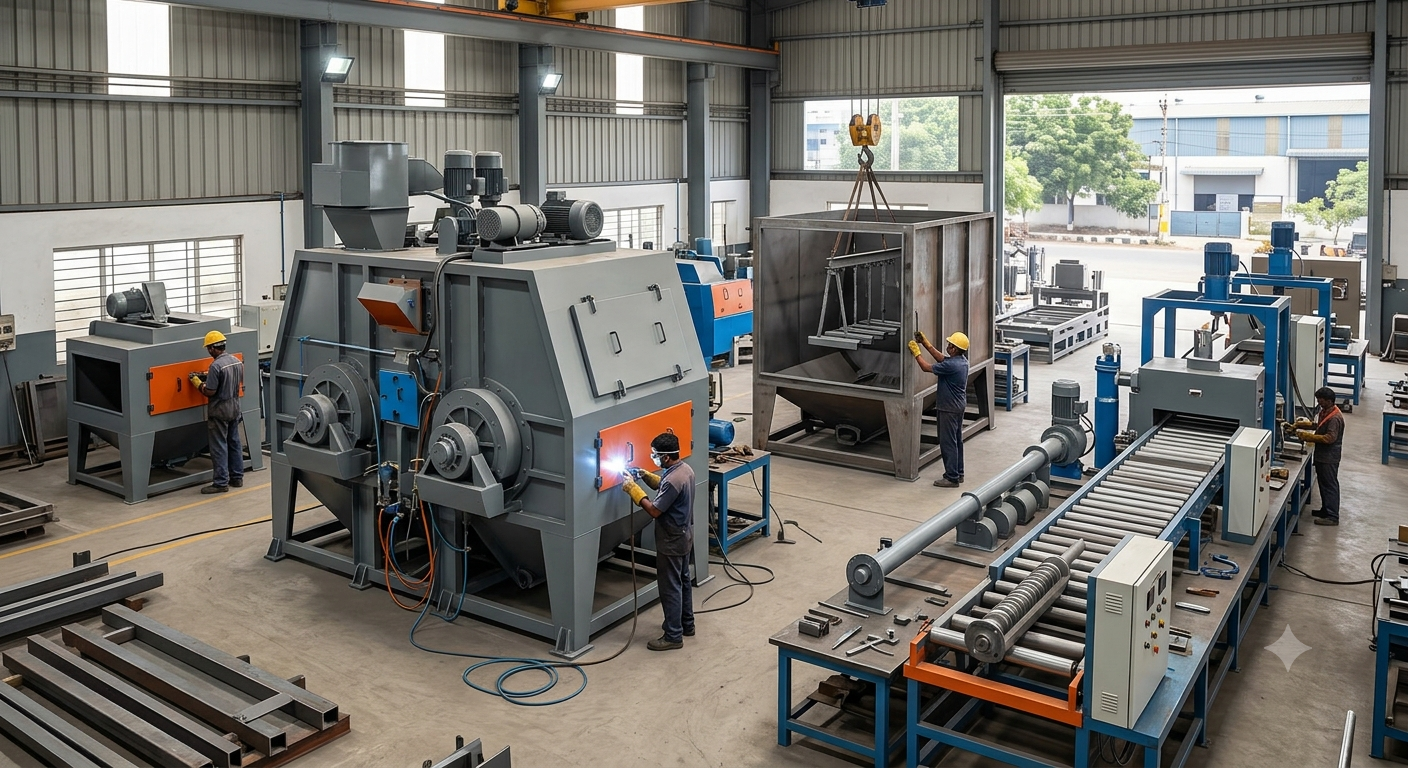
Understanding the Importance of Shot Blasting Equipment
Industrial components often require thorough surface preparation before painting, coating, welding, or other finishing processes. Rust, mill scale, casting sand, old coatings, and other contaminants can affect the quality and durability of subsequent treatments.
Shot blasting provides an efficient mechanical method for cleaning and preparing metal surfaces. Abrasive particles are propelled at high velocity against a component, removing unwanted material and creating a suitable surface profile.
Choosing the right shot blasting equipment supplier is important because the equipment must match the material, component design, production volume, and required surface finish.
How Shot Blasting Supports Modern Manufacturing
Surface preparation is often a critical step in maintaining product quality. Inconsistent cleaning can result in coating adhesion problems, uneven finishes, premature corrosion, or additional rework.
A properly selected blasting system can provide:
• Consistent surface cleaning
• Improved coating preparation
• Reduced manual intervention
• Better production efficiency
• Repeatable processing results
• Improved handling of high-volume workloads
The right equipment can therefore become an important part of an efficient manufacturing workflow rather than functioning as an isolated cleaning system.
Identify Your Production Requirements First
Before selecting equipment, manufacturers should clearly understand their operational requirements. Different components require different machine configurations, and purchasing equipment without considering these factors can lead to inefficient processing.
Important considerations include:
• Component dimensions
• Component weight
• Component shape
• Material type
• Production volume
• Required surface condition
• Available floor space
• Loading and unloading requirements
A professional shot blasting equipment supplier should be able to understand these requirements and recommend an appropriate machine configuration instead of offering a generic solution.
Choosing the Right Machine Configuration
Shot blasting machines are available in several configurations. Each type is designed to accommodate specific component characteristics and production processes.
Tumble blast systems can be suitable for batches of smaller components that can withstand controlled tumbling. Hanger type systems can process larger or irregular components by suspending them during blasting. Table type systems may be appropriate for components that need controlled positioning.
For continuous manufacturing environments, conveyor-based systems can help integrate blasting into an existing production line.
The machine should be selected according to the actual workflow, component characteristics, and desired production output.
Examine Blasting Performance
The effectiveness of a blasting system depends on several technical factors. Abrasive velocity, wheel arrangement, processing time, component positioning, and media selection all influence the final result.
Manufacturers should determine the required cleaning level before choosing equipment. Excessive blasting can increase wear and abrasive consumption, while insufficient blasting may leave contaminants on the component.
Consistent abrasive distribution is particularly important for complex components where certain areas may otherwise receive less exposure.
Consider Abrasive Recovery Systems
Abrasive media represents an ongoing operating expense, making recovery and recycling an important consideration.
An efficient blasting machine should be capable of collecting used abrasive and separating reusable particles from dust and contaminants. Suitable media can then be returned to the blasting cycle.
Effective recovery systems can help:
• Reduce abrasive wastage
• Maintain consistent blasting conditions
• Lower operating costs
• Improve housekeeping
• Support efficient production
When comparing equipment, manufacturers should understand how abrasive collection, separation, and circulation are integrated into the machine.
Dust Collection and Environmental Considerations
Blasting operations generate dust during the removal of surface contaminants. Proper dust collection is therefore essential for maintaining suitable workplace conditions.
A suitable extraction system should be capable of handling the dust generated by the machine while supporting effective filtration and collection.
Manufacturers should consider dust collector capacity, filter maintenance, airflow requirements, and the nature of the materials being removed during blasting.
Good dust management can contribute to cleaner production areas and more controlled equipment operation.
Evaluate Automation Requirements
Automation can help improve productivity in manufacturing environments where components need to be processed repeatedly.
Depending on the application, automated systems may control:
• Component loading
• Workpiece movement
• Blasting cycles
• Abrasive circulation
• Dust extraction
• Component unloading
Automation can reduce repetitive manual work and improve process consistency. However, the level of automation should correspond to production requirements. A small-volume operation may not need the same automation level as a high-volume manufacturing facility.
Machine Durability and Wear Protection
Shot blasting equipment operates under demanding conditions because abrasive media repeatedly impacts internal machine surfaces. Wear protection is therefore a significant consideration when evaluating equipment.
Manufacturers should examine the construction of the blasting chamber, protective liners, blasting wheels, abrasive handling components, and other wear-prone areas.
Durable construction can help reduce maintenance interruptions and support consistent machine performance over time.
Maintenance and Technical Support
The long-term performance of blasting equipment depends on regular inspection and maintenance. Wear components need to be checked periodically, while abrasive accumulation and dust should be managed appropriately.
Before purchasing equipment, ask about:
• Preventive maintenance requirements
• Replacement intervals
• Spare part availability
• Technical assistance
• Installation support
• Operator training
• Troubleshooting procedures
A dependable shot blasting equipment supplier should provide clear information about ongoing maintenance and operational requirements.
Prioritize Safety During Equipment Selection
Safety should be considered throughout the equipment selection process. Proper enclosures, controlled access, emergency controls, dust extraction, and suitable operating procedures can help protect operators.
Personnel should also receive appropriate training covering machine operation, abrasive handling, cleaning, inspection, and maintenance.
A well-designed system should make routine operation and maintenance practical while reducing unnecessary exposure to operational hazards.
Compare Total Cost of Ownership
The initial purchase price does not represent the complete cost of industrial blasting equipment. Energy consumption, abrasive usage, maintenance, replacement components, downtime, and technical support can influence the overall cost throughout the machine's operating life.
Manufacturers should therefore compare equipment based on long-term performance rather than choosing solely on initial price.
A machine that offers consistent output, efficient abrasive recovery, manageable maintenance, and reliable technical support may provide greater value over time.
Conclusion
Selecting industrial blasting equipment requires careful consideration of production requirements, machine configuration, blasting performance, abrasive recovery, dust collection, automation, durability, maintenance, and safety.
Wewin Finishing Equipments Pvt. Ltd offers equipment solutions designed for industrial finishing requirements. Businesses evaluating a shot blasting equipment supplier should assess technical suitability, operating efficiency, long-term reliability, and service support to make a confident investment decision.
 English
 Arabic
 French
 Spanish
 Portuguese
 Deutsch
 Turkish
 Dutch
Dutch
 Italiano
 Russian
 Romaian
 Portuguese (Brazil)
 Greek
Greek
 Advertise With Us
 About Us
 Terms And Conditions
 Politique de confidentialité
Tout voir
Politique de confidentialité
Tout voir