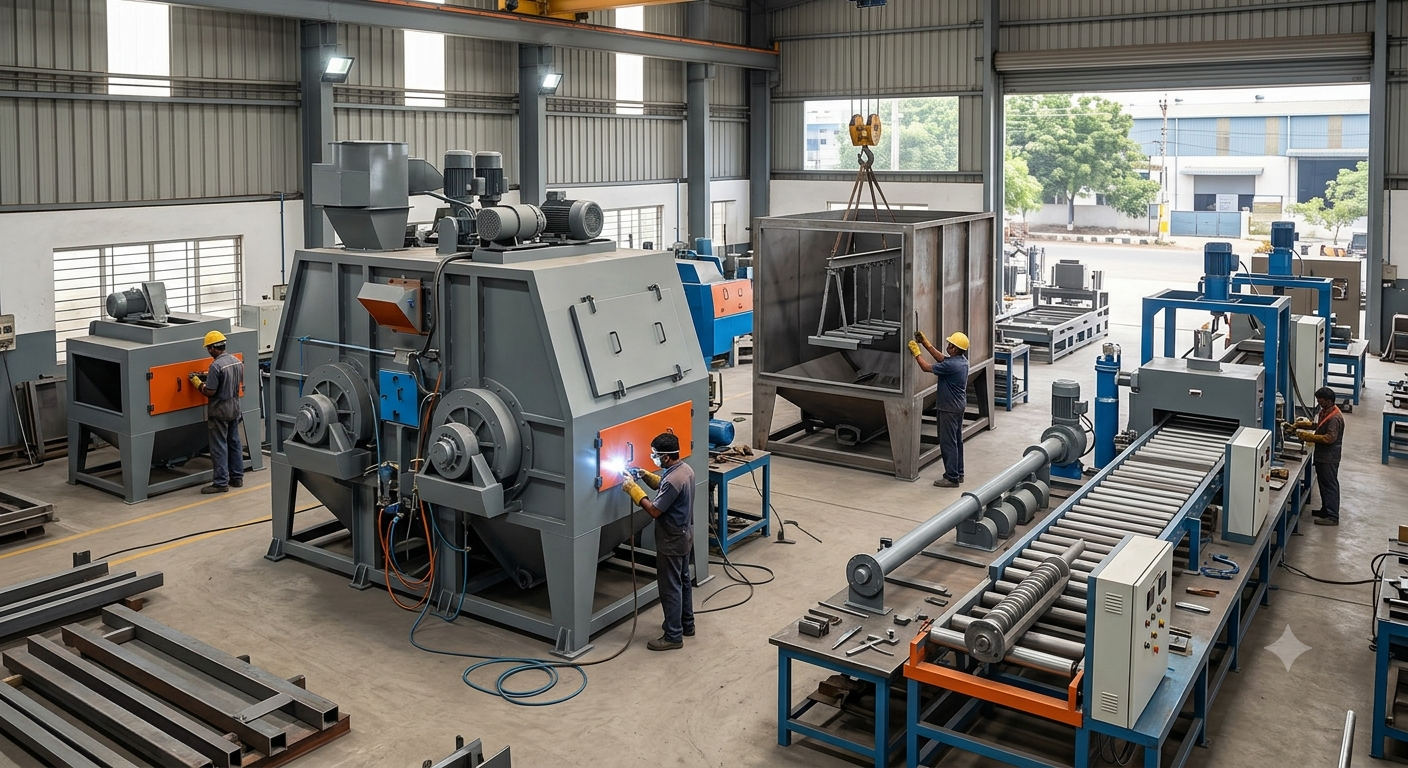
Understanding the Role of Shot Blasting
Surface preparation is an essential stage in many industrial manufacturing processes. Metal components often require cleaning, descaling, removal of corrosion, or preparation before painting and coating. Shot blasting is a mechanical surface treatment process that uses abrasive media propelled at high velocity to clean and prepare surfaces.
Selecting experienced shot blasting machine manufacturers can help industries choose equipment that matches their production requirements, component characteristics, and desired surface finish.
Unlike manual cleaning methods, automated shot blasting can provide greater consistency and productivity when properly designed and operated.
How Shot Blasting Machines Work
A shot blasting machine accelerates abrasive particles toward a workpiece. The impact removes unwanted materials from the surface while creating a suitable profile for subsequent finishing processes.
Depending on the machine configuration, components may be processed using different handling systems. The appropriate design depends on factors such as component size, geometry, production volume, material type, and required finish.
The blasting process generally involves:
• Loading the components
• Positioning the workpieces
• Propelling abrasive media
• Removing contaminants
• Collecting and recycling abrasive material
• Unloading the processed components
Understanding this process helps manufacturers determine which equipment configuration is appropriate for their facility.
Why Equipment Selection Matters
Choosing a blasting machine based only on initial purchase cost can create operational challenges later. Equipment should be evaluated according to its ability to deliver consistent surface treatment while supporting production requirements.
Important considerations include:
• Component dimensions
• Component weight
• Production volume
• Surface condition
• Required cleaning standard
• Abrasive media requirements
• Available floor space
• Automation level
Working with knowledgeable shot blasting machine manufacturers can make it easier to match machine specifications with actual production requirements.
Common Industrial Applications
Shot blasting is used across industries where metal surface preparation is important. It can support the preparation of castings, fabricated components, structural parts, automotive components, and various engineered products.
Typical applications include:
• Removal of rust and scale
• Cleaning cast components
• Surface preparation before painting
• Desanding of castings
• Removal of old coatings
• Surface texturing
• Preparation for protective finishes
The application determines the blasting intensity, machine configuration, abrasive selection, and processing time required.
Types of Shot Blasting Equipment
Different production environments require different machine designs. There is no single configuration that suits every application.
Common equipment categories include:
• Tumble blast machines
• Hanger type machines
• Table type machines
• Continuous blasting systems
• Roller conveyor systems
• Specialized blasting equipment
Tumble machines may be suitable for batches of smaller components, while hanger systems can accommodate larger or more complex workpieces. Conveyor-based systems may be preferred for continuous production environments.
The choice should be based on the workpiece and production workflow rather than simply selecting the most commonly used machine.
Evaluating Machine Construction
Industrial blasting equipment operates in an environment involving repeated abrasive impact. Machine construction therefore plays an important role in long-term performance.
When comparing manufacturers, examine the materials and protective components used in areas exposed to abrasive wear. Critical internal sections may require suitable wear-resistant protection to extend service life.
A well-engineered machine should also provide convenient access to components that require inspection, cleaning, adjustment, or replacement.
Abrasive Recovery and Recycling
Abrasive management is an important part of shot blasting efficiency. Modern systems are designed to collect used abrasive media and separate reusable material from dust and contaminants.
An effective recovery system can help reduce unnecessary abrasive consumption while maintaining consistent blasting performance.
Dust collection is equally important. Proper dust extraction helps maintain a cleaner working environment and prevents excessive accumulation of airborne contaminants within the production area.
Automation and Production Efficiency
Automation can improve productivity by reducing manual handling and creating more consistent processing cycles. The appropriate level of automation depends on production volume and component requirements.
Automated systems can help manage:
• Component movement
• Blasting cycles
• Abrasive circulation
• Media recovery
• Dust extraction
• Loading and unloading
For high-volume manufacturing environments, automation can reduce processing variation and improve workflow efficiency.
Maintenance and Operating Costs
The purchase price is only one part of the overall cost of ownership. Maintenance requirements, abrasive consumption, energy usage, replacement parts, downtime, and service support can significantly influence long-term operating expenses.
Before selecting equipment, ask about:
• Routine maintenance schedules
• Wear component replacement
• Abrasive consumption
• Spare part availability
• Cleaning requirements
• Technical support
• Expected service life
Reliable shot blasting machine manufacturers should be able to explain these factors clearly and help customers understand the machine's operational requirements.
Safety Features Should Be a Priority
Industrial blasting equipment should be designed with operator safety in mind. Protective enclosures, controlled access, dust extraction, emergency controls, and appropriate operating procedures are important considerations.
Operators should also receive suitable training covering machine operation, abrasive handling, inspection procedures, and maintenance precautions.
Safety should be considered during equipment selection rather than treated as an afterthought after installation.
Choosing a Manufacturer for Your Requirements
The right manufacturer should demonstrate an understanding of the application rather than simply offering standard equipment. Technical discussions should cover component specifications, production capacity, surface preparation requirements, available space, automation preferences, and future expansion plans.
It is also useful to evaluate the manufacturer's ability to provide installation assistance, operational guidance, maintenance support, and replacement components.
A detailed assessment of your production requirements can help ensure that the selected machine delivers practical value over its operating life.
Conclusion
Shot blasting is an important surface preparation technology for industries that require reliable cleaning, descaling, and surface treatment. Selecting the right machine requires careful consideration of component characteristics, production volume, machine construction, abrasive recovery, automation, maintenance, and safety.
Wewin Finishing Equipments Pvt. Ltd provides industrial finishing equipment solutions designed around different production requirements. Businesses evaluating shot blasting machine manufacturers can focus on technical suitability, long-term reliability, operational efficiency, and service support to make a well-informed equipment decision.
 English
 Arabic
 French
 Spanish
 Portuguese
 Deutsch
 Turkish
 Dutch
Dutch
 Italiano
 Russian
 Romaian
 Portuguese (Brazil)
 Greek
Greek
 Advertise With Us
 About Us
 Terms And Conditions
 Политика конфиденциальности
Смотреть все
Политика конфиденциальности
Смотреть все