English
 Arabic
 French
 Spanish
 Portuguese
 Deutsch
 Turkish
 Dutch
Dutch
 Italiano
 Russian
 Romaian
 Portuguese (Brazil)
 Greek
Greek
P Shot in Islamabad and the Connection Between Confidence and Daily Productivity
Health |
2026-06-03 05:34:11
 Advertise With Us
 About Us
 Terms And Conditions
 Politique de confidentialité
Tout voir
Politique de confidentialité
Tout voir

Mise à niveau vers Pro
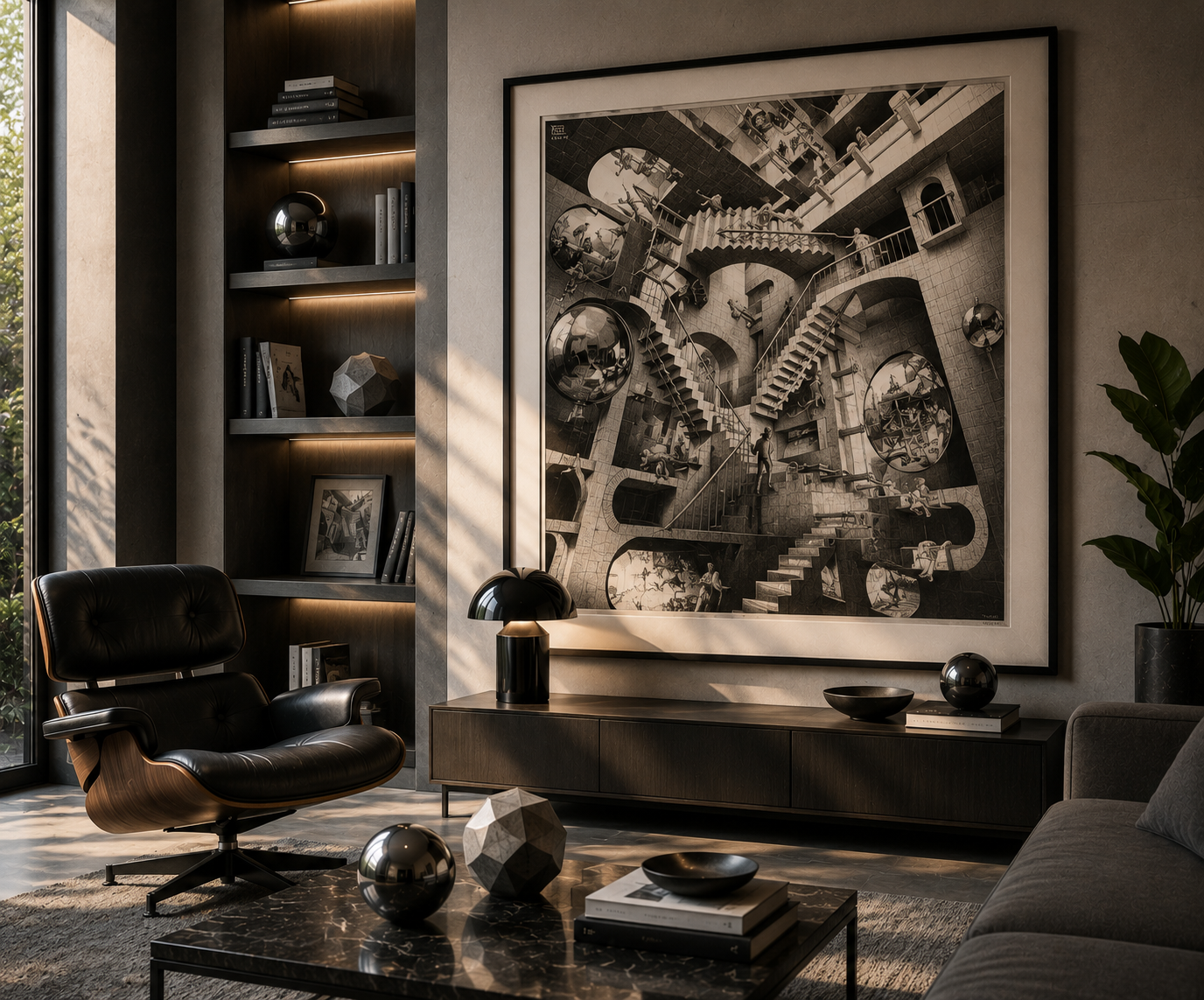
M.C. Escher had a remarkable ability to transform simple geometric forms into complex visual experiences. Throughout his career, he explored ideas involving perspective, symmetry, reflection, infinity, and three-dimensional space. His work demonstrates how a familiar object can become something much more intriguing when examined through an unconventional artistic perspective.
For collectors and enthusiasts exploring M.C. Escher images, his geometric compositions offer an especially fascinating glimpse into the relationship between mathematics and visual art. Among these works, Three Spheres II provides an excellent example of Escher’s interest in representing three-dimensional forms on a flat surface.
Geometry was more than a technical tool for Escher. It became a foundation for exploring how people understand the visual world. Circles, spheres, grids, polygons, and repeating shapes allowed him to investigate balance, depth, proportion, and perspective.
His fascination with geometric forms can be seen throughout his artistic career. He frequently took shapes that appeared simple and used them to create compositions with surprising complexity.
This approach is one reason M.C. Escher images remain so recognizable. The artwork often appears carefully ordered, yet there is usually an element that encourages the viewer to stop and reconsider what is happening within the composition.
Three Spheres II is a compelling example of Escher’s ability to make a relatively simple subject visually engaging. The composition focuses on three spherical forms and explores their physical presence through carefully controlled tonal contrasts and perspective.
A sphere may appear straightforward, but representing one convincingly on a flat surface requires careful attention to light, shadow, curvature, and proportion. Escher used these elements to create the impression of volume and depth.
The M.C. Escher Three Spheres II composition demonstrates how a simple geometric subject can become a study in perception. The spheres are not merely objects within the artwork; their arrangement allows the viewer to think about dimensionality and the challenge of translating three-dimensional forms into two-dimensional art.
A sphere has no obvious flat edge or corner. Its appearance changes depending on the direction of light and the position of the observer. An artist therefore has to create the impression of a curved surface using only lines, shading, and tonal variation.
Escher was exceptionally skilled at this type of visual construction. His attention to detail helped make solid objects appear convincing within the boundaries of a print.
In Three Spheres II, this attention to dimensionality becomes particularly interesting. The forms encourage the viewer to consider how shading can influence the perception of shape and how a flat image can suggest physical volume.
Reflection is another recurring idea throughout Escher’s work. He explored mirrors, water, polished surfaces, and reflective objects to investigate how one image can contain another.
Spherical objects offer an especially interesting opportunity for studying reflection because their curved surfaces can distort the surrounding environment. Instead of producing a simple mirror image, a curved surface can alter proportions and perspective.
One of the defining qualities of Escher’s work is that it rewards close observation. His compositions may initially appear simple, but studying them carefully can reveal details about structure, light, perspective, and spatial relationships.
This is true across many M.C. Escher images. Whether he was working with architectural forms, natural subjects, tessellations, or geometric objects, Escher consistently encouraged viewers to examine how individual elements interact.
Escher demonstrated that an artwork does not need a complicated subject to produce a complex viewing experience. A few carefully arranged geometric forms can raise questions about space, perception, and physical reality.
The M.C. Escher Three Spheres II composition illustrates this principle beautifully. By focusing on spherical forms, Escher shifts attention toward the qualities that make an object appear solid and dimensional.
For collectors and enthusiasts interested in studying M.C. Escher’s work, Walker Fine Art offers a specialized collection devoted to his artistic legacy. Exploring original works provides an opportunity to appreciate the technical precision, fine detail, and printmaking craftsmanship that can be difficult to fully experience through reproductions.
Looking at different works together can also reveal the recurring themes that shaped Escher’s career. Geometry, reflection, symmetry, transformation, and perspective appear throughout his work, but each composition approaches these ideas differently.
For those drawn to geometric compositions, studying Three Spheres II alongside other M.C. Escher images can provide valuable insight into his interest in dimensionality and visual perception.
M.C. Escher showed that mathematics and art could work together without sacrificing imagination. His geometric compositions demonstrate how simple forms can become vehicles for exploring complex ideas.
The M.C. Escher Three Spheres II work is a striking example of this approach. By concentrating on three-dimensional forms within a two-dimensional medium, Escher invites viewers to think about how depth, light, and shape are translated into visual art.
For collectors and art enthusiasts, exploring M.C. Escher images remains an opportunity to discover an artist who continually challenged conventional ways of seeing. Through Walker Fine Art, his remarkable work can be appreciated not only for its visual precision but also for the ideas that continue to make it fascinating.