English
 Arabic
 French
 Spanish
 Portuguese
 Deutsch
 Turkish
 Dutch
Dutch
 Italiano
 Russian
 Romaian
 Portuguese (Brazil)
 Greek
Greek
Managing Mounjaro injection in Dubai | Practical Strategies for Comfort
Health |
2026-05-06 06:47:15
 Advertise With Us
 About Us
 Terms And Conditions
 Политика конфиденциальности
Смотреть все
Политика конфиденциальности
Смотреть все

Обновить до Про
Industrial facilities need reliable measurement systems to understand emissions, improve process control, and maintain consistent product quality. From a continuous emission monitoring system to a headspace oxygen analyzer, the right analytical technology can provide valuable data for environmental compliance and industrial decision-making.
Uniphos offers monitoring and analytical solutions designed for applications involving emissions, gases, and process measurements.
A continuous emission monitoring system (CEMS) is an automated system used to continuously measure selected pollutants or gases released from industrial processes. Instead of relying only on occasional manual measurements, CEMS can provide ongoing information about emission concentrations.
A typical CEMS installation may include sampling equipment, gas analyzers, conditioning systems, data acquisition components, and reporting interfaces.
CEMS can be used in industries where monitoring stack or process emissions is an important part of environmental management.
A continuous emission monitoring system can help organizations:
Monitor selected emission parameters continuously
Identify changes in emission concentrations
Collect measurement data over time
Support environmental monitoring programs
Improve visibility into industrial emissions
Assist with applicable regulatory reporting requirements
The exact configuration depends on the gases being measured and the characteristics of the emission source.
A CEMS generally collects a representative sample from an emission source and passes it through an appropriate sampling and analytical arrangement. The analyzer measures specified gases or pollutants, while associated systems can process and record the measurement data.
The main stages can include:
Emission source → Sampling → Gas conditioning → Analysis → Data acquisition → Reporting
The equipment and measurement method vary depending on the application, target gases, concentration ranges, and operating conditions.
An emission monitoring system helps industrial facilities measure and evaluate gases or pollutants released during manufacturing and combustion processes.
Monitoring emissions can provide useful information about process performance and environmental conditions. It can also help identify unusual changes that may require investigation.
Emission monitoring applications can be found across sectors such as:
Power generation
Manufacturing
Chemical processing
Cement production
Oil and gas
Waste treatment
Industrial combustion processes
The appropriate monitoring technology depends on the emission source and parameters that need to be measured.
Emission monitoring provides measurable information about what is being released from an industrial process. Consistent data can help organizations understand emission patterns and investigate unexpected variations.
It can also support environmental management by providing documented measurements rather than relying solely on periodic observations.
For facilities with specific regulatory obligations, monitoring equipment should be selected and operated according to applicable local requirements and standards.
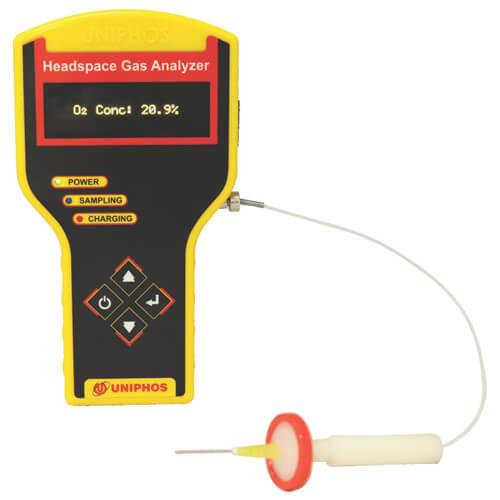
A headspace analyzer is an analytical instrument used to examine the gases present in the headspace above a product inside a sealed package, container, or vessel.
Headspace analysis is commonly associated with packaging and quality-control applications where the composition of gases inside a package can influence product condition, stability, or shelf life.
Depending on the analyzer, parameters such as oxygen and carbon dioxide may be measured.
A headspace analyzer typically takes a gas sample from the space above the product and sends it to analytical sensors or measurement components.
The instrument then determines the concentration of the selected gases.
For example:
Sealed package → Headspace sampling → Gas analysis → Measurement → Quality assessment
This approach allows manufacturers and quality-control teams to evaluate the internal atmosphere without necessarily opening the package for conventional laboratory analysis.
A headspace oxygen analyzer is specifically designed to measure oxygen concentration in the headspace of a package or container.
Controlling oxygen levels can be important for products where oxidation may affect quality, freshness, stability, or shelf life.
Headspace oxygen measurement can therefore be useful for quality-control teams that need to verify packaging conditions and identify potential variations in packaging processes.
Headspace oxygen analysis can be relevant to:
Food packaging
Pharmaceutical packaging
Medical products
Modified-atmosphere packaging
Research and development
Quality-control laboratories
The appropriate measurement technology depends on the packaging format, gas composition, sampling requirements, and required measurement range.
Although both technologies involve gas analysis, their applications are different.
|
Feature |
CEMS |
Headspace Analyzer |
|
Primary purpose |
Emission monitoring |
Product/package gas analysis |
|
Typical environment |
Industrial emission sources |
Sealed packages or containers |
|
Measurement focus |
Emitted gases or pollutants |
Headspace gas composition |
|
Monitoring approach |
Often continuous |
Usually sample-based |
|
Main objective |
Environmental/process monitoring |
Quality control and packaging analysis |
Understanding this distinction helps organizations select the appropriate analytical solution for their requirements.
Before selecting an analytical system, consider the target gas, measurement range, application environment, sampling method, accuracy requirements, and data-management needs.
For emission applications, organizations should evaluate the emission source, sampling conditions, required parameters, and applicable regulatory requirements.
For headspace applications, factors such as package type, gas composition, sample volume, testing frequency, and required detection limits should be considered.
Uniphos provides technologies for gas detection, environmental monitoring, emission measurement, and analytical applications.
Whether the requirement involves a continuous emission monitoring system, CEMS, emission monitoring system, headspace analyzer, or headspace oxygen analyzer, selecting a solution based on the actual measurement objective is essential.
Reliable analytical data can help organizations improve monitoring, strengthen quality-control processes, and make better-informed operational decisions.
A continuous emission monitoring system, or CEMS, is an automated monitoring arrangement used to continuously measure selected gases or pollutants from industrial emission sources.
CEMS stands for Continuous Emission Monitoring System. It is used to continuously measure and record specified emission parameters from industrial processes.
An emission monitoring system is used to measure gases or pollutants released from industrial processes. It can support environmental monitoring, process evaluation, and applicable compliance requirements.
A headspace analyzer measures the composition of gases in the space above a product inside a sealed package, container, or vessel. It is commonly used for quality-control and packaging applications.
A headspace oxygen analyzer measures the concentration of oxygen inside the headspace of a sealed package or container. It can help assess packaging conditions where oxygen levels affect product quality or stability.
Measuring headspace oxygen can help identify unwanted oxygen levels in packaged products. This can be particularly relevant when oxidation, freshness, stability, or shelf life is a concern.
CEMS is primarily used to monitor industrial emissions, often continuously, while a headspace analyzer is used to analyze gases inside sealed packages or containers. Their applications and sampling requirements are therefore different.
Consider the emission source, gases or pollutants being measured, concentration range, sampling conditions, measurement requirements, data needs, and applicable regulations before selecting an emission monitoring system.
Uniphos offers gas detection and analytical technologies for industrial and environmental applications. The appropriate Uniphos solution can be selected according to the required gas measurement, monitoring objective, and operating environment.