English
 Arabic
 French
 Spanish
 Portuguese
 Deutsch
 Turkish
 Dutch
Dutch
 Italiano
 Russian
 Romaian
 Portuguese (Brazil)
 Greek
Greek
Adeel Shams Net Worth: Career, Business Success & Financial Journey
Other |
2026-07-24 05:55:03
 Advertise With Us
 About Us
 Terms And Conditions
 Privacy Policy
See All
Privacy Policy
See All

Upgrade to Pro
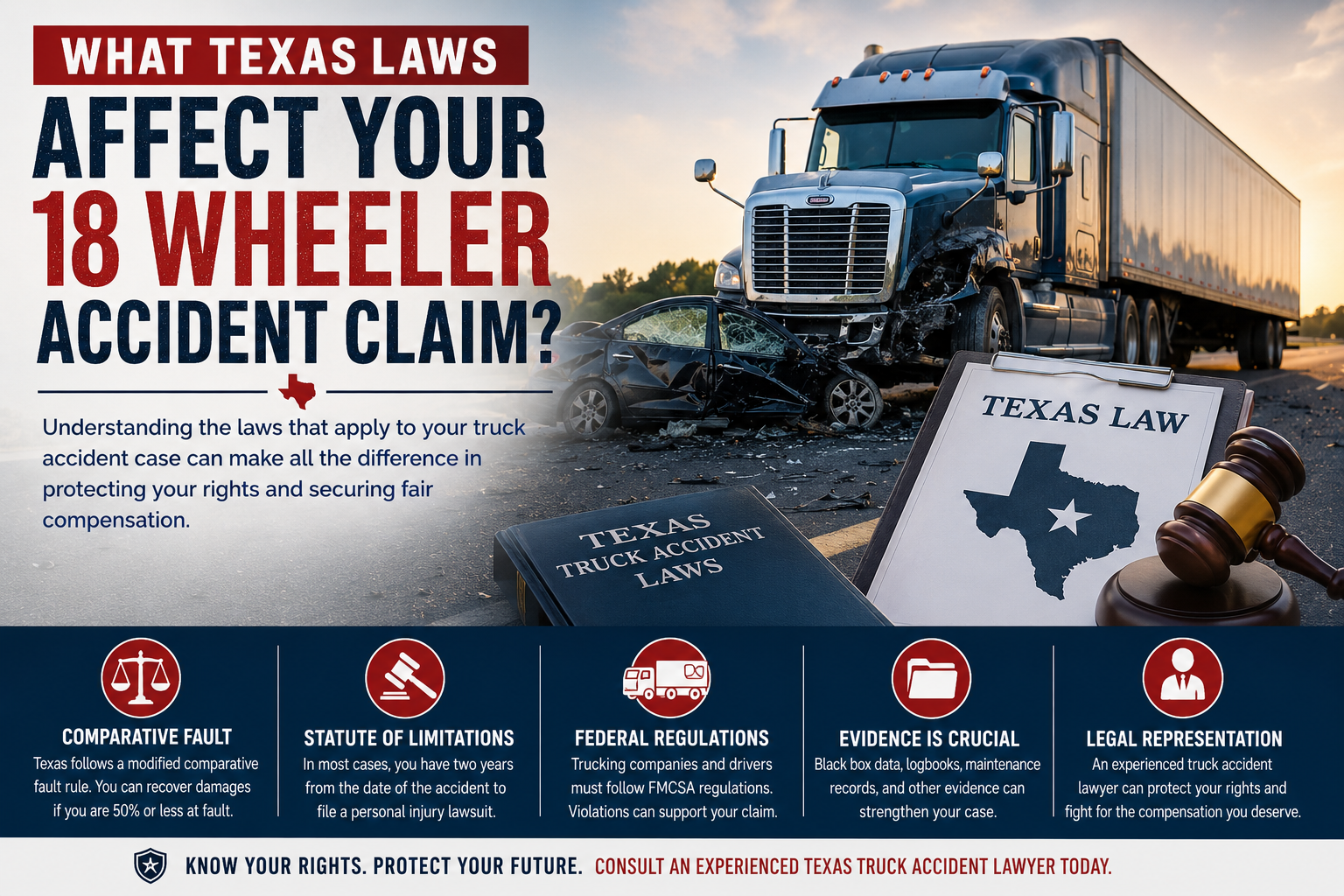
A collision involving an 18-wheeler can leave victims facing severe injuries, overwhelming medical bills, lost income, and uncertainty about the future. While every truck accident is different, one thing remains constant: Texas law plays a significant role in determining whether you can recover compensation and how much you may receive. Working with an experienced Texas truck accident lawyer can help you understand these legal requirements and protect your rights from the beginning of your claim.
Whether your accident involved a fatigued truck driver, improperly maintained commercial vehicle, or negligent trucking company, understanding the laws that apply to your case can make a meaningful difference.
Truck accident claims are more complex than typical car accident cases. In addition to Texas personal injury laws, commercial trucking companies and drivers must comply with federal safety regulations established by the Federal Motor Carrier Safety Administration (FMCSA).
Your claim may involve multiple liable parties, including:
The truck driver
The trucking company
A maintenance contractor
The cargo loading company
Truck or parts manufacturers
Identifying who violated state or federal laws is often a critical step toward recovering compensation.
One of the most important laws affecting truck accident claims is Texas's modified comparative fault rule.
Under Texas Civil Practice and Remedies Code, each party involved in an accident may be assigned a percentage of fault.
Here's how it works:
If you are 50% or less responsible, you may still recover compensation.
Your compensation will be reduced by your percentage of fault.
If you are more than 50% responsible, you cannot recover damages.
For example, if you are awarded $500,000 but found 20% responsible, your recovery would be reduced to $400,000.
Insurance companies often try to shift blame onto injured victims. An experienced attorney works to gather evidence that accurately establishes liability.
Texas law also limits how long you have to file a truck accident lawsuit.
Generally, injured victims have two years from the date of the accident to file a personal injury lawsuit.
Missing this deadline could prevent you from pursuing compensation altogether.
However, certain situations may affect the filing deadline, making it important to speak with a lawyer as soon as possible after the crash.
Commercial trucks are governed by strict federal regulations that do not apply to passenger vehicles.
These include rules regarding:
Driver Hours of Service (HOS)
Driver qualification standards
Drug and alcohol testing
Truck inspections
Vehicle maintenance
Cargo securement
Electronic Logging Devices (ELDs)
If a trucking company or driver violated these regulations, those violations may serve as evidence of negligence.
For example, if electronic logbooks show a driver exceeded legal driving hours before the crash, that evidence may significantly strengthen your claim.
Texas law allows evidence to disappear quickly if immediate action is not taken.
Important evidence may include:
Black box (Electronic Control Module) data
Driver logbooks
Dashcam footage
GPS records
Maintenance records
Inspection reports
Employment records
Cell phone records
Accident scene photographs
Police reports
A lawyer may send a spoliation letter requiring the trucking company to preserve critical evidence before it is lost or destroyed.
Many truck accident claims involve more than just the driver.
Texas law may hold trucking companies responsible for their employees' negligence under the legal principle of respondeat superior.
Additionally, companies may be independently liable if they:
Failed to properly train drivers
Negligently hired unsafe drivers
Ignored safety violations
Failed to maintain commercial vehicles
Encouraged violations of federal safety regulations
Holding every responsible party accountable often increases the available insurance coverage for injured victims.
Texas law allows truck accident victims to seek compensation for both economic and non-economic damages.
Depending on the circumstances, you may recover compensation for:
Medical expenses
Future medical treatment
Lost wages
Loss of future earning capacity
Property damage
Pain and suffering
Emotional distress
Physical impairment
Permanent disability
Disfigurement
In fatal truck accidents, surviving family members may also pursue wrongful death damages under Texas law.
Commercial trucking companies usually carry significantly higher insurance limits than passenger vehicles.
Unfortunately, insurance companies often begin investigating immediately after a serious crash.
Adjusters may:
Request recorded statements
Offer quick settlements
Minimize injuries
Dispute liability
Delay claim payments
Before accepting any settlement, it is wise to understand the full value of your damages and the legal options available.
Truck accident litigation involves extensive investigation, accident reconstruction, federal regulations, and negotiations with commercial insurance carriers.
A knowledgeable 18 wheeler accident lawyer Texas understands how to:
Investigate trucking company negligence
Obtain black box evidence
Review FMCSA compliance
Work with accident reconstruction experts
Calculate long-term damages
Negotiate aggressively with insurers
Prepare the case for trial when necessary
Having experienced legal guidance allows victims to focus on recovery while their legal team handles the complexities of the case.
Texas truck accident claims are governed by a combination of state laws and federal trucking regulations. Rules regarding comparative fault, filing deadlines, employer liability, and FMCSA compliance can all influence the outcome of your case. Because trucking companies and insurers often act quickly to protect their interests, injured victims benefit from understanding their legal rights as early as possible.
If you or a loved one has been injured in a commercial truck collision, speaking with an experienced legal professional can help you preserve evidence, identify liable parties, and pursue the compensation you deserve.
In most cases, Texas law allows two years from the date of the accident to file a personal injury lawsuit, although certain exceptions may apply.
Yes. Under Texas's modified comparative fault rule, you may recover damages if you are 50% or less responsible for the accident, though your compensation will be reduced by your percentage of fault.
Commercial trucking companies must comply with FMCSA regulations covering driver hours, maintenance, inspections, cargo securement, licensing, and safety standards.
Depending on the circumstances, liability may include the truck driver, trucking company, maintenance providers, cargo loaders, or manufacturers of defective truck components.
Black box data can provide valuable information about the truck's speed, braking, engine activity, and driver actions immediately before the collision, helping establish liability.